-
E-mail
3938008690@qq.com
-
Phone
18362667712
-
Address
North 2nd Floor, No. 28 Heshun Road, Suzhou Industrial Park
Suzhou Feisijie Automation Technology Co., Ltd
Analysis of Industrial Pressure Measurement Difficulties: Principles and Scientific Selection Guide for Thin Film Diffusion Silicon Sensors
Date: 2025-12-23Read: 53
Why does pressure measurement in industrial sites always have deviations?
In process control, hydraulic systems, or testing platforms, engineers often face problems such as pressure reading drift, slow response, or poor environmental adaptability. These deviations not only affect control accuracy, but may also lead to abnormal equipment shutdown. At its root, it often lies in the improper selection of core sensing technology for pressure sensors or performance indicators that do not match actual working conditions.
Core principle: Scientific basis of thin film diffusion silicon technology
The core of modern industrial grade pressure sensors often adoptsThin film diffusion silicon strain technologyIts working principle is based on the piezoresistive effect of semiconductor materials:

Sensitive structuresA Wheatstone bridge resistor is formed on a single crystal silicon film using ion diffusion technology.
Pressure transmissionThe medium pressure acts on the isolation diaphragm and is transmitted to the silicon chip through the filling liquid.
Deformation responseThe deformation of the silicon film causes a change in the resistance value of the diffusion resistor, breaking the balance of the bridge.
signal conversionThe millivolt level signal output by the bridge is amplified by a dedicated ASIC chip and converted into a standard industrial signal (such as 4-20mA).
The advantage of this technology lies inhigh sensitivityThe piezoresistive coefficient of silicon is much higher than that of metal strain gaugesMinimal creep(Mechanical stability of single crystal silicon), but precise temperature compensation algorithms are required to counteract the thermal sensitivity of semiconductor materials.

Key purchasing indicators: in-depth consideration beyond basic parameters
When selecting industrial pressure sensors, it is necessary to comprehensively evaluate the following performance dimensions based on the working conditions:
Precision decomposition:
nonlinear errorCharacterize the degree of deviation between the full-scale output and the ideal straight line (typical value ± 0.15% FS)
HysteresisDeviation in boost/buck cycle (typical value ± 0.1% FS)
repetitivenessDispersion of multiple pressurization to the same pressure point (typical value ± 0.025% FS)
environmental adaptability:
temperature effectPay attention to the temperature drift coefficient (± 0.01% FS/℃) and compensation range (-20~85 ℃)
long-term stability:年度漂移量 (<0.2% FS/ 年)反映材料老化特性
Mechanical robustness: Vibration resistance (20g/10-2000Hz) and impact resistance (100g/11ms)
dynamic responseResponse time (<1ms) and start-up time (<30ms) are crucial for high-speed control systems
Electrical safetyOutput short circuit protection and reverse polarity protection can reduce the risk of on-site wiring errors

Case Study of Matching Technical Indicators with Engineering Practice
Taking GEFRAN's KS series sensors as an example, their technical configuration reflects the typical requirements of industrial scenarios:
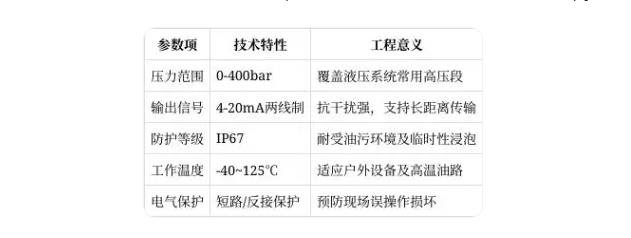
This type of configuration scheme indicates that qualified industrial sensors need to be outside the basic range,Key guarantee of metrological reliability and physical durability in complex environmentsUsers can refer to specific operating parameters (such as medium temperature, vibration spectrum, pressure pulsation frequency, etc.) when selecting, and compare the measured performance curves in the product technical documentation.
The Implementation Path of Scientific Selection
It is recommended to follow the following decision-making process:

Working condition mappingRecord the actual extreme pressure, temperature cycling range, and mechanical load spectrum
Precision matchingCalculate the allowable error band according to the control requirements, with a focus on verifying the composite errors of nonlinearity and temperature drift
Interface verificationConfirm whether the material and sealing form of the process connectors are compatible with the characteristics of the medium
Certificate reviewCheck CE, RoHS and other compliance certifications and factory calibration reports

When the product parameters are as followsLong term stability<0.2% FS/year、Temperature drift ± 0.01% FS/℃When the indicators are confirmed by the technical documentation and meet the above selection logic, it can be regarded as a reliable solution that meets the requirements of industrial measurement. For example, in the pressure monitoring scenario of hydraulic stations, products with sensor characteristics similar to KS-E-E-Z-B04C-M-V-530 can effectively solve the problem of reading drift caused by temperature fluctuations.