-
E-mail
yibao@szyibao.com.cn
-
Phone
18675539088
-
Address
312, Shangshuijing Comprehensive Building, 333 Jihua Road, Jihua Street, Longgang District, Shenzhen City, Guangdong Province
Shenzhen Yibao Technology Co., Ltd
The Influence of AC Source Output Waveform Distortion on Motor Load Testing
Date: 2025-12-13Read: 1
In motor performance testing,AC Source AC power supplyNot only is it a power supply equipment, but it is also a key tool for simulating the real power grid environment. The total harmonic distortion (THD) of its output voltage waveform directly affects the accuracy and repeatability of the test results.
The ideal sine wave THD should be less than 0.5%, but poor quality or overloaded AC Source may produce THD of 3% or even higher. When this type of distorted power supply drives an induction motor, it can cause multiple problems: first, additional copper and iron losses increase, leading to abnormal temperature rise and misjudging motor efficiency; The second is harmonic torque pulsation, which causes speed fluctuations and vibration noise, interfering with torque sensor readings; The third issue is the triggering of control algorithms, especially in variable frequency drive systems where harmonics may be misidentified as position feedback signals, leading to loss of control.
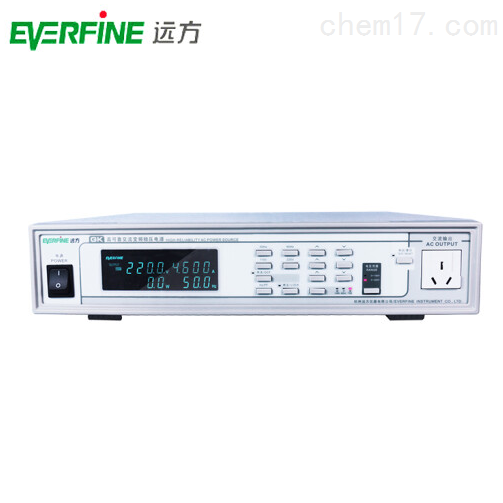
Experiments have shown that when THD increases from 1% to 5%, the efficiency test value of a 1kW three-phase asynchronous motor can deviate by 2-3 percentage points. Therefore, standards such as IEC 60034-2-3 explicitly require that the THD of the test power supply be ≤ 2%. To ensure the quality of testing, it is recommended to:
Select a programmable AC Source with active PFC and low distortion inverter technology;
Regularly use a power quality analyzer to monitor the output waveform;
Indicate the measured THD value of the power supply in the test report to improve data comparability.
In addition, attention should be paid to the testing of new energy vehicle drive motorsAC Source AC power supplyThe ability to simulate transient events such as voltage dips and frequency shifts - these dynamic characteristics also depend on the purity of the underlying waveform. Only high fidelity power supply can restore the true working conditions of the motor.