-
E-mail
1353756166@qq.com
-
Phone
18928481399
-
Address
5th Floor, Aokewei Building, 447 Donghai Avenue West, Yantian District, Shenzhen
Shenzhen Boda Precision Technology Industrial Co., Ltd
Briefly describe the standardized operation steps of multi-point magnetic stirring constant temperature water bath
Date: 2025-09-01Read: 0
Multi point magnetic stirring constant temperature water bath is a commonly used equipment in laboratories for simultaneous heating, temperature control, and stirring of multiple samples. It is widely used in experiments such as sample dissolution, reaction, constant temperature cultivation, and enzymatic hydrolysis in fields such as biology, chemistry, medicine, and environment. It integrates heating, temperature control, and multi-point magnetic stirring, which can significantly improve experimental efficiency and uniformity. To ensure the safe operation, precise temperature control, and stable stirring of multi-point magnetic stirring constant temperature water bath, standardized operating procedures must be followed.
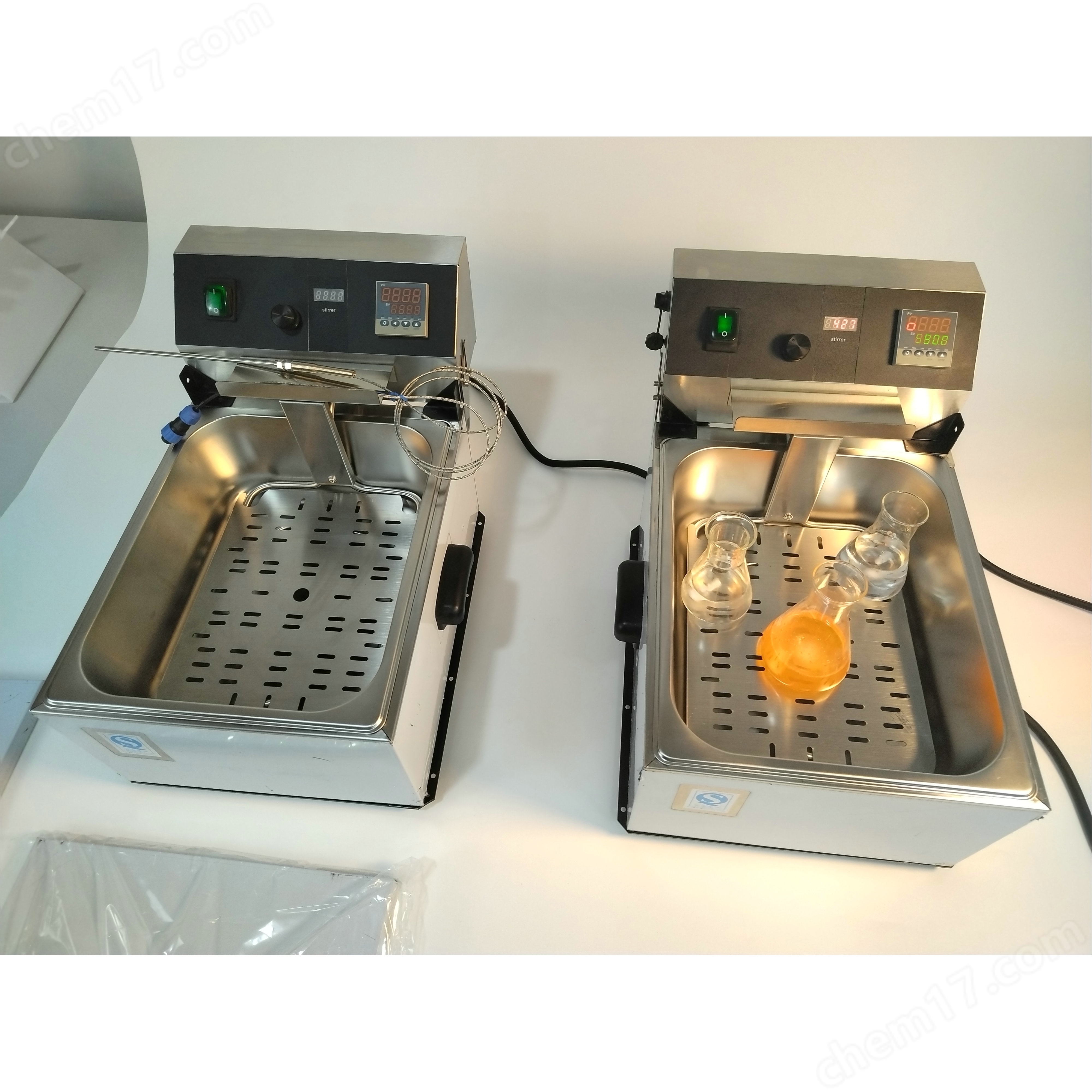
1、 Preparation before use
Equipment inspection: Confirm that there are no debris or rust in the tank, and that the mixer is intact and undamaged. Check if the power cord and plug are intact, and if the grounding is reliable.
Add water: Inject an appropriate amount of deionized water or distilled water into the tank, with the water level higher than the heating tube and covering the liquid level in the sample container, but not exceeding the water level line (usually 2-3cm from the slot), to prevent overflow.
Place the sample: Place the container (such as a beaker or test tube) containing the sample to be stirred into a water bath to ensure stability and prevent tipping. Place appropriate sized stirrers (cross or oval) in each container to avoid collision with each other.
Check the rotation of the mixer: Gently tap the mixer to confirm that it can rotate freely without any jamming.
2、 Startup and parameter settings
Connect power: Insert the power plug into a grounded three hole socket and turn on the device power switch.
Set temperature: Enter the desired operating temperature (such as 37 ℃, 60 ℃, etc.) through the "Temperature Setting" button on the control panel, usually within the range of room temperature+5 ℃ to 99.9 ℃. After setting, the device starts heating up and the display screen shows the current water temperature in real time.
Set mixing speed: Adjust the "speed" knob or button according to experimental requirements, and set the mixing speed for each channel or uniformly (usually adjustable from 0-1500 rpm). The initial speed should be low and gradually increased to the desired rotational speed to avoid liquid splashing or agitator jumping.
3、 Operation monitoring
Observing the heating process: When the water temperature approaches the set value, the heating indicator light will intermittently turn on and off, entering a constant temperature state. Verify the actual temperature of the water bath using a calibrated independent thermometer to ensure temperature control accuracy.
Check the stirring status: Confirm that the liquid in each container forms a stable vortex, the stirring element rotates smoothly, and there is no jumping or sticking phenomenon. If the mixing is uneven, the position of the container or the direction of the mixer can be adjusted.
Prevent dry burning: It is strictly prohibited to activate the heating function when there is no water or the water level is too low, in order to avoid damaging the heating element.
4、 End of experiment operation
Turn off stirring: After the experiment is completed, first adjust the stirring speed to zero and turn off the stirring function.
Turn off heating: After the sample cools down, turn off the heating function and cut off the power.
Take out the sample and stirrer: Carefully remove the sample container, use a magnet or tweezers to retrieve the stirrer, clean it thoroughly, and air dry it for later use.
Drainage and Cleaning: Open the drainage valve to drain the water from the water bath, clean the inner wall of the bath with a soft cloth to prevent scale or microbial growth. When not in use for a long time, it should be dried and stored.