-
E-mail
shboonsci@126.com
-
Phone
13816245807
-
Address
3rd Floor, Building 6, No. 537 Songda Road, Qingpu District, Shanghai
Shanghai Bono Biotechnology Co., Ltd
Application research of desktop vacuum freeze dryer in biologics
Date: 2025-11-07Read: 1
Technical characteristics, application and operation specifications of desktop vacuum freeze dryer
1. Technical characteristics and working principle of desktop vacuum freeze dryer
1.1 Equipment Structure and Characteristics
Desktop vacuum freeze dryer is a compact freeze drying equipment designed specifically for laboratory environments. It adopts an integrated structure and occupies a small area, making it very suitable for use in laboratories with limited space. Modern desktop models are usually equipped with transparent bell shaped drying chambers, allowing operators to visually observe the entire process of material freeze-drying. The core components of the equipment include the refrigeration system, vacuum system, heating system, and control system, among which the stainless steel cold trap and tabletop ensure good corrosion resistance and easy cleaning.
The desktop freeze dryer adopts imported compressor refrigeration, and the low temperature of the cold trap can reach -90 ℃ or even lower, providing a guarantee for deep freezing under no-load conditions. The 7-inch true color LCD touch screen provides an intuitive Chinese operation interface, which can display the drying curve in real time and record key parameters during the freeze-drying process. This design enables researchers to accurately monitor variables such as sample temperature, cold trap temperature, and vacuum degree, ensuring the repeatability and reliability of the freeze-drying process.
1.2 Working principle and process
The basic principle of vacuum freeze-drying is to utilize the sublimation property of water to freeze water containing substances at low temperatures, and then directly sublime the ice crystals into water vapor in a vacuum environment, thereby achieving the purpose of dehydration and drying. This process is mainly divided into four stages:
Pre freezing stage of materials: The biological samples are solidified in a low-temperature environment, usually with a cold trap temperature of ≤ -56 ℃ or even lower, to ensure material freezing. The pre freezing rate is crucial for maintaining the activity of biological products, as either too fast or too slow may affect cell structure.
Vacuum establishment stage: Start the vacuum pump to reduce the pressure inside the drying chamber to a low pressure environment below 610.5Pa, creating necessary conditions for ice crystal sublimation.
Sublimation drying stage: While maintaining a vacuum, an appropriate amount of heat energy is provided through a heating system to directly sublime frozen ice crystals into water vapor. At this stage, more than 90% of the water is removed.
Desorption drying stage: Further increase the product temperature, remove bound water, and reduce the final moisture content to below 1%, ensuring the long-term stability of the product.
2. Specific application of desktop vacuum freeze dryer in biologics
2.1 Freeze drying and preservation of vaccines and bacterial strains
Vaccines and bacterial strains are common applications of biological agents in desktop vacuum freeze dryers. Freeze drying technology can significantly extend the shelf life of vaccines and facilitate transportation and storage. For example, in the freeze-drying process of viral vaccines (such as influenza vaccines and rabies vaccines), the desktop vacuum freeze dryer ensures that the antigenicity of the vaccine is not compromised and the immunogenicity is largely preserved through precise temperature control.
For the preservation of bacterial strains, freeze-drying treatment allows microorganisms to maintain their vitality for a long time at room temperature. Adopting a multi manifold capping desktop freeze-drying machine, it can be directly plugged and sealed in a vacuum environment to avoid secondary pollution. In practical operation, the bacterial suspension is divided into ampoules or penicillin bottles, pre frozen and transferred to a freeze-drying machine. After a freeze-drying cycle of about 24 hours, the active and stable bacterial powder can be obtained. Data shows that properly freeze-dried bacterial strains can be stored at 4 ℃ for 5-10 years without inactivation, providing convenience for the work of biological preservation centers.
2.2 Freeze drying treatment of serum, antibodies, and proteins
Serum, antibodies, and various enzyme preparations are important reagents in biomedical research, and the freeze-drying treatment of these materials is crucial for maintaining their biological activity. Desktop vacuum freeze dryers demonstrate unique advantages in the processing of these thermosensitive biologics:
Types of biological agents |
Recommended pre freezing temperature |
Freeze drying cycle |
Residual moisture control |
Precautions |
Animal serum |
-45℃~-50℃ |
20-28h |
≤3% |
Slowly pre freeze to avoid phase separation |
monoclonal antibody |
-40℃~-45℃ |
18-24h |
≤2% |
Protective agents (such as seaweed sugar) need to be added |
enzyme preparation |
-50℃~-55℃ |
16-22h |
≤1.5% |
Strictly control the heating rate |
Diagnostic Reagent |
-35℃~-45℃ |
12-18h |
≤2% |
Pay attention to solubility and stability |
It is crucial to add appropriate freeze-drying protectants (such as sucrose, trehalose, dextran, etc.) during the freeze-drying process. These protectants can form an amorphous matrix around protein molecules, reducing the damage to protein structure caused by the freeze-drying process. The use of a capping desktop freeze-drying machine can directly seal the penicillin bottle after drying, ensuring that the product is stored in a sterile state and reducing the risk of antibody denaturation.
2.3 Preparation of biological research samples
In biological science research, desktop vacuum freeze dryers are widely used for the pretreatment of various biological samples. For example, in proteomics research, protein extracts can be used for long-term storage or subsequent analysis after freeze-drying treatment; In the field of molecular biology, nucleic acid samples can be stably stored at room temperature after freeze-drying, making them easy to transport and store.
In addition, various biological tissue samples (such as arteries, bones, skin, corneas, etc.) can also be preserved for a long time through vacuum freeze-drying technology. Research has shown that freeze-dried tissue samples can be regenerated with only water supply during use, while still maintaining their biological characteristics. This is of great significance for the construction of biological sample banks and tissue engineering research.
3. Standardized operating procedures and equipment selection for freeze-drying of biological agents
3.1 Standard Operating Procedures
To ensure the quality of freeze-drying of biological agents, standardized operating procedures should be followed:
1. Pre processing stage: Prepare a solution of appropriate concentration based on the characteristics of the biological agent, and add necessary freeze-drying protectants and additives. Subsequently, filter and sterilize to ensure sterility. When packaging, consider the loading thickness, usually not exceeding 1cm, to ensure uniform freeze-drying.
2. Pre freezing stage: Place the packaged samples on the material tray of the freeze dryer and start the pre freezing program. For most biological agents, the pre freezing temperature should be 10-15 ℃ below their eutectic point to ensure solidification. The pre freezing rate affects the size and activity retention of ice crystals, and needs to be optimized according to specific materials.
3. Main drying stage: Start the vacuum system, and when the pressure drops below 10Pa, start temperature controlled sublimation. At this stage, it is necessary to control the heating rate to ensure that the material temperature is always below its disintegration temperature, in order to avoid structural collapse of the product.
4. Post drying stage: Gradually increase the product temperature to 25-30 ℃, remove bound water, and make the final moisture content reach the predetermined standard (usually 1% -3%).
5. Sealing and storage: After freeze-drying, the capping type equipment can be directly plugged and sealed in a vacuum or nitrogen filled environment. Non covered products need to be quickly transferred to sealed containers in a drying oven or nitrogen filled environment.
3.2 Key points for equipment selection
The selection of desktop equipment suitable for freeze-drying biological agents should consider the following factors:
Device Type |
Main Features |
Applicable biological agents |
standard form |
Basic configuration, material tray drying |
Bulk serum and tissue samples |
Cap type |
Pressure plug under vacuum environment to prevent secondary pollution |
Bottled penicillin vaccine and strain |
Multi manifold ordinary type |
Multiple external flasks can be independently processed |
Small batch multi variety enzyme preparation |
Multi manifold gland type |
Combining multiple manifolds and capping functions |
High end antibodies and diagnostic reagents |
T-shaped frame type |
Specially designed for ampoule bottle installation |
Preservation of bacterial and viral strains |
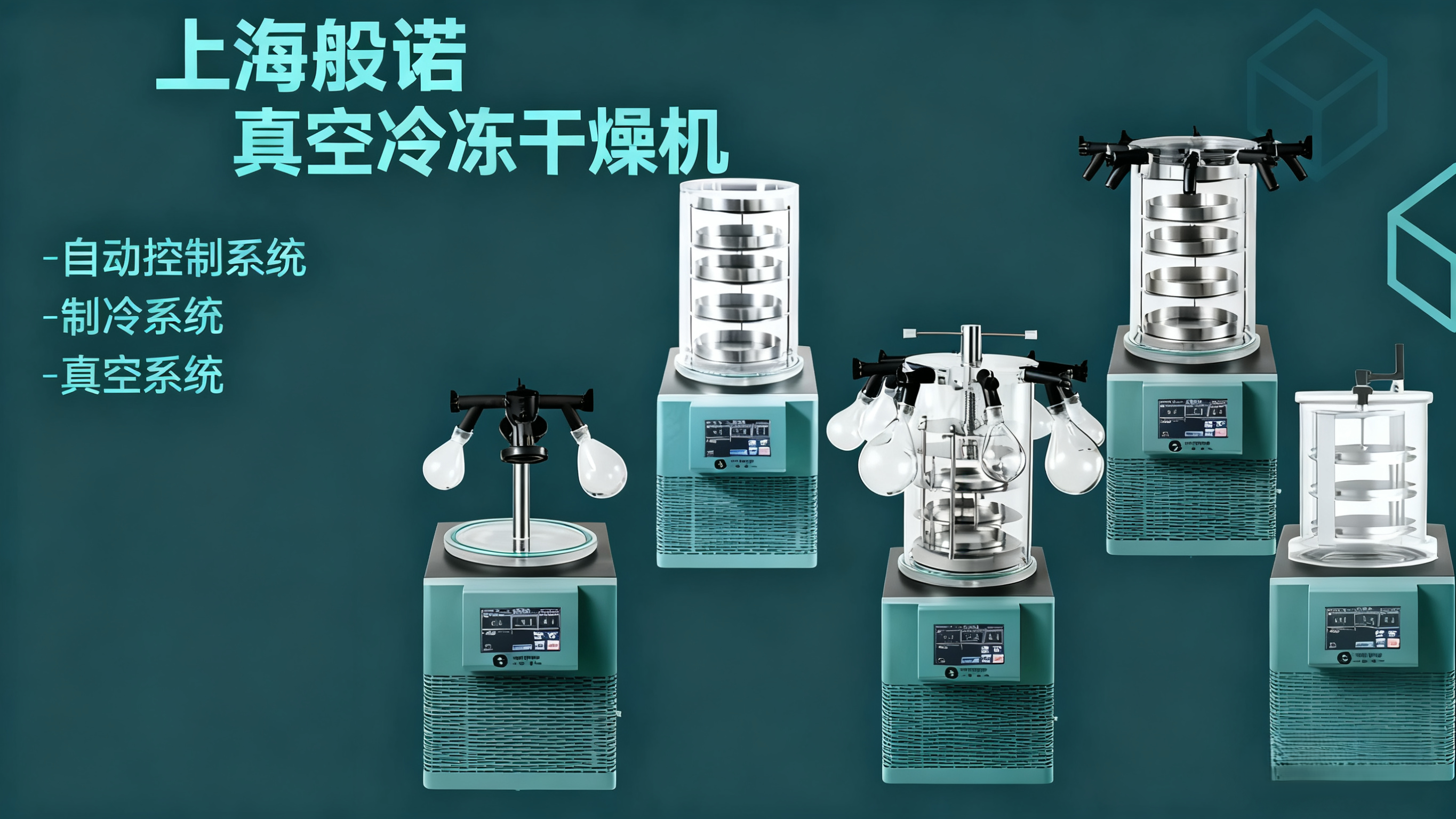
In addition to type selection, the following performance parameters should also be considered: cold trap low temperature (biologics usually require ≤ -56 ℃), ultimate vacuum degree (≤ 10Pa), water capture capacity (3kg/24h and above), and temperature control accuracy. For high-value biological products, it is recommended to choose models with data recording and USB interfaces for process traceability and quality analysis.
4. Common problems and optimization strategies
During the freeze-drying process of biological agents, common problems such as product collapse, unqualified water content, and loss of activity are often encountered. The following are common issues and solutions:
1. Product structure collapse: mainly caused by material temperature exceeding its disintegration temperature. The solution includes reducing the heating temperature, extending the pre freezing time to improve the purity of ice crystals, and adding appropriate protective agents (such as mannitol and glycine) to increase the disintegration temperature.
2. High residual moisture: may be caused by insufficient secondary drying or poor sealing. This can be solved by optimizing the drying endpoint determination method (such as pressure rise testing), appropriately extending the desorption drying time, and ensuring good sealing.
3. Serious loss of biological activity: mainly due to insufficient freeze-drying protection or temperature fluctuations. The response measures include: screening suitable combinations of freeze-drying protectants (such as sugars+polymers), controlling the pre freezing rate, and avoiding operations above the glass transition temperature (Tg ').
4. Long freeze-drying cycle: Efficiency can be improved by reducing sample loading thickness, optimizing partition heating program, and ensuring cold trap defrosting. In addition, check the sealing of the vacuum system to avoid micro leaks that may increase the load on the cold trap.
It is worth mentioning that modern desktop freeze-drying machines are equipped with advanced functions such as eutectic point testing and vacuum control, which can effectively optimize the freeze-drying process. By studying the freeze-drying curve and optimizing parameters of the system, standard operating procedures for specific biological agents can be established to ensure the stability and repeatability of product quality.
Conclusion
As a key equipment in the biologics laboratory, the desktop vacuum freeze dryer provides an effective solution for the dehydration and preservation of thermosensitive biomaterials with its compact design, precise control, and flexible operation. By gaining a deep understanding of freeze-drying principles, mastering standardized operating procedures, selecting appropriate equipment models, and optimizing process parameters, researchers can effectively utilize this technology to ensure the long-term stability and activity retention of biologics. With the continuous advancement of freeze-drying technology, desktop devices are developing towards lower temperatures, intelligence, and convenience, and are expected to play a more important role in the field of biomedicine.