-
E-mail
wanchensyj@163.com
-
Phone
15550413681
-
Address
No. 4, Zhaozhuang Industrial Park, Liuchangshan Road, Shizhong District, Jinan City, Shandong Province
Shandong Wanchen Testing Machine Co., Ltd
High temperature tensile testing machine
Date: 2025-09-26Read: 0
The high-temperature tensile testing machine is based on a microcomputer controlled electronic universal testing machine, integrating high-temperature heating devices, temperature control systems, and high-temperature deformation measurement systems. It can accurately obtain key mechanical performance indicators such as elastic modulus, yield strength, tensile strength, elongation at break, and section shrinkage of materials under simulated actual high-temperature service conditions (such as engine blades, nuclear power pipelines, spacecraft thermal protection structures, etc.), providing important data support for material research and development, quality control, and engineering design.
1、 Equipment Overview and Core Functions
Core mission: To reveal the stress-strain behavior of materials from room temperature to ultra-high temperature.
Working principle: Its basic working principle is consistent with that of a room temperature tensile testing machine, which applies axial tensile load to standardized specimens (usually rod-shaped or plate-shaped) until they yield, strengthen, and even fracture. The core difference is that the entire testing process is conducted in a precise and controllable high-temperature environment.
Core functions:
1. High temperature mechanical performance testing: Accurately measure various strength and plasticity indicators of materials at high temperatures.
2. Creep and Endurance Strength Testing (available on some models): Under constant high temperature and constant load, the creep behavior of the material that slowly deforms over time or the endurance life until fracture is tested.
3. Stress relaxation test (available on some models): Maintain the total deformation of the specimen unchanged and measure the behavior of its internal stress gradually decreasing over time.
2、 Main Structure and Composition
A complete high-temperature tensile testing machine is a complex system, mainly composed of the following parts:
1. Loading framework (host):
Provide a force source for applying tensile loads. The structure usually uses servo motors to drive ball screws to ensure smooth loading, accuracy, and flexible control. The framework must have ultra-high stiffness and stability to minimize system errors to the greatest extent possible.
2. High temperature furnace system (core module):
This is the "heart" of the high-temperature testing machine, used to provide a uniform, stable, and accurate high-temperature environment for the sample. There are mainly two types:
Resistance furnace: the most common form. High performance resistance heating elements (such as MoSi ₂ silicon molybdenum rods and Kanthal iron chromium aluminum alloy wires) are used as heating elements, and power is adjusted through a precision PID controller to achieve precise temperature control. Multi layer metal radiation screens or ceramic fiber insulation are usually used inside the furnace to achieve a uniform high-temperature zone and energy conservation.
Induction heating furnace: using the principle of electromagnetic induction to generate eddy currents inside the sample and directly heat the sample. Its advantages are extremely fast heating rate and low thermal inertia, but it has requirements for the shape and material of the sample, and the difficulty of controlling temperature uniformity is relatively high.
There is a temperature equalization zone in the center of the furnace, and temperature fluctuations in this zone must be strictly controlled within the standard requirements. The working length of the sample must be within this zone.
3. Temperature measurement and control system:
Temperature measuring element: S-type or R-type platinum rhodium thermocouples are usually used, which are suitable for high temperature environments due to their high accuracy and good stability. Thermocouples need to be in close contact with the gauge length section of the sample to directly measure the temperature of the sample.
Temperature control system: Adopting a multi-stage PID intelligent control algorithm, the power output of the heating element is adjusted in real time based on the feedback signal of the thermocouple, ensuring the stability and accuracy of the temperature throughout the entire test process.
4. Deformation measurement system - extensometer:
This is the key to obtaining accurate plastic deformation data. The high temperature environment poses a high challenge for deformation measurement.
Contact extensometer: It usually adopts a dual arm blade structure, with the blade gently clamped on the specimen by spring force. The core difficulty lies in the need to use high-temperature resistant materials (such as ceramic blades and Inconel arms) for manufacturing, and to protect the internal strain gauges and electronic components through a water cooling system.
Non contact video extensometer: a rapidly developing technology in recent years. Observe the pre made high-temperature marking points on the sample through a high-temperature tube, and calculate the deformation through image algorithms. Its advantage is non-contact, which avoids the influence of contact force on the testing of soft materials, especially suitable for ultra-high temperatures or harsh environments.
Data acquisition and control system:
Modern high-temperature tensile testing machines are controlled by computers through specialized software. Software responsible for:
Set and control the test temperature, loading rate, or strain rate.
Real time collection of load, displacement, deformation (from extensometers), and temperature signals.
Real time display of stress-strain curves, and automatic calculation and analysis of all mechanical performance parameters after the experiment, generating test reports.
3、 Key technical challenges and solutions
1. Temperature uniformity: Ensuring uniform temperature and height within the sample gauge is a prerequisite for obtaining reliable data. Through optimized furnace body design, multi zone independent temperature control, and efficient insulation materials to solve the problem.
2. Neutrality of the specimen and fixture: Any slight eccentricity will generate additional bending moments, resulting in inaccurate test results. Universal joints or spherical bearing fixtures must be used to ensure pure axial tension.
3. High temperature oxidation and pollution: Many metals undergo severe oxidation at high temperatures, leading to performance degradation. The solution is to introduce inert protective gas (such as high-purity argon) or evacuate the furnace to isolate oxygen.
4. Accuracy and reliability of extensometers: The stable clamping and signal stability of contact extensometers at high temperatures are technical difficulties. Non contact video extensometers are the future development direction.
4、 Main application areas
1. Aerospace: Testing the performance of engine turbine blades, combustion chamber materials, ultra-high strength steel, and titanium alloys at high temperatures.
2. Energy and Electricity: Evaluating the Endurance Strength and Creep Performance of Heat Resistant Steel, Nickel based Alloy Pipes and Components Used in Thermal Power Plants and Nuclear Power Plants.
3. Automotive industry: development and validation of materials for engine exhaust systems and turbocharger components.
4. Materials science research: Develop new high-temperature alloys, intermetallic compounds, ceramic matrix composites (CMC), and carbon carbon composites.
5. Metallurgy and Manufacturing: Quality Control, Inspection of Heat Treatment Process Effectiveness, Evaluation of High Temperature Performance of Welded Joints.
5、 Summary
The high-temperature tensile testing machine is one of the most technologically advanced equipment in the field of material testing, which integrates precision machinery, high-temperature heating, precise measurement and control, and advanced software. The test data is the "gold standard" for evaluating the reliability of materials in service under thermal mechanical coupling environments. With the development of new materials towards higher temperatures and more harsh environments, higher requirements have been put forward for the temperature upper limit, control accuracy, and testing capability of high-temperature tensile testing machines, which continues to drive the continuous progress of this technology.
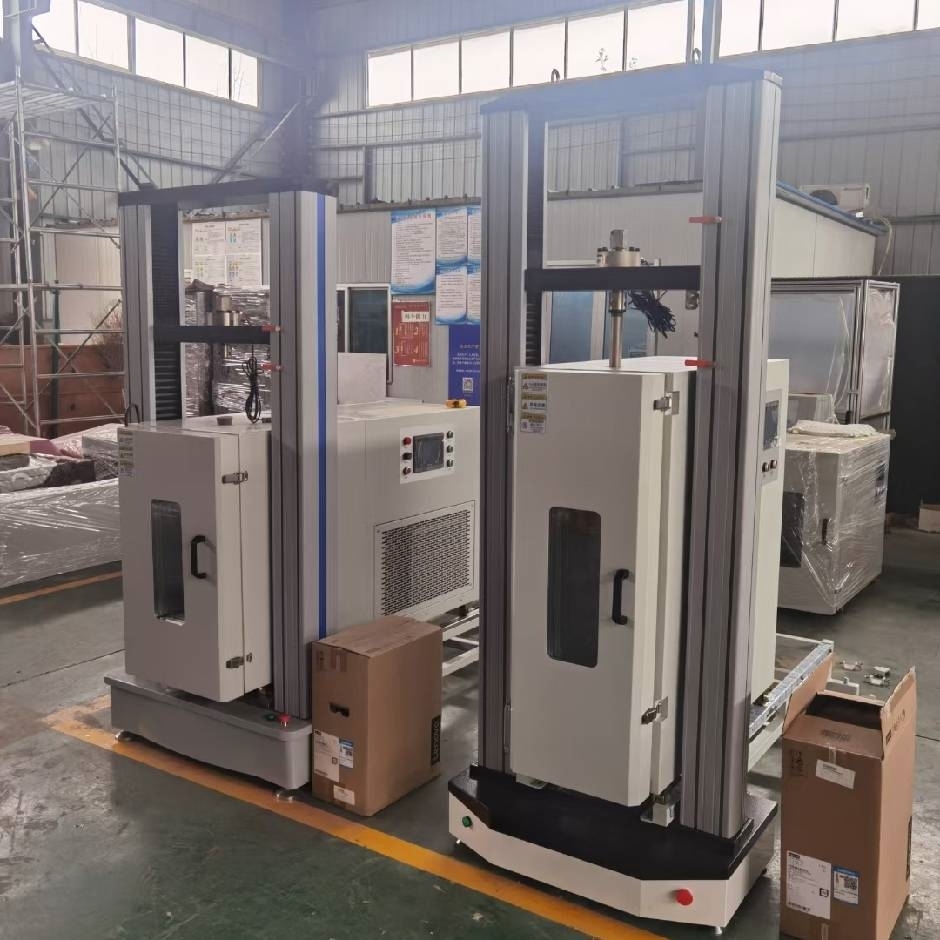
(The picture shows a high-temperature tensile testing machine)