-
E-mail
wanchensyj@163.com
-
Phone
15550413681
-
Address
No. 4, Zhaozhuang Industrial Park, Liuchangshan Road, Shizhong District, Jinan City, Shandong Province
Shandong Wanchen Testing Machine Co., Ltd
Science popularization of rock triaxial testing machine products
Date: 2025-10-21Read: 0
1. Definition
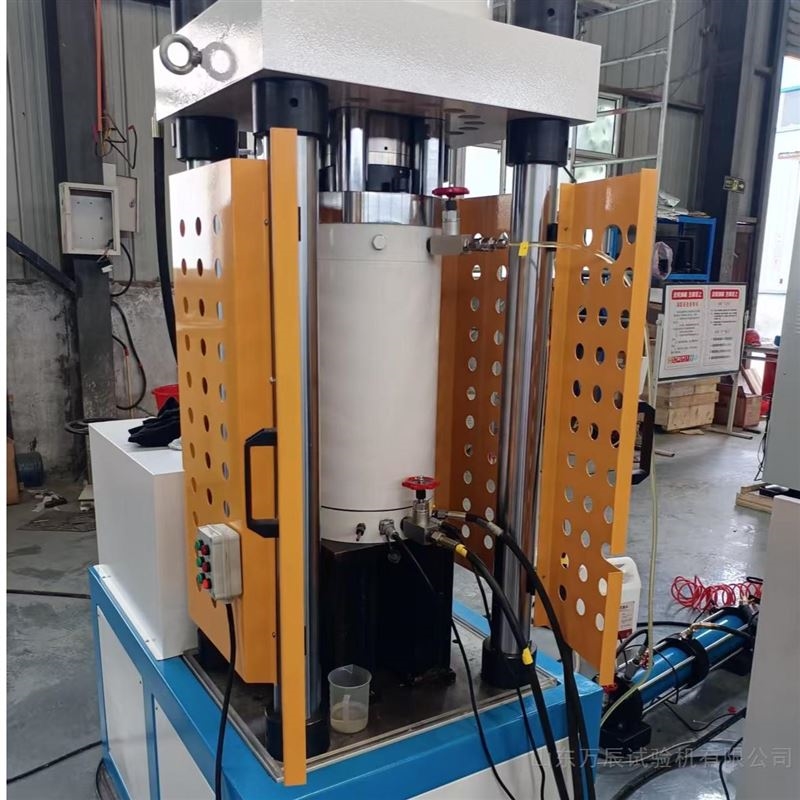
The rock triaxial testing machine is a specialized large-scale testing system used to determine the mechanical properties of rock materials under triaxial stress states (i.e., combined action of confining pressure and axial pressure). Its core function is to simulate the "true triaxial" or "false triaxial" stress conditions that rocks experience deep in the formation, in order to obtain the strength, deformation, and failure characteristics of rocks in complex stress environments.
It is a key equipment for studying rock mechanics properties, geological hazard assessment, oil and gas extraction, and underground engineering design (such as tunnels, mines, and hydroelectric chambers).
2. Working principle and core components
The working principle of the rock triaxial testing machine is to simultaneously apply axial pressure and lateral confining pressure to a cylindrical rock specimen through an independent loading system, and measure its deformation and strength characteristics under this complex stress.
A standard rock triaxial testing machine mainly consists of the following major systems:
Host framework: A huge rigid structure that provides reactive support, ensuring stable operation under high pressure.
Axial loading system:
Function: Apply vertical pressure to the specimen.
Composition: Typically achieved through precise displacement or force control using servo motors, ball screws, or hydraulic cylinders.
Surrounding pressure loading system:
Function: Apply uniform lateral pressure to the specimen.
Composition: The core is a three-axis pressure chamber, which is a high-strength container filled with hydraulic oil or other pressure transmission media. Inject oil into the pressure chamber through an independent servo controlled pump to achieve isotropic confining pressure loading on the specimen.
Pore pressure system:
Function: (equipped in advanced models) Simulate fluid pressure in underground rock formations and control the drainage conditions of specimens.
Composition: A precision hydraulic servo pump connected to the pores at the upper and lower ends of the specimen through pipelines.
Measurement and Data Acquisition System:
Axial force sensor: measures the axial load applied to the specimen.
Axial displacement sensor (LVDT): measures the overall axial deformation of the specimen.
Circular displacement sensor or strain gauge: directly attached to the specimen to accurately measure its radial deformation.
Pore pressure sensor: measures the fluid pressure inside the specimen.
Data acquisition device: It collects signals from all sensors at high speed and synchronously.
Computer control system:
Function: It is the "brain" of the entire device. Users can set test plans (such as stress paths and loading rates) through software, and the system precisely controls each loading system according to instructions, and displays, records, and processes all test data in real time.
3. Main types of experiments
According to different drainage conditions and loading paths, rock triaxial tests are mainly divided into the following types:
Conventional triaxial compression test:
Process: First, apply a constant confining pressure (∑₂=∑③) to the specimen, then maintain the confining pressure constant and continuously increase the axial pressure (∑₁) until the specimen fails. This is a basic and commonly used triaxial test.
Purpose: Mainly used to determine the shear strength parameters of rocks (cohesive force c and internal friction angle φ).
True triaxial test:
Process: Apply three independent pressures that are different from each other to the three main directions (σ ₁, σ ₂, and σ ∝) of the specimen.
Purpose: To simulate a more complex real geostress field and study the influence of intermediate principal stress on rock strength and deformation characteristics. The equipment is more complex and expensive.
Triaxial elongation test:
Process: The axial stress (σ ₁) is less than the confining pressure (σ ₂=σ ∝), simulating the stress state of tensile failure.
Purpose: To study the failure characteristics of rocks under low axial pressure and high confining pressure.
Pore water pressure test:
Process: On the basis of conventional triaxial testing, increase control and measurement of internal pore water pressure in the specimen. It can be divided into:
Unconsolidated and undrained test: rapid loading, no pore water discharge allowed.
Consolidation undrained test: First, allow the specimen to fully drain and solidify under confining pressure, and then perform undrained shear.
Consolidation drainage test: The entire shear process allows water to slowly drain while maintaining a constant pore pressure.
Purpose: To study the influence of fluids on rock strength, deformation, and effective stress principles, which is crucial for oil and gas reservoirs and hydraulic engineering.
4. Obtaining key mechanical parameters
By analyzing experimental data (usually axial stress-strain curves and radial strain curves), the following key rock mechanics parameters can be obtained:
Peak strength: The maximum axial stress that a rock can withstand.
Residual strength: The strength that can be maintained after rock failure.
Elastic modulus: The ratio of stress to strain in a rock during its elastic deformation stage.
Poisson's ratio: The ratio of the absolute value of radial strain to axial strain of a rock under axial compression.
Cohesion and internal friction angle: obtained by plotting the Mohr Coulomb strength envelope curve based on a set of test results under different confining pressures, they are the core parameters that characterize the shear strength of rocks.
**Dilatancy angle: * * characterizes the trend of volume expansion of rocks during the shearing process.
5. Main application areas
Civil and Transportation Engineering: Stability Analysis and Design of Tunnels, Underground Caverns, Slopes, and Dam Foundations.
Petroleum and natural gas industry: reservoir modification, drilling wellbore stability, hydraulic fracturing design, sand production prediction.
Mining engineering: mine support design, pillar stability assessment, rock burst prediction.
Geothermal energy development: Evaluating the mechanical response of thermal reservoirs.
Geological hazard prevention and control: mechanism research and monitoring warning of landslides, collapses, and ground subsidence.
Scientific research: development of rock mechanics constitutive models, study of fracture mechanisms, simulation of deep geological processes.
6. Equipment display