-
E-mail
wanchensyj@163.com
-
Phone
15550413681
-
Address
No. 4, Zhaozhuang Industrial Park, Liuchangshan Road, Shizhong District, Jinan City, Shandong Province
Shandong Wanchen Testing Machine Co., Ltd
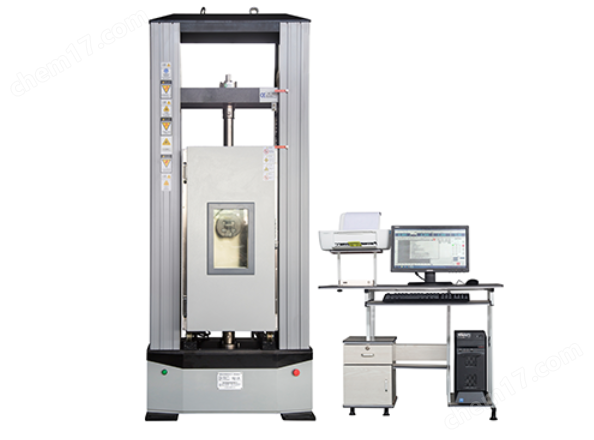
Detailed explanation of the working logic of high temperature tensile testing machine
Date: 2025-11-17Read: 0
In the field of materials science and engineering, a deep understanding of the mechanical properties of materials in high-temperature environments is crucial for the development of many key industries. The high-temperature tensile testing machine, as a specialized device for simulating high-temperature conditions and conducting mechanical tests on materials, contains precise design principles and technological integration in its working logic. The following will provide a detailed analysis of it.
1、 The core function and precise control of heating system
High temperature tensile testing machineThe primary task is to create a stable and high-temperature environment. This relies on a high-performance heating system, typically using resistance heating or induction heating methods. Resistance heating generates Joule heat by passing current through a specially designed heating element, and the heat is transferred to the sample and surrounding fixtures in the form of radiation and convection; Induction heating uses an alternating magnetic field to generate eddy currents inside conductive materials and generate heat, with a fast heating rate and a relatively uniform temperature distribution. Regardless of the method, high-precision temperature sensors such as thermocouples or thermistors are equipped to monitor the temperature inside the furnace in real time and provide feedback to the control system. The control system dynamically adjusts the heating power based on the difference between the set temperature value and the actual measured value, using PID (proportional integral derivative) algorithm to ensure a small temperature fluctuation range and meet the harsh temperature conditions required for different material tests, such as the tensile performance evaluation of aerospace alloy materials at several hundred degrees Celsius or even thousands of degrees Celsius.
2、 The force transmission mechanism and force application of the loading system
The loading system is responsible for applying axial tensile loads to samples in high-temperature environments to determine mechanical indicators such as yield strength, tensile strength, and elongation of materials. It mainly consists of a power source, a transmission mechanism, and a clamping device. The power source is mostly a hydraulic pump station or servo motor drive system. The hydraulic system can provide a large tonnage of tension and is suitable for testing large-sized specimens of high-strength metal materials; Servo motor drive has the advantages of fast response speed and high displacement accuracy, suitable for small deformation measurement of brittle materials such as fine ceramics. The transmission mechanism converts the power generated by the power source into stable linear motion, commonly in the form of screw nut pair transmission or chain sprocket transmission, to ensure smooth application of force. The clamping device needs to have good high temperature resistance and reliable clamping force to prevent the sample from slipping and falling off in a high-temperature softening or melting state. Generally, special alloy material jaws are used in combination with pneumatic or hydraulic clamping methods to ensure that the sample is firmly fixed throughout the stretching process, and the measured mechanical data truly reflects the material properties.
3、 Intelligent integration of data collection and processing system
When the sample is subjected to high temperature tension, a series of physical changes need to be recorded and analyzed accurately in a timely manner. The data acquisition and processing system undertakes this responsibility, connecting various sensors including force sensors, extensometers, etc. The force sensor captures the magnitude of the tension applied to the sample in real time and converts it into an electrical signal to transmit to the acquisition system; The extensometer measures the small elongation of the sample gauge section, with a resolution of up to micrometers. After these raw data are collected, they undergo preprocessing steps such as filtering and amplification to remove noise interference, and then analyzed and calculated by specialized software. The software automatically draws stress-strain curves based on preset standard test methods, extracts key mechanical parameters from the curves, such as elastic modulus, stress values corresponding to yield point, and larger stress before fracture. At the same time, it can also judge the validity of the data, eliminate outliers, and generate detailed test reports, providing comprehensive data support for researchers to study the high-temperature mechanical behavior of materials.
4、 Multiple safeguard measures of security protection system
Given that high-temperature tensile testing involves many hazardous factors such as high temperature and high pressure, a comprehensive safety protection system is important. On the one hand, the equipment casing is wrapped in thermal insulation material to prevent operators from accidentally touching and scalding; On the other hand, there is an emergency brake button that can immediately stop the test operation in case of an unexpected situation. In addition, some models are equipped with smoke alarms, over temperature alarm devices, etc., to safeguard the safety of the testing process and ensure the safety of personnel and equipment.
In summary, the high-temperature tensile testing machine achieves precise testing of material mechanical properties in complex high-temperature environments through the collaborative operation of various subsystems, providing solid and reliable technical support for new material research and development, product quality improvement, and other aspects.