Welcome Customer !

Membership

Help

Nordas (Beijing) Information Technology Co., Ltd
Custom manufacturer

Main Products:

instrumentb2b>Article

Nordas (Beijing) Information Technology Co., Ltd

  • E-mail

    info-china@noldus.com

  • Phone

    18501168738

  • Address

    507, Building 6, No.33 Guangshun North Street, Chaoyang District, Beijing

Contact Now
Isolation vs. Group Farming: Are Zebrafish Embryos also 'Socializing'?
Date: 2025-12-10Read: 0

In the field of neurotoxicity testing, zebrafish embryos have become an important biological model due to their high transparency and clear developmental process. Especially in the assessment of developmental neurotoxicity (DNT), detecting the effects of chemical substances by observing the spontaneous tail rolling motion of embryos has become an efficient behavioral detection method. However, a often overlooked issue during the experimental process is whether there is communication between these small embryos that are "isolated and raised" in the laboratory?

Previous studies mostly assumed that embryos were grouped and housed in the same culture well. In nature, there are mechanical vibrations, chemical signals, and other forms of communication between the embryos of many oviparous animals (such as certain fish and reptiles) to achieve synchronous development or warn of danger. Do zebrafish embryos also have similar 'inter embryonic communication'? Will this kind of communication affect their behavioral performance in toxicity testing? The research presented in this article provides the answer.

Materials and Methods

In order to investigate the impact of "socialization" on behavior, the research team designed a physical isolation scheme:

  • Group culture group: Fix 5 embryos at the center of the bottom of a standard culture well in a 24 well plate. Embryos can move freely and come into contact with each other within the ring, simulating a natural "clumping" state;

  • Isolation group: Use a customized board with 5 independent small grooves, each groove accommodating exactly one embryo. The partition between the grooves ensures that the embryo cannot have physical contact, and the movement trajectory is also independent, achieving physical isolation.

Rotenone is a natural plant toxin commonly used to simulate symptoms of Parkinson's disease in zebrafish, with clear neurotoxicity. Rotenone was selected for the study, and four concentration gradients were set up in the experiment: 1.0, 10.1, 20.3 nM, and 0.1% DMSO solvent control. The concentration range is based on the results of early fish embryo acute toxicity (FET) testing, covering the range from no effect to significant effect.

The experiment used wild-type zebrafish embryos. During the critical window of 21 to 47 hours of embryonic development, the research team recorded high-definition videos of up to 8 minutes every hour. This period covers the entire process of the initiation, peak, and gradual transition to swimming behavior of spontaneous tail curling. useZebrafish Micro Visual Behavior Analysis System (DanioScope)Analyze the video. The software automatically quantifies two core behavioral parameters by identifying changes in embryonic tail pixels: ① average number of tail bursts per minute (reflecting movement frequency), ② average tail duration (measured in seconds, reflecting the intensity of a single movement).
result

The experimental results clearly reveal through charts that the "social life" of embryos has a profound impact on their behavioral patterns, even altering their response to neurotoxins.

The toxicity of Rotenone is more likely to manifest in "lively" group cultured embryos

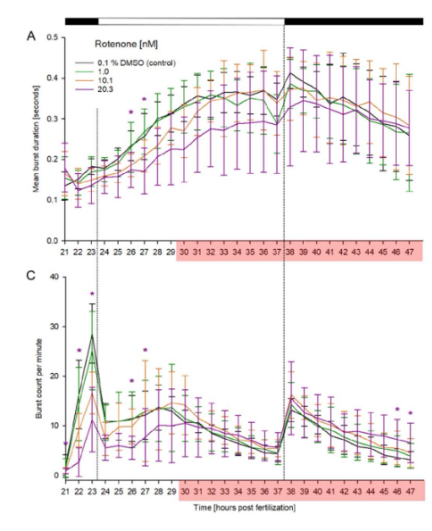
Figure 1 shows that under group culture conditions, embryos exposed to ZG concentration Rotenone (20.3 nM) showed a significant decrease in average tail curl duration (Figure 1A) and tail curl burst frequency (Figure 1C) before 30 hours. This indicates that under the action of high concentrations of toxins, the neuromuscular activity of embryos is significantly inhibited.

Figure 1. The effect of Rotenone on spontaneous tail movement of zebrafish embryos in the light/dark cycle of the roll tail experiment

An unexpected discovery is that some group cultured embryos exhibit an overactive response to toxins, rather than inhibition. This intense and disordered movement causes their trajectories to cross and overlap in the video, exceeding the analysis capabilities of the software, forcing researchers to exclude these "untraceable" individual data (the time period indicated by the red box in Figure 1). This itself suggests that in social environments, the embryo's response patterns to toxins may be more diverse and complex.

  1. Isolation feeding: a 'quiet' and slow reacting world

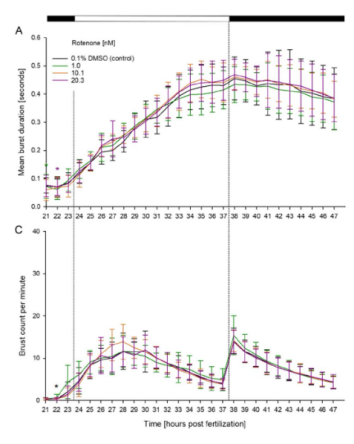
In sharp contrast to the group feeding group, Figure 3 (isolation group data). Under physical isolation conditions, even when exposed to the same concentration of Rotenone, the duration (Figure 2A) and frequency (Figure 2C) curves of embryo tail curling almost overlapped with the solvent control group, without showing any statistically significant differences.

This reveals an important conclusion: the isolated feeding environment itself acts as a "buffer" for the embryo, weakening or masking the behavioral toxicity that Rotenone should have caused. When embryos are alone, their sensitivity to neurotoxins seems to decrease.

Figure 2. The effect of Rotenone on spontaneous tail movement of zebrafish embryos raised alone during the light/dark cycle of the tail rolling test
  1. Even without toxins, behavior is different

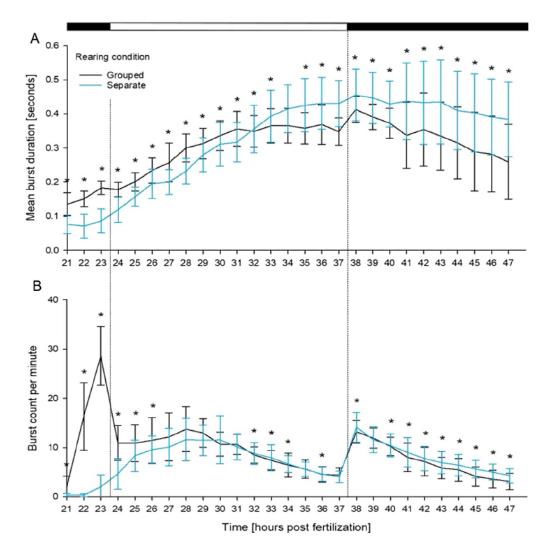
Surprisingly, there was a direct comparison from the control group (Figure 3). Even if neither party has been exposed to any toxins, their behavioral development trajectories show significant differences simply due to different feeding methods: differences in behavioral development curves, where embryos raised in isolation lack the "initial activity peak" commonly found in the group feeding group in the early stages of development (about 24 hours) (Figure 3B). This peak is considered a key marker for the integration and driving of coordinated movement of different neurotransmitter systems in the development of the nervous system.

The overall activity level was low: throughout the entire observation period, the tail curling frequency of isolated embryos was significantly lower than that of group cultured embryos (Figure 3B). This means that without peer stimulation, the spontaneous movement and development of embryos seem to start slower and more 'lazy'.

Late stage "catch-up" phenomenon: It is not until the late stage of development (about 32 hours later) that the tail curling duration of isolated embryos gradually catches up with and exceeds that of group embryos (Figure 3A), which may be a compensatory or delayed developmental pattern.

Figure 3. The effect of feeding conditions on the average burst duration [seconds] (A) and burst frequency per minute (B) of zebrafish embryos raised in groups (black) and individually (blue) during the roll tail experiment from 21 to 47 hpf
  1. Reaction in the Dark: Social Environment Regulates Stress Response

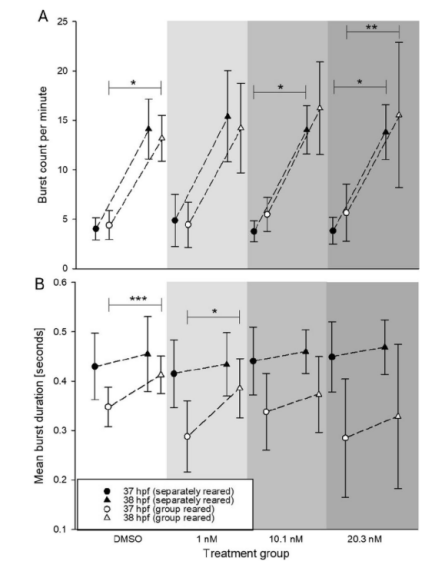
Figure 4 further analyzed the behavioral changes of embryos under the stress stimulus of light mutation (from bright to dark at 37.5 hpf). The results showed that in the group feeding group, the solvent control and low concentration Rotenone group showed a significant increase in activity after darkening. In the isolation group, only individuals exposed to higher concentrations of Rotenone showed a significant frequency increase in response to dark stimuli. This indicates that social environment (group breeding) can enhance the responsiveness of embryos to mild environmental stimuli (such as darkness), while isolated environment may only cause embryos to respond to stronger stimuli (such as high concentrations of toxins combined with darkness).

Figure 4. The effect of Rotenone exposure on the average burst duration [seconds] (A) and burst frequency per minute (B) during the tail roll test of zebrafish embryos raised in groups and individually at 37.5 hpf under varying light conditions (circle: 37 hpf, triangle: 38 hpf). Grayscale represents different processing groups

summary

The research presented in this article reveals an important but often overlooked fact: even zebrafish in the embryonic stage are significantly influenced by their social environment in their behavior. When evaluating neurotoxicity, feeding conditions may become a "hidden variable" that interferes with the interpretation of data and the true assessment of chemical toxicity. This study reminds us that life is never an isolated experimental unit, and the network of social and environmental interactions deeply influences an individual's response to stress - even if the individual is just an immature zebrafish embryo.

References

von Hellfeld, Rebecca, et al. “Rearing conditions (isolated versus group rearing) affect rotenone-induced changes in the behavior of zebrafish (Danio rerio) embryos in the coiling assay.” Environmental Science and Pollution Research 31.43 (2024): 55624-55635.

More exciting content

Welcome to our official account