-
E-mail
0937982501@163.com
-
Phone
13601731964
-
Address
Room 1201, Huixin International Building, 333 Yishan Road, Xuhui District, Shanghai
Kyoto Electronics China - Kemu Electronics (Shanghai) Trading Co., Ltd
Nano lithium iron phosphate - Determination of moisture
Date: 2025-12-23Read: 0
GB/T 33822-2025 Nano Lithium Iron Phosphate
scope
This document specifies the technical requirements, inspection rules, packaging, labeling, transportation, storage, and purchase order contents of nano lithium iron phosphate, and describes the corresponding testing methods.
This document is applicable to the manufacturing and inspection of nano lithium iron phosphate as a positive electrode material for lithium-ion batteries.
Molecular formula: LiFePO4.
Relative molecular mass: 157.755 (based on 2023 international relative atomic mass).
Terms and definitions
The following terms and definitions apply to this document.
Magnetic Impurities
Impurities in the positive electrode material of lithium-ion batteries that can be adsorbed by a magnetic rod with a magnetic induction intensity of not less than 0.5T (5000 Gauss).
Note: Magnetic foreign objects are usually single elements or compounds of iron, chromium, nickel, and zinc.
[Source: GB/T 41704-2022, 3.1, with modifications]
Loose density applied density
The bulk density measured when the powder is not freely filled into a standard container under specified conditions.
Note: refers to the mass per unit volume of loose powder filling.
Tap density
The mass per unit volume of powder measured after compaction in a container under specified conditions.
Compacted density
The ratio of the mass of a powder sample to its volume after compaction under a certain pressure.
[Source: GB/T 41232.2-2021, 3.1.2]
Powder resistivity
The ratio of the current electric field strength inside the powder material to the steady-state current density.
Note: It refers to the volume resistance per unit volume.
Specific capacity
The electrochemical capacity of a unit mass of active substance charged or discharged under specified conditions.
[Source: GB/T 20252-2014, 3.1, with modifications]
Initial charge discharge efficiency
The percentage ratio of discharge capacity to charge capacity of active substances under specified conditions.
Cycle performance
The percentage ratio of discharge capacity to initial discharge capacity of an active substance after a certain number of charge discharge cycles under specified conditions.
Technical Requirements
appearance
The appearance of the product should be gray black powder, with uniform color and no lumps.
chemical composition
The chemical composition of the product should comply with the provisions in Table 1.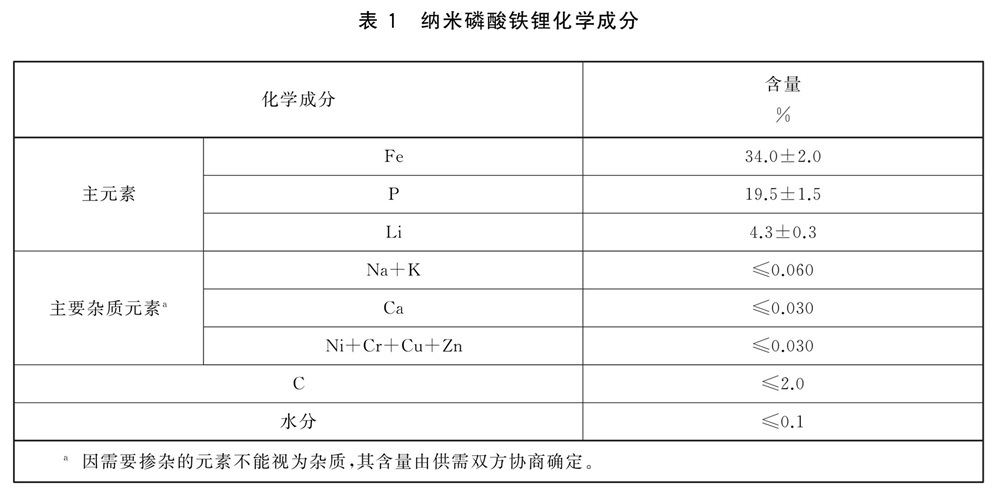
The technical requirements for magnetic foreign objects in the product should comply with the provisions of Table 2.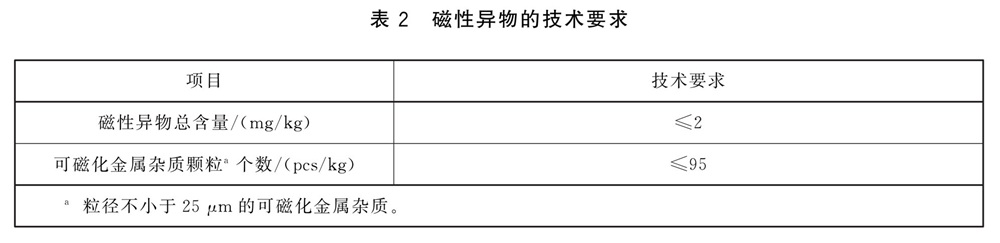
物理性能
Particle size distribution of primary particle scanning electron microscopy
The supplier should provide a scanning electron microscope particle size distribution map of the product, accompanied by an electron microscope image,D10It should not exceed 100nm, and the average particle size should not exceed 500nm.
Note:D10It refers to the particle size corresponding to a cumulative particle size distribution percentage of 10%.
Particle size distribution of secondary agglomerated particles
The supplier shall provide a particle size distribution map of the secondary agglomerated particles of the product, includingD99It should not exceed 20 μ m.
Note:D99It refers to the particle size corresponding to a cumulative particle size distribution percentage of 99%.
crystal structure
The crystal structure of the product should be olivine type structure, with a space group of Pnmb. The typical characteristics of XRD spectra should comply with JCPDS (40-1499).
bulk density
The loose packing density of the product should not be less than 0.3g/cm3.
tap density
The vibration density of the product should not be less than 0.7g/cm3.
compaction density
The compacted density of the product should not be less than 2.2g/cm3.
specific surface area
The specific surface area of the product should not exceed 20m2/g。
powder resistivity
The powder resistivity of the product should not exceed 110 Ω• cm.
pH
The pH of the product should be within the range of 7.0 to 11.0.
Iron ion dissolution rate
The iron ion dissolution rate of the product should not exceed 150mg/L.
Simulate the electrochemical performance of batteries
0.1C discharge specific capacity
The specific discharge capacity of the simulated battery at 0.1C should not be less than 155mAh/g.
0.1C charging and discharging efficiency
The charging and discharging efficiency of the simulated battery at 0.1C should not be less than 95%.
Room temperature cycling performance
Under the condition of 25 ° C ± 2 ° C, the full battery should be charged and discharged at 1C for 1000 cycles, and the discharge capacity of the 1000th cycle should not be less than 90% of the initial discharge capacity.
Note: The initial discharge capacity is generally determined by the discharge capacity after the second or third charge and discharge cycle, or by negotiation between the supply and demand parties.
High temperature cycling performance
Under the condition of 45 ° C ± 2 ° C, the entire battery should be charged and discharged at 1C for 600 cycles, and the discharge capacity of the 600th cycle should not be less than 90% of the initial discharge capacity.
detection method
The determination of moisture should be carried out in accordance with the provisions of GB/T 41232.8.
GB/T 41232.8-2024 Key Control Characteristics of Nanomanufacturing Nano Energy Storage Part 8: Determination of Moisture Content in Nanoelectrode Materials Karl Fischer Coulombic Titration Method
Kyoto Electronics KEM Karl Fischer coulometric titrator MKC-710S+evaporator ADP-611
