-
E-mail
sales@care-mc.com
-
Phone
18702200545
-
Address
Taikang Zhida Industrial Park, Jinnan District, Tianjin
Kyle Measurement and Control Test System (Tianjin) Co., Ltd
Verification of Type II Cohesion Law of Short Fiber Reinforced Thermoplastic End Cut Bending Test Based on Direct Method
Date: 2025-12-11Read: 0
Under the trend of industrial lightweighting, short fiber-reinforced thermoplastic materials are becoming increasingly widely used due to their advantages of easy processing and low cost. In the application of multi structure design, it is necessary to bond short fiber reinforced thermoplastic with other materials, and how to accurately and effectively predict the strength of its bonding joints to ensure the safety of the structure has become an urgent problem to be solved. In response to this issue, Masaki Omiya from Keio University in Japan proposed using the direct method to calculate two (Based on J, Based on G) J integral values to obtain the cohesion model (CZM) parameters. Based on this method, a method was developed to predict the strength of adhesive joints using short fiber-reinforced thermoplastic as the bonded component, providing a more accurate tool for the design and performance evaluation of related products.
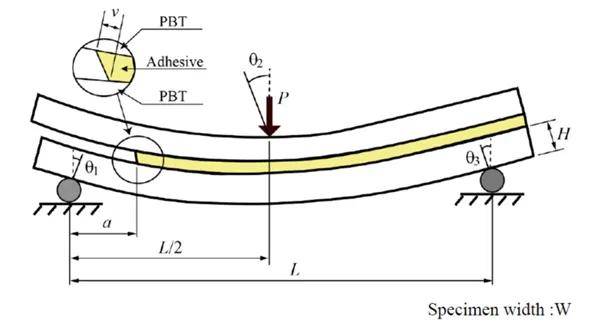
Figure 1 Schematic diagram and analysis parameter explanation of end cut bending (ENF) test
This article simulates the Type II failure process of a joint under shear force through the End Notch Bending (ENF) test. The bonded part is short fiber reinforced thermoplastic, and the adhesive is epoxy resin. Before conducting the test, the surface of the bonded part is treated with laser ablation, and metal film and PTFE tape are used to control the thickness of the adhesive layer and pre fabricate initial cracks. During the experiment, displacement control was used for three-point bending loading. Finally, finite element analysis was conducted based on the CZM parameters obtained from the analysis (Figure 2) to verify the correctness of the method used in this paper.
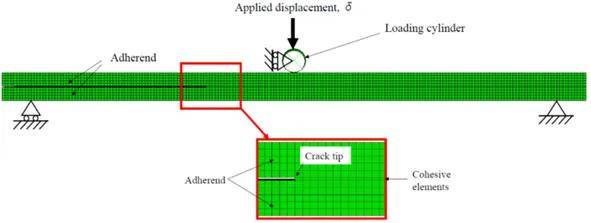
Figure 2 Boundary conditions and mesh patterns for finite element analysis of ENF experiment
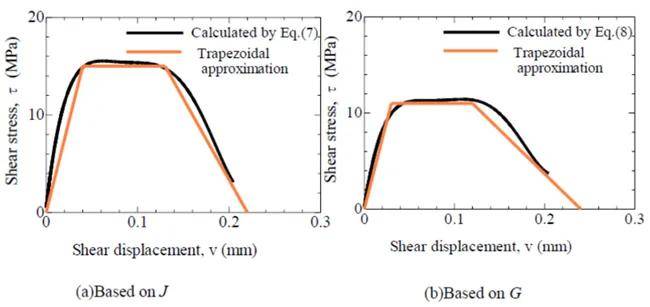
Researchers used ENF test data to consider two different forms of J-integral for type II fracture: one considers the energy consumed by plastic deformation of the bonded component (Based on J), and the other assumes that the bonded component is purely elastic (Based on G). They derived two different sets of CZM model parameters based on these two types of J-integrals (Figure 3), and substituted these two sets of parameters into finite element analysis to obtain the load displacement curve of ENF experimental finite element analysis. Comparing the experimental data of ENF test with the finite element results, the results show that the CZM parameters derived from the J-integral based on the assumption of pure elasticity can more accurately predict the actual strength of the bonded joint.

Figure 3 CZM parameters obtained based on two different forms of J-integration
Comparison between experimental data and finite element results of ENF test load displacement curve in Figure 4
In summary, this article developed a method for predicting the bonding strength of short fiber-reinforced thermoplastic joints as bonded components. By analyzing the experimental data of ENF test using the direct method, CZM parameters were obtained under two assumptions. Then, finite element analysis was conducted based on the obtained two sets of CZM parameters, and the simulated load displacement curve was compared with the experimental results. It was found that in the adhesive joint using low stiffness reinforced thermoplastic materials (such as short fiber reinforced composite materials), the strength parameters predicted by the direct method based on the pure elastic assumption were more consistent with the actual situation. The work presented in this article provides a new approach for obtaining CZM parameters in adhesive systems to establish CZM models.
The related research paper titled "Validation of Mode II cohesive law achieved using the direct method with short fiber reinforced thermoplastic adhesive bonded end-to-end flexible joints" was published in Engineering Fracture Mechanics.