-
E-mail
info@giantforce.cn
-
Phone
18911365393
-
Address
1311, Building B, Wanda Plaza, No. 58 Xinhua West Street, Tongzhou District, Beijing
Juli Optoelectronics (Beijing) Technology Co., Ltd
The necessity of using a dual light source solar simulation simulator for testing perovskite/stacked/multi junction solar cells
Date: 2025-09-11Read: 49
For precise measurement of perovskite solar cells, stacked and multi junction solar cells,Dual lamp/dual source solar simulatorIt can better avoid the impact of spectral mismatch testing, thereby improving the accuracy of test results.
Evaluating the impact of spectral mismatch on the testing of perovskite solar cells requires a combination ofTheoretical quantificationandexperimental verificationBy conducting targeted analysis of the deviation patterns of key parameters, the dependence of material properties, and the repeatability of testing, the sources and degrees of errors are identified. The following are specific evaluation methods and steps:
1、 Core Quantitative Indicator: Calculation of Spectral Mismatch Factor (MMF)
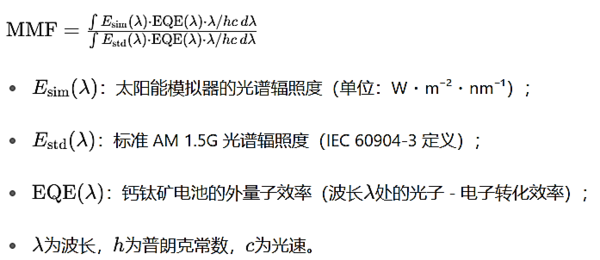
The Mismatch Factor (MMF) is a core parameter for evaluating the degree of spectral mismatch, and its physical meaning is the ratio of the short-circuit current of the battery under test conditions to the standard conditions (AM 1.5G), directly reflecting the impact of spectral mismatch on Jsc. The calculation formula is as follows:
Calculation steps and significance:
1. Measure key input data:
·Measure with a spectrometersunlightSimulators in the absorption band of perovskite (300-1000 nm, adjusted according to bandgap)Esim(λ);
·Measure the EQE of the battery(λ)(It is necessary to ensure the accuracy of EQE testing, especially near the absorption cutoff wavelength).
2. Calculate MMFIf: MMF=1, Explain the spectrumveryMatching;
MMF>1 indicates that the simulator has high light intensity in the sensitive band of the battery, and the measured Jsc is overestimated;
If MMF<1, Jsc is underestimated.
3. Correct Jsc: ThroughJ sc,correction=Jsc,measurement×MMFEliminating the first-order error of spectral mismatch in Jsc is the basis for evaluation.
2、 Deviation analysis of key performance parameters
The impact of spectral mismatch needs to be quantified by comparing the "IV parameters under mismatched spectra" with the "theoretical/calibration values under standard spectra", and quantifying the deviation amplitude of each parameter:
1. Deviation of short-circuit current density (Jsc)
· Direct deviationCalculate theoretical deviation through MMF(ΔJ sc=J sc,measurement−Jsc,correction), and calculate the relative deviation(ΔJ sc/J sc,correction×100%).
·Judgment suggestionWhat is the relative deviation of AAA level simulator in the absorption band of perovskite (300-800 nm)>15% indicates severe spectral mismatch.
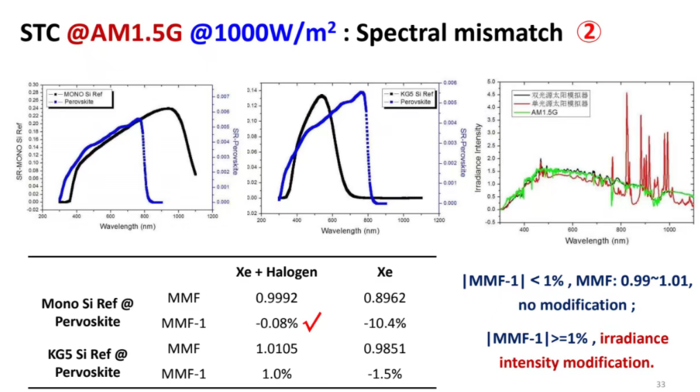
·Wavelength dependent verificationBased on the EQE curve, the positioning deviation mainly comes from the frequency band. For example, if the EQE peak is higher at 500 nm and the simulator 500 nm intensity is lower than the standard spectrum, then this band is the main cause of Jsc deviation.
2. Open circuit voltage (Voc) deviation
·Measure Voc under different spectral conditions (such as changing the spectral distribution of the simulator through a filter to maintain consistent total light intensity), and calculate the relative deviation(ΔVoc/Voc,correction×100%).
·Analysis pattern: If the short wave (<500 nm) light intensity is insufficient and causes a decrease in Voc, it indicates that the decrease in carrier concentration is the main cause; If the long wave is too strong and causes a decrease in Voc, it may be due to an increase in temperature (synchronous monitoring of battery temperature is required).
3. Linkage bias between fill factor (FF) and efficiency (PCE)
·Calculate the relative deviation of FF(ΔFF=(FFmeasurement−FFcorrection)/FFcorrection×100%)Among them, FF correctionRe calculate based on the corrected Jsc and Voc.
·PCE total deviation: ThroughΔPCE=(PCEmeasurement−PCEcorrection)/PCEcorrection×100%Assessment, ifThe deviation is significant,Then the spectrum needs to be recalibrated.
3、 Evaluation of Lag Effect and Repeatability
The hysteresis and repeatability effects of spectral mismatch on perovskite IV curves need to be verified through statistical analysis
Fluctuations in lag degree:
·Under the same simulator, repeatedly measure the IV curve of forward scan (from Voc to Jsc) and reverse scan (from Jsc to Voc), and calculate the hysteresis factor(HF=(PCEanti-sweep−PCEsweeping)/PCEanti-sweep×100%).
·Compare the HF distribution under different spectral conditions (such as replacing the simulator or adjusting the filter), and determine the relative standard deviation (RSD)largerThis indicates that spectral mismatch exacerbates hysteresis instability.
4、 Component dependency assessment (for different bandgap perovskites)
Due to the variation of the bandgap (absorption cutoff wavelength) of perovskite with composition, it is necessary to evaluate the differential effects of spectral mismatch:
1. Narrow bandgap perovskite (e.g. 1.2-1.4 eV, absorbed up to 900 nm):
·Focus on verifying the spectral matching of the 700-900 nm band, calculate the sub MMF of this band (integrating only 700-900 nm), and if the sub MMF deviateslargerThe total deviation of Jsc will significantly increase.
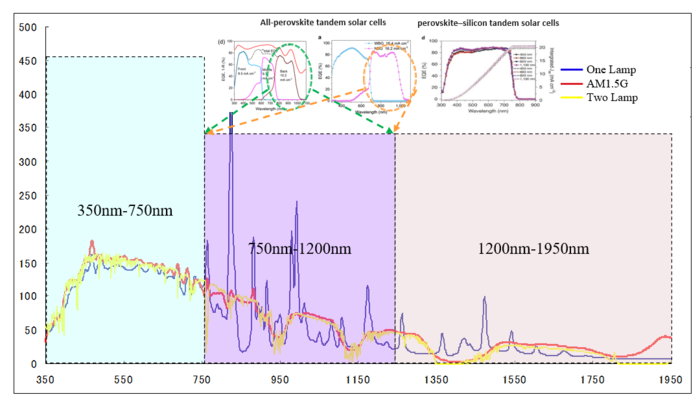
Note: Spectral comparison chart:
-Dual source solar simulatorThe spectrum from 300nm to 1200nm is almost identical to the AM1.5G standard spectrum;
-Single Xenon Lamp Solar SimulatorThe spectrum shows high peaks and low valleys after 750nm, although it is an A-level or A+level spectrum, the spectral matching is still poor in a small range!
-For stacked solar cells, the main spectral absorption of the middle/bottom cells is concentrated in the wavelength range after 700nm, therefore, significant errors are inevitably generated on a single lamp solar simulator; ButDual lamp/dual light source solar simulatorIt can effectively avoid the influence of this factor.
2. Wide bandgap perovskite (e.g. 1.6~1.8 eV, absorption up to 680 nm):
· Key verification of spectral matching in the 350-600 nm band, while monitoring Voc deviation. If the intensity fluctuation in this band causes Voc RSDlargerTargeted calibration is required.
3. comparative experiment: Use the same simulator to test perovskite with different bandgaps, draw the "bandgap parameter deviation" curve, and define the "sensitive wavelength range" of the simulator spectrum.
5、 Experimental verification: Control variable method and standard battery calibration
1. Controlled variable method:
·Maintain the total light intensity (100 mW/cm ²) constant, change the spectral distribution of the simulator by replacing the filter (such as short wave cut filter, long wave cut filter), and measure the changes in IV parameters.
·For example, after adding a 650 nm cut-off filter (removing>650 nm light), the Jsc of wide bandgap perovskite (absorbing up to 680 nm) should significantly decrease. If the decrease deviates from the EQE predictionlargerThis indicates that the original spectrum is mismatched in this band.
2. Standard battery comparison:
·Using certified perovskite standard cells (or reference cells with known performance), under testsunlightSimulators andHigh precision standardsunlightSimulators (such asDual lamp solar simulatorTheA+A+Grade A, spectral matching error<±10%(<± 5% is better)MS level))Test separately and compare parameter deviations.
·If to be testedsunlightThe Jsc of the simulator deviates from the standard valuelargerAnd even after MMF correction, it stilllargerIf so, the simulator spectrum needs to be recalibrated.
Summary: Evaluation Process and Qualification Standards
1. Calculate MMF and correct Jsc to ensure relative deviation of Jscsmall enough;
2. Analyze the chain bias of Voc, FF, PCE, and total PCE biassmall enough;
3. Verify lag factor and parameter repeatability,enableRSDsmall enough;
4. Evaluate spectral matching of sensitive bands and MMF deviation of sub bands for perovskite components (bandgap)small enough.
Through the above steps, the impact of spectral mismatch can be systematically quantified, providing a basis for the reliability of test data. For high-precision research,adoptDual lamp/dual source solar simulator(Spectral mismatch<± 10% A+level or ± 5% MS level) is an ideal choice.