-
E-mail
sale@zjuee.com
-
Phone
13372416330
-
Address
12th Floor, Building 3, No. 1418-50 Moganshan Road, Gongshu District, Hangzhou City, Zhejiang Province
Hangzhou Zeda Instrument Co., Ltd
Briefly describe the corresponding solutions to common problems in the practical application of cold chain real-time monitoring system
Date: 2025-11-03Read: 0
The real-time monitoring system for cold chain is the key to ensuring the quality and safety of temperature sensitive materials such as food and drugs during transportation and storage. In practical applications, some problems often arise that affect the accuracy and reliability of monitoring. It is crucial to understand and promptly address these issues with the real-time monitoring system for the cold chain.
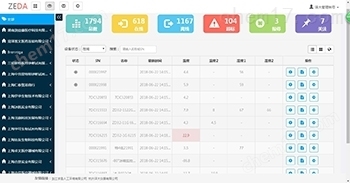
1. Abnormal or drifting sensor data
This is one of the common problems, manifested as temperature and humidity readings not matching the actual environment, or experiencing severe fluctuations. The main reasons include sensor aging, calibration failure, improper installation location (such as near cold or heat sources), or electromagnetic interference.
Solution: Regularly perform professional calibration on sensors (recommended every 6-12 months); Check and optimize the installation position of sensors to ensure that they can truly reflect the environment of the core area of the goods, avoiding direct sunlight or direct blowing from ventilation openings; Check if there are strong electromagnetic devices around, and if necessary, replace the anti-interference model or add shielding measures.
2. Data transmission interruption or signal loss
Wireless monitoring systems (such as GPRS, NB IoT, LoRa) may not be able to upload data due to poor network coverage, device power outages, SIM card arrears, or antenna damage.
Solution: Conduct network signal testing before deployment and choose a communication method with stable signals; Equip monitoring equipment with backup batteries or ensure stable power supply; Regularly check the SIM card status and data plan; Check if the antenna connection is secure and replace it if necessary.
3. Alarm function failure or false alarm
The system's failure to issue alerts in case of abnormal conditions such as overheating, or frequent and meaningless alerts, will reduce the system's credibility and response efficiency. The reasons may be unreasonable alarm threshold settings, incorrect alarm rule configurations, communication failures that prevent alarm information from being delivered, or sensor transient fluctuations triggering.
Solution: Scientifically set the alarm threshold and duration based on the characteristics of the goods (such as triggering an alarm only after exceeding the limit for 5 minutes to avoid false alarms due to instantaneous fluctuations); Check if the alarm information and push channels (SMS, APP, email) are configured correctly; Regularly test whether the alarm function is normal.
4. Difficulty accessing the system platform or data storage issues
Users may encounter issues such as login failure, interface lag, inability to query or lose historical data. This is usually related to platform server failures, network congestion, database anomalies, or user permission settings.
Solution: Contact the system service provider to confirm the platform's operational status; Check the local network connection; Ensure sufficient data storage space and regularly backup important data; Verify if the user account permissions are correct.