-
E-mail
mk@lubex.com.cn
-
Phone
18922417705
-
Address
2203, the Pearl River International Building, No. 112, Yuehua Road, Yuexiu District, Guangzhou
Guangzhou Lvbaicao Scientific Instrument Co., Ltd
Beginner's Must See: 3 Core Misconceptions in Chiral Chromatography Analysis (with Daicel Column Usage Suggestions)
Date: 2025-12-02Read: 1
Chiral chromatographic analysis is a crucial step in drug development and natural product detection. Novices often encounter difficulties due to unfamiliarity with the principles and column characteristics, leading to separation failure or rapid decline in column efficiency.
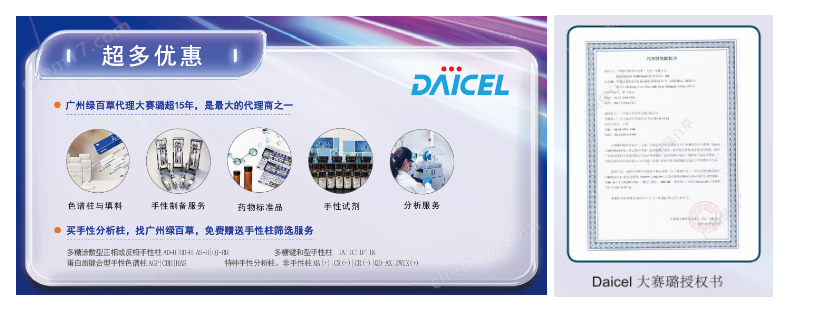
Authorized agent of Daicel - Guangzhou Green Baicao combined with Daicel (Daicel) chiral columns (such as AD-H, OD-H, CR (+), etc.) in the usage scenarios, sorting out three core misconceptions and solutions to help efficient hands on.
Misconception 1: Blind selection, ignoring compound and column matching
Novices tend to rely on "popular models" for selection (such as following the trend with AD-H), but ignore the structural characteristics of the target compound - for example, using AD-H to separate alkaline alkaloids has poor separation and tailing peaks, but OD-H is actually more suitable.
Suggestions for using Daicel columns:
Containing aromatic rings, neutral/acidic compounds → Select CHIRALPAK® AD-H手性柱(正相)、CHIRALCEL OJ-RHChiral column (reverse phase);
Alkaline compounds (amines, alkaloids) → PriorityCHIRALCEL OD-H(Positive phase)CHIRALCEL OD-RH(Reverse phase), 0.1% diethylamine can be added to inhibit adsorption;
Amino acids/ammonium salts → ExclusiveCROWNPAK CR (+)Chiral column; Biological samples →CHIRALPAK AGPChiral column (protein bonded type, good biocompatibility).
Misconception 2: One size fits all use of mobile phase/additives
Common errors:
① Polysaccharide coated type( CHIRALPAK® AD-HThe CHIRALCEL OD-H)Adding strong polar solvents such as acetone and chloroform can cause the stationary phase to detach; ② Give itCROWNPAK CR (+) The chiral column uses a mobile phase containing potassium salt to disrupt the recognition sites of crown ethers; ③ Randomly adding high concentrations of acid and alkali, exceeding the pH tolerance range of the column.
Correct operation——
Solvent compatibility: Daicel polysaccharide coating type prohibits acetone and chloroform; AGP prohibits ethanol (which can cause protein denaturation);
Additive matching: add 0.1% to acidic samples Trifluoroacetic acid(TFA), Add 0.1% diethylamine (DEA) to alkaline samples, and prohibit potassium salts on CR (+) columns;
PH control: The pH of OD-RH, OJ-RH and other reverse phase columns should be between 2.0 and 9.0, and the pH of AGP column should be between 4.0 and 7.0.
Misconception 3: Neglecting column maintenance and storing it directly after use
Novices often fail to rinse after completing experiments or use the wrong storage solvent (such as AD-H stored in pure water), resulting in residual sample adsorption, damage to the stationary phase, and rapid decline in column efficiency. Key maintenance points for Daicel columns:
After the experiment, rinse the columns (AD-H, OD-H) with n-hexane/isopropanol (90:10) for 30 minutes; Reversed phase column (OD-RH) with water/acetonitrile (60:40) desalted and then equilibrated;
Storage solvent: AD-H/OD-H with n-hexane/isopropanol (90:10), AGP with buffer solution (pH 7.0), CR (+) with 0.1% perchloric acid aqueous solution;
Taboo: Avoid long-term high temperature (polysaccharide coated type ≤ 40 ℃), frequent reverse column connection, and rinsing with exclusive solvents when column efficiency decreases (such as AD-H using 100% ethanol).
Following the principle of "selecting matching structure+mobile phase matching column type+standard maintenance" can significantly reduce the failure rate of experiments, while extending the service life of Daicel chiral columns and quickly mastering the core techniques of chiral chromatographic analysis.