-
E-mail
1115468868@qq.com
-
Phone
13622644996
-
Address
Building B1, No. 6 Yanhai Road, Yongtou Community, Chang'an Town
Guangdong Laibotong Testing Equipment Co., Ltd
Mechanical Impact Testing Machine: Core Principles for Controlling Impact Energy and Acceleration
Date: 2025-12-15Read: 1
Mechanical impact testing machineThrough various methods such as free fall and pendulum impact, it accurately simulates the impact environment that products may encounter during transportation and use. Its core technological advantage lies in the precise control of impact energy and acceleration. This regulatory capability stems from the design logic of "energy calculable and process controllable", which optimizes mechanical structural parameters and precisely intervenes in motion states to achieve parameter matching in different testing scenarios, providing scientific basis for product reliability evaluation.
The energy and acceleration control of the free fall impact testing machine relies on the dual parameter settings of "height and mass". According to the energy formula E=mgh (E is the impact energy, m is the total mass of the sample and fixture, g is the gravitational acceleration, and h is the drop height), the equipment can adjust the impact energy through two core methods: one is to accurately control the drop height, and stabilize the sample to the set height (ranging from tens of millimeters to several meters) through a servo lifting mechanism, with a height error controlled within ± 1mm, ensuring precise and controllable gravitational potential energy; The second is to adapt to fixtures of different qualities. When the sample quality is fixed, the total impact mass can be adjusted by increasing or decreasing the fixture quality to broaden the energy range. The control of acceleration is achieved through the material and buffering structure of the drop table - the rigid table can generate instantaneous strong impact, with acceleration up to thousands of m/s ², suitable for precision component testing; Installing buffer pads of different hardness can reduce the peak acceleration of impact, simulate the buffering protection scenario during transportation, and meet the testing requirements of packaging.
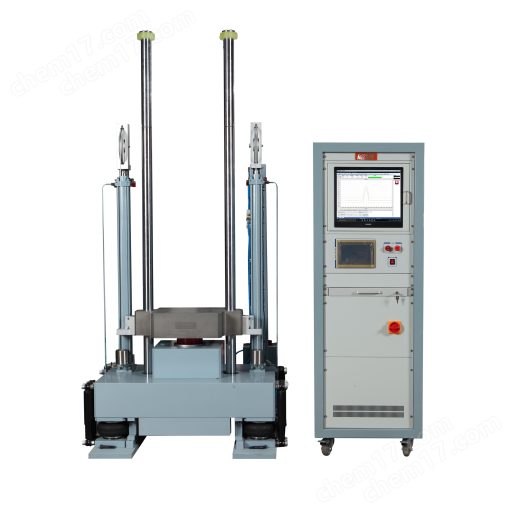
The control logic of the pendulum impact testing machine revolves around "pendulum length, pendulum mass, and impact angle". The impact energy comes from the gravitational potential energy of the pendulum when it is lifted to a specific angle. According to the formula E=mgL (1-cos θ) (where L is the pendulum length and θ is the pendulum angle), adjusting the pendulum length, pendulum mass, or pendulum angle can change the impact energy. Equipment is usually equipped with multiple sets of pendulum weights of different masses (ranging from hundreds of grams to tens of kilograms), combined with adjustable pendulum length mechanisms, to achieve a wide range of energy coverage; The swing angle is precisely controlled by a servo positioning system, with an angle error of ≤ 0.5 °, ensuring the consistency of energy output. The control of acceleration is related to the impact velocity and contact time. By optimizing the shape of the pendulum impact head (such as spherical or wedge-shaped), the impact contact area and time can be changed, thereby adjusting the peak impact acceleration; At the same time, the built-in acceleration sensor of the device can collect real-time acceleration curves during the impact process, and dynamically correct the swing angle and pendulum parameters through a closed-loop control system to ensure the accuracy of test data.
Regardless of the impact method, the core control cannot be separated from the synergy of "mechanical structure optimization+sensing feedback regulation". The equipment ensures precise execution of motion parameters through high-precision mechanical components such as servo motors and ball screws, while using acceleration sensors and displacement sensors to collect real-time impact process data, which is transmitted to the central control system for analysis. When the actual parameters deviate from the set values, the system can automatically adjust the lifting height, swing angle, or pendulum mass to form a closed-loop control, ensuring that each impact test can accurately match the preset energy and acceleration requirements, providing stable and reliable technical support for product reliability testing in different industries.