-
E-mail
market@exponentsci.com
-
Phone
13322809603
-
Address
Room 403, Building B, Huicheng Building, No. 602 Guangshan 2nd Road, Tianhe District, Guangzhou City
Aibo Neng (Guangzhou) Science and Technology Co., Ltd
The Influence of Atmospheric Conditions on the Composition of Tropical Rainforests: The Key Role of Rainwater Isotopes
Date: 2025-11-21Read: 1

Background Introduction
The Bay of Bengal is located in the northeast of the Indian Ocean, and its triangular shape allows it to produce massive amounts of water vapor. These water vapor continue to flow towards the Indian subcontinent, bringing abundant precipitation to eastern India and surrounding countries, especially during the monsoon season from May to September, when the precipitation phenomenon is more significant. And India's agriculture and economic activities rely heavily on summer rainfall.
The unique climate and location characteristics of the Bay of Bengal profoundly affect the generation and transmission of moisture in the region. During the monsoon season, the sea surface temperature in this area often exceeds 28 ° C, making it prone to air convection and providing water vapor to the atmosphere throughout the year. Even with high sea temperatures and frequent convection, the precipitation during the summer monsoon season is still much greater than the evaporation, making the Bay of Bengal an important water vapor sink, like a "large warehouse for storing water vapor".
Why study isotopes in rainwater
Determining where water vapor comes from and goes is the core link in studying hydrological cycles. This research can not only help people understand the variability of the monsoon, but also help us cope with the rainstorm disaster caused by tropical cyclones and reduce losses.
analyzePhysical tracerIt is a reliable method for exploring the sources and sinks of atmospheric water vapor, including precipitation in the Andaman Islands in the Bay of Bengalstable isotopeIt is an important research object. The forest coverage of the Andaman Islands is as high as 92% of the surface, and there are very few potential sources of secondary water vapor such as soil moisture, which interferes with research. Therefore, isotope studies of local rainwater can provide valuable data for revealing dynamic water vapor processes.
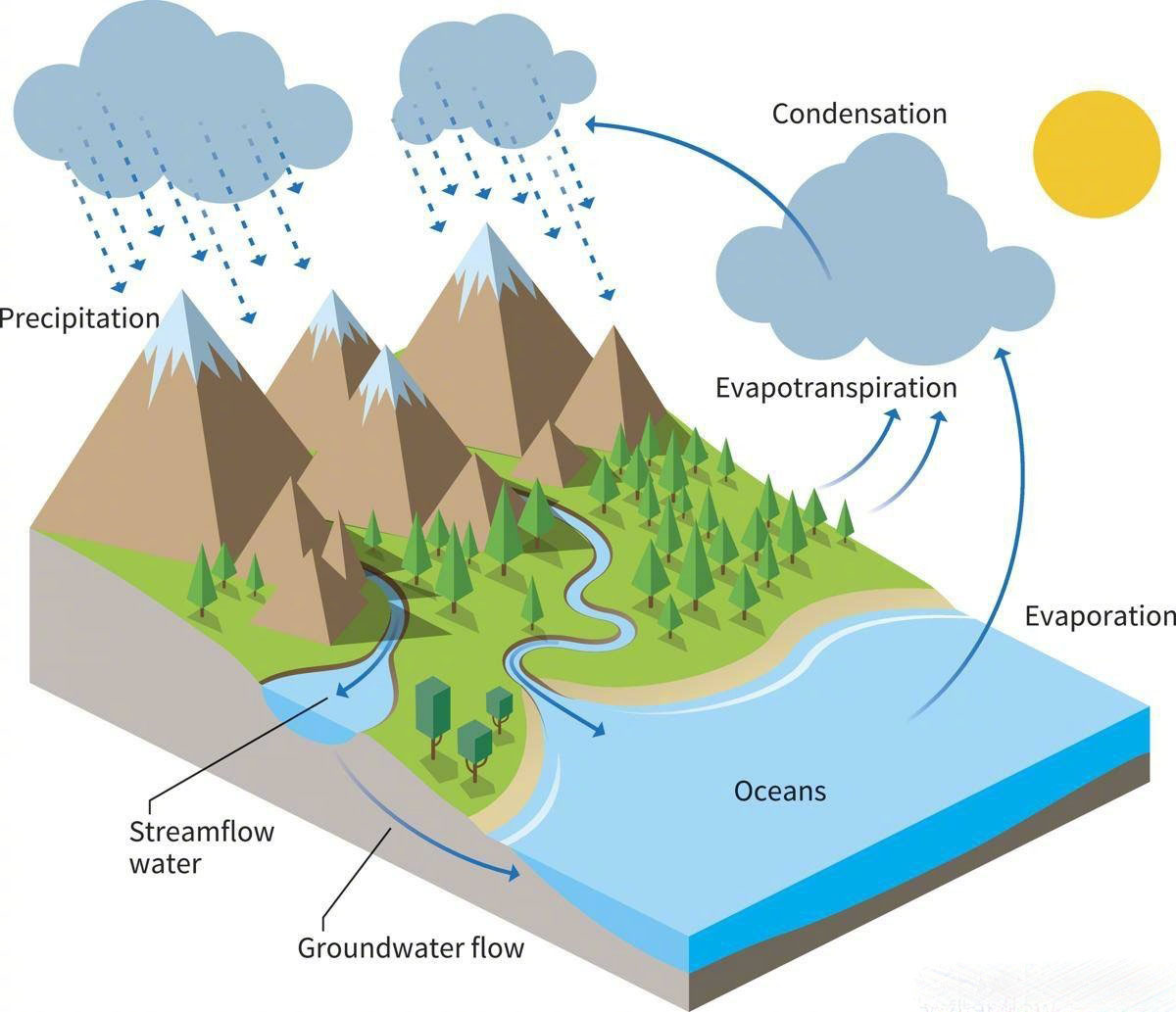
Hydrological cycle diagram
But currently, research on the isotopes of rainwater here is very scarce, and in the short term, everyone is still unclear about its characteristics. Although there are currently global circulation models that can simulate the rainfall distribution and isotopic variability of the Indian summer monsoon, which are in good agreement with actual observations, there are significant differences in the simulated "rainfall effect" (the relationship between rainfall and isotopes) data.
To clarify these issues, experts from the Indian Institute of Tropical Meteorology (IITM Pune) and Pondicherry University conducted a two-year study on rainwater isotopes in Port Blair, the largest city in the Andaman Islands.
The research aims to achieve four major objectives:
Clarify the characteristics of precipitation isotopes in the region;
Exploring how ocean atmospheric variables such as water vapor sources, flow, and convective activity affect isotopes;
Clarify the characteristics of the "rainfall effect" and whether it is affected by changes within the monsoon season;
Verify whether the isotopic composition of rainwater is related to rainfall events and water vapor flux that affect monsoons.
Research Methods
During the two-year study, experts collected approximately 90 daily rainwater samples annually at the Bendixeri University campus in Port Blair, packaged in leak proof plastic bottles, and sent to the Indian Institute of Technology Pune for isotope analysis.
Initially, the research team used an Isotope Ratio Mass Spectrometer (IRMS) for detection, and subsequently analyzed all samples using the ABB OA-ICOS Laser Isotope Water and Water Vapor Analyzer TIWA-45-EP (predecessor of GLA431-TIWA Enhanced).

ABB GLA431-TIWA Enhanced High Performance Desktop Triple Isotope Water Analyzer (our agent product, welcome to inquire)
Core Achievements
The results showed that the isotopic ratios measured by the two instruments were consistent within a range of ± 1 σ, with an analysis accuracy of approximately 0.1% for δ 18O and less than 1% for δ 2H. By analyzing the daily rainfall and δ 18O time series of Port Blair in 2012 and 2013, it was found that the more rainfall in 2012, the lower the δ 18O content, which confirms the existence of the "quantity effect".

Daily rainfall and δ 18O time series of Port Blair in 2012 (top) and 2013 (bottom). The black bar represents the rain gauge data, and the red line is the corresponding δ 18O record. There is a clear inverse correlation between the rainfall in 2012 and δ 18O, indicating a "quantity effect".
The study also found that the oxygen and hydrogen isotopes of rainwater in the southern Bay of Bengal, although typical of tropical oceanic regions, vary with changes in ocean and atmospheric conditions, and experience significant losses during tropical cyclones. Isotope data collected over the past two years indicate that during the early monsoon season, relatively low humidity but strong circulation can lead to moderate re evaporation of raindrops, thereby promoting rainfall effects; And the isotopic composition of rainwater is not determined by a single rainfall event, but depends on the dynamic properties of water vapor.
In the mature stage of the monsoon season, with changes in atmospheric conditions, the degree of raindrop evaporation weakens. At this time, the influence of water vapor quantity depends more on the convergence of water vapor flow rather than local evaporation. Overall, the precipitation isotopes over the Bay of Bengal will systematically decrease with large-scale convective activity and be regulated by the comprehensive effects of convective activity, and are closely related to the seasonal variations and synchronous scale fluctuations of the monsoon.

Specifically, the "rainfall effect" in the early and middle stages of the monsoon is mainly caused by the re evaporation of rainfall; In the later stage, it is due to the accumulation of water vapor, rather than evaporation. In addition, the "quantity effect" exhibits significant characteristics over the course of two years and is regulated by seasonal monsoon changes.
This study provides us with a deeper understanding of the 'rainfall effect' in the northern Indian Ocean and helps narrow the gap between observational results and rainfall model simulations.
If you would like to learn more about isotope analyzers, please feel free to contact us!
Case source:The research mentioned in the article is part of the International Atomic Energy Agency's (IAEA) project "Stable isotopes in tropical precipitation and paleoclimate archives to improve regional hydrological and climate impact models".