-
E-mail
market@exponentsci.com
-
Phone
13322809603
-
Address
Room 403, Building B, Huicheng Building, No. 602 Guangshan 2nd Road, Tianhe District, Guangzhou City
Aibo Neng (Guangzhou) Science and Technology Co., Ltd
Hyperspectral imaging technology: the "golden eyes" of the food industry
Date: 2025-11-17Read: 1
Hyperspectral Imaging: An Inside View of Food Quality
On the tip of the tongue, China has long bid farewell to the era of 'just eat enough'. Nowadays, what we pursue is higher quality, safer and more reassuring food. Hyperspectral imaging technology, as an emerging technology, can penetrate the surface of food like a "golden eye", detecting its internal components, quality, and safety status. Next, let's take a tour of the application of hyperspectral imaging technology in the food industry.
In China, the era of being satisfied with merely 'having enough to eat' is long gone. Today, we pursue higher quality, safer, and more reliable food. As an emerging technology, hyperspectral imaging can penetrate the surface of food products—much like having 'eyes that see beneath the surface'—to detect their internal composition, quality, and safety conditions. Below, let’s explore the applications of hyperspectral imaging technology in the food industry.
Quality Inspection of Agricultural Products
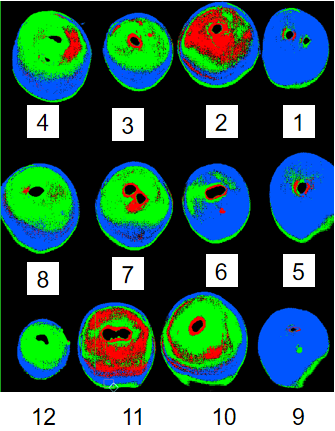
Hyperspectral imaging is particularly adept at non-destructive testing in agricultural product selection, detecting internal damage that is difficult to detect with the naked eye. For example, it can detect bruises or internal damage that may not be visible on the surface of an apple, achieving more accurate grading and enhancing product value. This non-destructive testing method can help producers eliminate products with potential quality issues, enhance overall product quality and market competitiveness.
Hyperspectral imaging excels in the non-destructive inspection of agricultural products, particularly in sorting operations. It can detect internal damage that is difficult to see with the naked eye. For example, it can identify bruises or internal defects in apples that are not visible externally, enabling more accurate grading and enhancing product value. This non-destructive testing method helps producers remove items with potential quality issues, thereby improving overall product quality and market competitiveness.
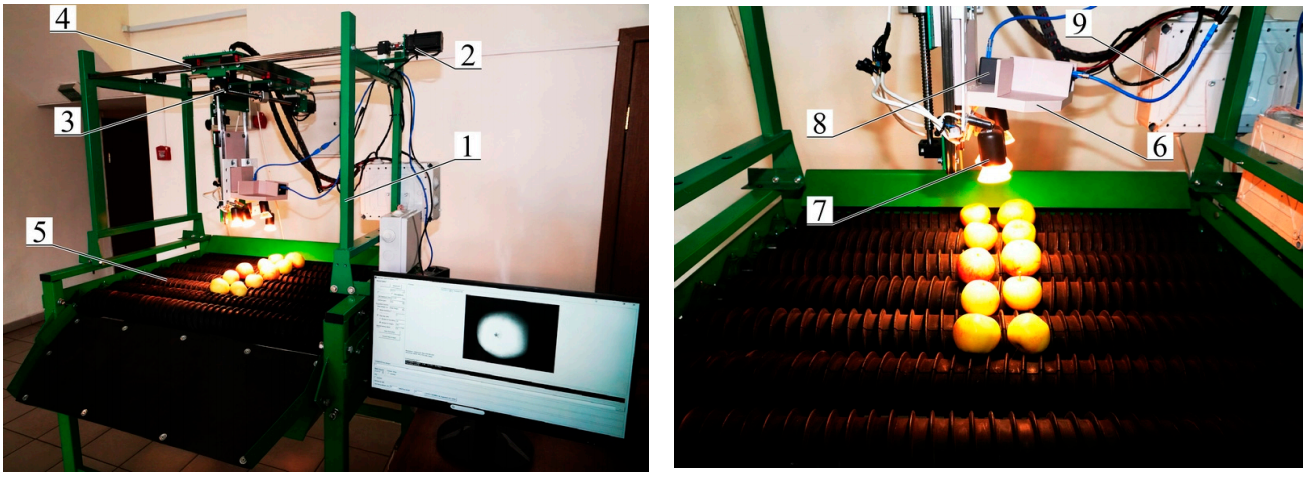
Hyperspectral Based Apple Sorting
Evaluation of Sensory Characteristics in Agricultural Products
Sensory characteristics such as sugar content, acidity, hardness, and maturity directly affect consumers' preferences for agricultural products. Hyperspectral imaging technology has shown great potential in food sensory evaluation, as it can predict these key indicators without loss. For example, by analyzing the reflectivity of persimmons at specific wavelengths, a prediction model for astringency can be established; By analyzing the spectral absorption characteristics of grapes in the near-infrared band, their sugar content and acidity can be predicted. Compared with traditional sensory evaluation methods, hyperspectral imaging has the advantages of being fast, objective, and non-destructive.
Sensory attributes such as sugar content, acidity, firmness, and ripeness directly influence consumer preference for agricultural products. Hyperspectral imaging shows great potential in the sensory evaluation of food, as it can non-destructively predict these key indicators. For instance, by analyzing the reflectance of persimmons at specific wavelengths, a prediction model for astringency can be developed. Similarly, by examining the spectral absorption features of grapes in the near-infrared range, their sugar and acid levels can be predicted. Compared with traditional sensory evaluation methods, hyperspectral imaging offers the advantages of speed, objectivity, and non-destructiveness.
Real time online detection of glucose levels using hyperspectral technology/ Real-Time Online Detection of Grape Sugar Content Using Hyperspectral Technology
Tea Quality Assessment
By analyzing the spectral information of tea leaves, it is possible to non destructively and accurately analyze the bioactive components in tea leaves, such as tea polyphenols, caffeine, and amino acids, which are crucial for the flavor and quality of tea. A certain team used hyperspectral data to establish a model that can accurately estimate the content of tea polyphenols in tea leaves. Another team used a hyperspectral camera mounted on a drone to predict the content of tea polyphenols and amino acids, and evaluate the ratio of tea polyphenols to amino acids.
By analyzing the spectral information of tea leaves, key bioactive components such as tea polyphenols, caffeine, and amino acids—which are crucial to the flavor and quality of tea—can be assessed accurately and non-destructively. One research team developed a model based on hyperspectral data to accurately estimate the content of tea polyphenols. Another team used a drone-mounted hyperspectral camera to predict the contents of tea polyphenols and amino acids, and further evaluated the ratio between the two.
Meat Quality Assessment
Hyperspectral imaging can accurately measure fat and protein content, evaluate nutritional value and flavor. For example, analyzing beef marble patterns to predict tenderness and juiciness, or evaluating the degree of protein degradation in fish to determine freshness, distinguishing between normal breast meat and "woody breast meat", can not only optimize utilization, but also detect foreign objects such as bone fragments to ensure food safety.
Hyperspectral imaging can accurately measure fat and protein content, helping to evaluate nutritional value and flavor profiles. For example, it can analyze the marbling of beef to predict tenderness and juiciness, or assess the degree of protein degradation in fish to determine freshness. It is also capable of distinguishing between normal chicken breast and woody breast, and can detect foreign materials such as bone fragments—enhancing utilization efficiency while ensuring food safety.

Differentiating Chicken Breast Meat Quality Using Hyperspectral Technology
Hyperspectral imaging technology, as an emerging food detection method, has enormous potential. Despite the challenges posed by data processing, equipment costs, and the complexity of application scenarios, the rapid development of artificial intelligence and machine learning has brought new opportunities for hyperspectral imaging technology. By combining big data analysis and modeling, it is expected to further improve the accuracy of food quality prediction, achieve intelligent upgrading of agricultural products and other industrial chains, and bring more efficient and quality guaranteed production modes from production to processing and sales.
As an emerging tool in food inspection, hyperspectral imaging holds significant potential. Although challenges remain in data processing, equipment costs, and the complexity of application scenarios, the rapid development of artificial intelligence and machine learning presents new opportunities for the technology. By integrating big data analysis and modeling, hyperspectral imaging is expected to further improve the accuracy of food quality prediction and enable intelligent upgrades across agricultural and food production chains—from production and processing to sales—paving the way for more efficient and quality-assured production models.