-
E-mail
market@exponentsci.com
-
Phone
13322809603
-
Address
Room 403, Building B, Huicheng Building, No. 602 Guangshan 2nd Road, Tianhe District, Guangzhou City
Aibo Neng (Guangzhou) Science and Technology Co., Ltd
Sunscreen Label Guide: Easily Understand SPF and PA, Say Goodbye to Difficulties in Choosing!
Date: 2025-11-28Read: 1
Sunscreen Label Guide: Decoding SPF, PA & Beyond
Even in winter when UV rays are relatively mild, taking good care of the sun is still an important step in daily skincare. How to accurately interpret various professional labels on products? This article will help you simplify and quickly grasp the key points of sunscreen labels.
While UV radiation may be milder in winter, sun protection remains an essential step in daily skincare. With various technical terms on product labels, how can consumers make informed choices? This guide simplifies key sunscreen labeling information for everyday understanding.
Key to sun protection: SPF value/UVB protection: Understanding SPF
SPF (Sun Protection Factor) is a universal UVB protection index. UVB is the culprit that causes skin redness and sunburn.
SPF (Sun Protection Factor) is the universal metric for UVB protection - the primary cause of sunburn and skin reddening.
1. Definition
The SPF value is based on the "minimum erythema dose (MED)" - the minimum amount of ultraviolet radiation required to cause visible redness (i.e. sunburn) to appear on the skin at the beginning.
According to the human testing method of ISO24444, SPF=MED after applying sunscreen ÷ MED without applying sunscreen.
Simply put, SPF value represents the multiple that prolongs the time it takes for the skin to be sunburned.
1. Definition
SPF is calculated based on Minimal Erythema Dose (MED) - the minimum UV exposure required to cause just-visible skin reddening. According to ISO24444 human testing protocols:
SPF = MED with sunscreen ÷ MED without sunscreen
Essentially, SPF indicates how much longer protected skin can withstand UV exposure before burning compared to unprotected skin.

2. Protection efficiency
The higher the SPF value, the higher the blocking rate of UVB, but it does not increase nonlinearly.
SPF30 ≈ can block 97% of UVB rays
SPF50 ≈ can block 98% of UVB rays
It is worth noting that increasing the SPF value from 30 to 50 only increases the blocking rate by 1.3%, but the product texture usually becomes thicker.
2.Protection Efficiency
Higher SPF values block more UVB, but not proportionally:
• SPF30 ≈ 97% UVB blockage
• SPF50 ≈ 98% UVB blockage
Note: While SPF50 only provides 1.3% more protection than SPF30, the formulation typically becomes heavier.

3. Correction of common misconceptions
Misconception: SPF value can be directly converted into a fixed 'security protection duration'.
Correct concept: The sun protection effect will dynamically change due to usage, environmental factors, etc., so the SPF value represents the ability to block UV dose, rather than a fixed time commitment. If the application amount is insufficient, even if using SPF50 products, the actual protective effect will be greatly reduced, possibly to around SPF10.
3. Common Misconceptions
• Myth: SPF directly converts to guaranteed 'safe sun exposure time'
• Fact: SPF indicates UV dose blockage capacity, not fixed time protection. Real-world factors like application amount and environmental conditions significantly impact effectiveness. Insufficient application (less than 2mg/cm²) can reduce SPF50 performance to SPF10 levels.
Sunscreen Black/Sunscreen Old Key: UVA Protection/UVA Protection: Preventing Tanning&Aging
UVA is the main factor causing skin tanning, aging, and wrinkles. At present, there is no unified standard for UVA protection in each region, and there are mainly three systems:
UVA causes skin darkening, aging and wrinkles. Global UVA protection standards vary:
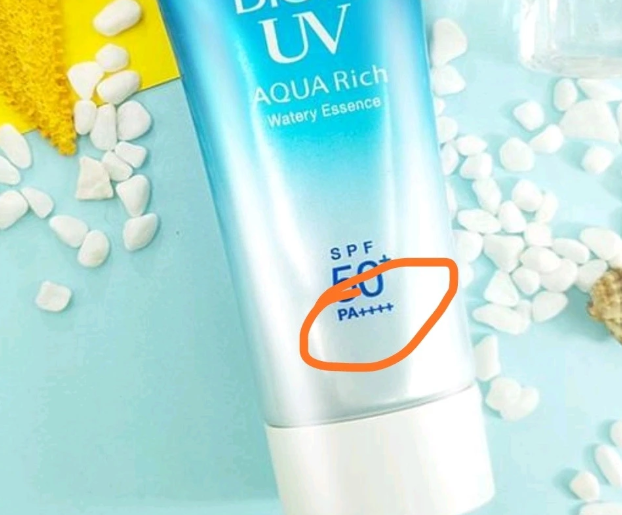
1. China Japan Korea Standard: PA Index
PA rating is based on PFA value (UVA protection index), which determines the amount of ultraviolet radiation required for the skin to start tanning. Use a "+" sign to indicate protection strength:
PA+:PFA 2-3, Mild protective effect
PA++:PFA 4-7, Moderate protective effect
PA+++:PFA 8-15, High protection effect
PA++++:PFA≥16, Ultra high protection effect
The more "+" signs there are, the less likely it is to get tanned and the stronger the ability to protect against UVA rays.
1. Asian Standard: PA Rating
PA grades based on Protection Factor of UVA (PFA) - measuring UV dose required to induce tanning:
• PA+: PFA 2-3 (basic protection)
• PA++: PFA 4-7 (moderate protection)
• PA+++: PFA 8-15 (high protection)
• PA++++: PFA≥16 (very high protection)
More '+' symbols indicate stronger UVA protection. China's highest rating is PA++++.
2. US Standard: Broad Spectrum Sunscreen
The United States does not use PA values, but instead adopts the "broad-spectrum sunscreen" standard. The product must simultaneously meet the following requirements:
SPF value ≥ 15
• Critical wavelength (CW) ≥ 370 nanometers
Products that meet the standards can be labeled as' Broad Spectrum '. Products that do not meet the standards must have warning labels indicating that the product can only protect against sunburn and cannot prevent skin cancer or aging.
Note: Critical wavelength (CW): proposed by the American Academy of Dermatology. The maximum wavelength that sunscreen products can block 90% of ultraviolet rays after testing. Simply put, the higher the CW value, the wider the wavelength range that can be protected, and the better the protection effect against ultraviolet rays.
2. US Standard: Broad Spectrum
Requirements:
• SPF≥15
• Critical wavelength (CW)≥370nm
Products meeting both criteria can claim 'Broad Spectrum. ' Others must warn they only prevent sunburn, not skin cancer or aging.
Critical wavelength (CW): The longest wavelength blocking 90% of UV. Higher CW values indicate broader UV protection spectrum.

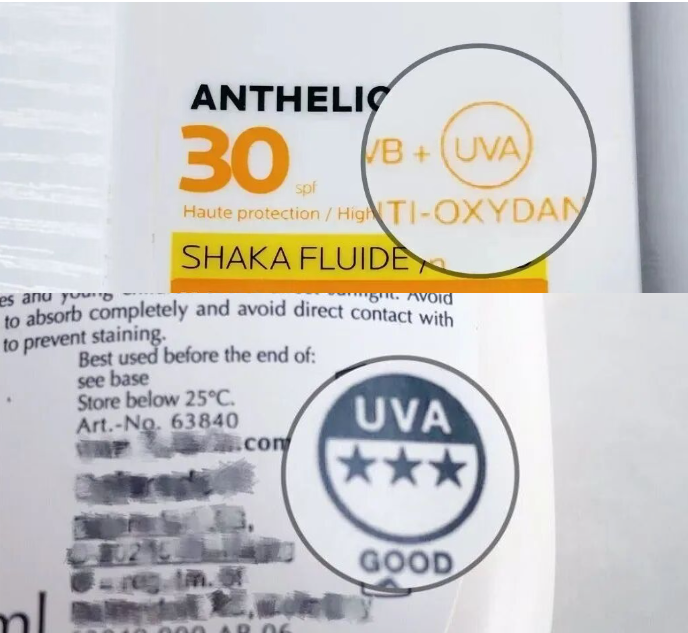
3. European standard: UVA circles and Boots star rating
UVA circle: If there is a UVA letter with a circle outside on the product packaging, it represents a critical wavelength of ≥ 370 nanometers and UVA protection of at least one-third of the SPF value.
Boots star rating: Use star ratings (one to five) to indicate the balance of UVA and UVB protection capabilities. The higher the star rating, the more balanced the protection between UVA and UVB, and the more comprehensive the resistance to UV damage to the skin. Zui mostly has five stars.
3. European Standard: UVA Circle & Boots Star Rating
• UVA Circle: Indicates CW≥370nm and UVA protection ≥1/3 of SPF value
• Boots Stars (1-5): Rates UVA/UVB protection balance. Higher stars mean more balanced protection against both UV types.
Waterproof and Sweatproof Function/Water Resistance Claims
1. Chinese standards
Anti water and anti sweat: The product has passed a 40 minute test and can be labeled as "waterproof and anti sweat", with a time limit of no more than 40 minutes.
You Yue Water Resistance: The product has passed an 80 minute test and can be labeled as "You Yue Water Resistance", with a maximum duration of 80 minutes.
If the SPF value decreases by more than 50% after soaking, it cannot be claimed to have waterproof function.
2. American labeling
Generally labeled as' Water Resistant '.
1. China Standards
• Water Resistant: Maintains SPF after 40min water immersion
• Very Water Resistant: Maintains SPF after 80min
Products losing >50% SPF after testing cannot claim water resistance.
2. US Standards
Labeled as 'Water Resistant '

Other labels/Additional Label Terms
Safe Eye Tech: The product has passed validation testing and can be used around the eyes without causing eye irritation.
Wet Skin: Can be applied directly on wet skin, perfect for scenes such as the beach and swimming pool.
12M: It is recommended to use it within 12 months after opening. The stability of sunscreen will decrease over time, and the protective effect of sunscreen in the following year will be greatly reduced. It is not recommended to continue using it.
• Safe-Eye Tech: Ophthalmologist-tested for eye area use
• Wet Skin Application: Can apply to damp skin
• 12M: Use within 12 months after opening for optimal efficacy

Ultimately, sun protection is not just about buying a product with a good index and everything will be fine. The real secret lies in "applying enough and reapplying frequently", combined with hard sun protection equipment such as hats and sunglasses, in order to achieve effective sun protection.
Remember this selection tip:
Daily commuting to work: Choose lightweight and non sticky materials for easy reapplication at any time.
Outdoor sports and playing in the water at the beach: Waterproof and sweat proof functions are of utmost importance, and it is important to identify clear waterproof signs.
Ultimately, sun protection isn’t as simple as buying the product with the highest SPF and calling it a day. The real secret lies in applying a sufficient amount and reapplying it frequently, combined with physical protection like hats and sunglasses, to ensure complete safety.
Keep this selection tip in mind:
For daily commutes: Choose lightweight, non-sticky formulas for easy reapplication.
For outdoor activities or beach trips: Water and sweat resistance is crucial—always look for clear waterproof labeling.