-
E-mail
flyapple1987@163.com
-
Phone
18938669930
-
Address
301, Building C, No. 10 Gongye 1st Road, Jiangbian Community, Songgang Street, Bao'an District, Shenzhen
Product Categories
Yunyi Ultrasound (Shenzhen) Co., Ltd


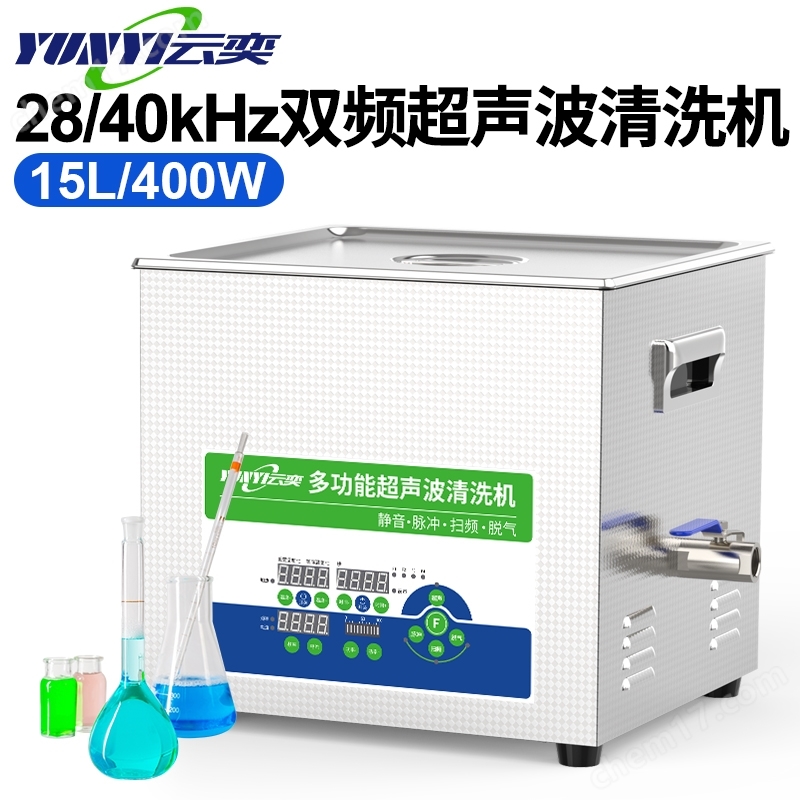
Yunyi 22L dual frequency ultrasonic cleaning machine with adjustable 80/120KHZ
NegotiableUpdate on 02/06
- Model
- Nature of the Manufacturer
- Producers
- Product Category
- Place of Origin
Overview
Yunyi 22L dual frequency ultrasonic cleaning machine 80/120KHZ adjustable YL1622-80120 Shenzhen factory direct sales $r $n functions: mute, sweep frequency, pulse, degassing, heating, power frequency current visualization, power adjustable
Product Details
Yunyi 22L dual frequency ultrasonic cleaning machine with adjustable 80/120KHZYL1622-80120 Shenzhen factory direct sales
Function: Mute, sweep frequency, pulse, degas, heat, power frequency current visualization, adjustable power
1. Model: YL1622-80120 (digital button type/dual frequency adjustable/bottom oscillator type)
2. Inner groove size: length 500mm * width 300mm * height 150mm;
3. External dimensions: length 530mm * width 330mm * height 335mm;
4. Ultrasonic rated power: 0-800W (with 16 50W vibration heads installed) plus vibration mode
5. Ultrasonic rated frequency: 80/120kHz
6. Heating rated power: 1000W
7. Temperature control: Digital display control (adjustable from room temperature to -80 ° C)
8. Time control: Digital display control, accurate to seconds (1-9999 seconds can be set)
9. Capacity approximately: 22L (4-point drain valve)
10. The inner groove of the cleaning machine is made of high-quality stainless steel material with a thickness of T1.5mm, stamped and formed, and seamlessly welded. The outer shell is packaged with anti fingerprint stainless steel plate, which is beautiful and durable. The whole machine is made of 304 stainless steel (including the inner groove, shell, valve body, and pipeline);
11. Power requirements: AC220V 50HZ
12. Standard stainless steel cleaning basket, stainless steel dust cover, power cord, etc


Yunyisonic | Dedicated to the field of laboratory analysis, providing scientific instrument solutions
Laboratory research applications: efficient laboratories, biotechnology, healthcare, food engineering, new materials research, environmental protection, agriculture, etc
YL series products can be used for: preparation of biological samples, cell crushing and extraction, mixing and catalysis of liquid phase, dispersion and melting promotion of small particles, preparation of suspensions, cleaning of experimental vessels, ultrasonic chemical reactions, chemical synthesis, biopharmaceuticals
Synthesis, degradation of biomaterials, recombination, extraction of traditional Chinese medicine, cleaning of precision instrument components, complex blind holes and narrow slits, etc ..
Advantages and Characteristics of Yunyi Laboratory Ultrasonic Cleaning Machine
Standard features: pulse, sweep frequency, deaeration, adjustable power [power, current, frequency visualization for easy recording of experimental data]
Single frequency: 17, 20, 25, 28, 33, 40, 50, 53, 68, 80, 120, 132, 200Khz
Dual frequency: 28/40, 40/68, 40/80, 40/120, 80/120Khz
三频: 20/40/60Khz 40/80/120Khz 40/80/100Khz
Four frequency: 25/50/80/120kHz 40/80/120/170kHz 40/80/100/160kHz
Noise reduction configuration
Double layer noise reduction configuration makes the noise soft and not harsh. Noise reduction cotton is added to the bottom, end, and surrounding areas of the cleaning tank to eliminate some of the noise. The full bridge excitation circuit board and the vibration head are highly matched, so that the electric excitation vibration frequency will be lower than the natural frequency of the system, and the system will not cause resonance noise due to the flow of the medium in the slot or the throwing of the cleaning workpiece in the medium, which can reduce noise.
[Sweep frequency, pulse, degassing function]
Sweep frequency: Sweep frequency is used to improve the structure of the sound field, solve the uneven standing wave field in the groove, make the cleaning uniform, achieve uniform and strong cleaning effect without blind spots, and ensure that users can obtain uniform and stable cleaning effect for each batch of cleaning operations.
Pulse: The ultrasonic pulse signal is converted into high-frequency vibration by a transducer, which generates strong impact force in the cleaning solution, forming tiny bubbles that quickly rupture, thereby producing strong impact force.
Degassing: Quickly remove the air from the cleaning solution, reduce the bubble resistance generated by ultrasonic cavitation reaction, prevent item oxidation, make cleaning cleaner, and enhance the cleaning effect of ultrasonic waves.
Relieve the temperature rise of the solution during the experimental process
Ultrasonic waves will heat the cleaning agent during long-term operation. The Yunyi Laboratory ultrasonic instrument uses a full bridge excitation circuit board and a highly matched oscillator, which has low heat generation and can alleviate the limitation of liquid temperature rise. Its performance is more stable and its service life is longer.
Supports normally open mode and can work for a long time
Introduction to Laboratory Ultrasonic Cleaning Machine
Laboratory ultrasonic cleaning machine is a device that uses ultrasonic technology for cleaning. It has been widely used in laboratories due to its efficient, environmentally friendly, and non-contact cleaning characteristics.
The working principle of laboratory ultrasonic cleaning machine is mainly based on the physical effect of "cavitation effect" when ultrasonic waves are transmitted in the cleaning liquid medium. The ultrasonic generator generates high-power electrical energy with ultrasonic frequencies higher than 20KHz, which is converted into high-power ultrasonic energy through the inverse piezoelectric effect of the ultrasonic transducer and transmitted to the cleaning medium. Ultrasonic waves expand under negative pressure and compress strongly under positive pressure tens of thousands of times per second in the cleaning solution, creating countless "cavities" and forming high-frequency micro shock waves. These shock waves can penetrate into tiny gaps and grooves on the surface of objects, peeling dirt and impurities off the surface.
Analysis of Frequency
17-28 KHz - The appropriate frequency to eliminate stubborn stains from heavy oil rust. Do not use on mirror polished surfaces and sensitive materials such as glass and aluminum.
40 KHz - standard frequency, compatible with various materials, and capable of removing various types of stains. Suitable for laboratory cleaning of utensils and some routine small experiments.
68-80 kHz - This frequency is suitable for cleaning parts with complex geometric shapes. Cavitation bubbles can enter small holes to remove pollution.
120-200 kHz and megahertz ultrasound - mainly used for precision optical components, used for cleaning highly sensitive components such as wafers. The cavitation power is very low, so this frequency is suitable for the final cleaning process to remove dust from the components
For experiments with high precision involving cells and micrometer sized nanoparticles, use 80KHz or 120KHz
Yunyi 22L dual frequency ultrasonic cleaning machine with adjustable 80/120KHZYL1622-80120 Shenzhen factory direct sales
Similar Product Recommend