- Phone
-
Address
26 Chengtong Street, Shijingshan District, Beijing
Product Categories
Beijing Zhonghui Tiancheng Technology Co., Ltd

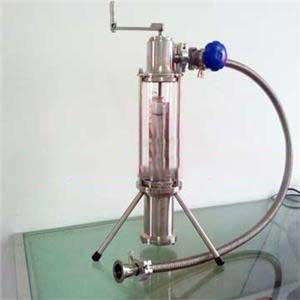
Vertical Maxwell vacuum gauge
NegotiableUpdate on 05/11
- Model
- Nature of the Manufacturer
- Producers
- Product Category
- Place of Origin
Overview
Style: Wall mounted/supported/supported with lever/with lever $r $n Measurement range: 1-15000Pa $r $n Accuracy error: #177; 15%
Product Details
| Vertical Maxwell vacuum gauge Model: DJKPM-6A |
Item number: ZH11531 |
| Product Parameters: Style: Wall mounted/Supported/Supported with lever/Supported with lever Measurement range: 1-15000Pa Accuracy error: ± 15% Usage: The steel needle and rubber head inserted into the vacuum tube are used for mercury loss during transportation of the vacuum gauge. Please remove them after the vacuum gauge is installed and connected to the vacuum system (please do not discard them, and when sent for maintenance in the future, they should be plugged and sent back). For the wall mounted or lever type vacuum gauge you have chosen, when using a bolt for fixed installation, it is necessary to ensure the verticality of the vacuum gauge to the horizontal plane. If using a support type or lever type, please screw on the three support rods one by one (the lever type also has a balance rod on the left side), and choose one Suitable for placing a platform to support the vacuum gauge, with the vacuum gauge properly positioned. When measuring vacuum degree (A) by rotating the handwheel, look at the handwheel from above the vacuum gauge. Clockwise rotation is to lift the mercury, and the rotation progress should be slow. When the mercury level in the suction tube (also known as the comparison tube) rises to the SET setting, then look at the mercury level position in the measuring tube on the right side The corresponding reading is the vacuum degree of the system, (B) measured by a lever. Hold down the balance bar with your left hand, pull out the lever with your right hand, and lift it down at a constant speed to raise the mercury level in the exhaust pipe to the SET setting. When the mercury level reaches the SET setting during vacuum limiting, the lever will automatically stop Stay in this position and check the vacuum degree on the right side. (C) For the reading of PM-6 vacuum gauge, the low vacuum measurement method is the same as A and B. The measurement method for the left coarse vacuum is to raise the mercury level in the right measuring tube to the "0" line at the lower end of the measuring tube, and then look at the left side The reading corresponding to the mercury surface in the comparison tube is the rough vacuum degree of the system. If your tested vacuum system cannot reach a low vacuum degree of 5PA or above, please choose a vacuum pump that can pump up to 0.1PA or above to vacuum exhaust the vacuum gauge. When the vacuum gauge can display a vacuum degree of 5PA or above, connect the vacuum gauge to the tested vacuum system. If a vacuum rubber tube is used for connection, please shorten the length of the hose to within 50cm. Of course, if the vacuum gauge is matched with the vacuum system, first use a ¢ 6MM copper tube to weld the copper nozzle of the vacuum gauge to each other, and configure a controllable connection between the vacuum gauge and the vacuum system The valve provides a good guarantee for the service life of the vacuum gauge. After the measurement is completed, the valve between the vacuum gauge and the measurement system should be closed in a timely manner, the handwheel should be retracted until it cannot be turned, and the lever should be returned to the over starting position. The following situations can cause inaccurate measurement of the vacuum gauge: (1) shaking and tilting of the vacuum gauge; (2) Not subjected to high vacuum treatment; (3) Entering liquids and dust; (4) Severe oxidation of mercury; (5) The rubber liner has ruptured and leaked air. Tip: Before unboxing and installing, do not rotate the bottom handwheel or press the lever to avoid mercury overflow! Maintenance and upkeep: Strictly follow the instructions for operation. It is recommended to store the vacuum gauge in a vacuum state during normal times. For vacuum environments with chemical, dusty, and polluting properties, please periodically clean the surface of the vacuum gauge. In Article 6 of the (Instructions for Use), if any of the three situations (3), (4), or (4) occur, please promptly send it to the manufacturer for repair. It is strictly prohibited to disassemble without authorization. Some components have already been positioned before leaving the factory, and maintenance services are also provided for foreign Maxwell vacuum gauges. |
 |
Similar Product Recommend


