- Phone
-
Address
Luwang 13864506509, Shahe Town, Laizhou City, Shandong Province
Product Categories
Laizhou Longjun Machinery Co., Ltd


Vacuum kneading machine
NegotiableUpdate on 05/15
- Model
- Nature of the Manufacturer
- Producers
- Product Category
- Place of Origin
Overview
Vacuum kneading machine is an ideal equipment for kneading, mixing, vulcanization, and polymerization of high viscosity, elastoplastic materials. Kneading machines can be used to produce silicone rubber, sealants, hot melt adhesives, food adhesives, pharmaceutical preparations, etc. Kneading machine is a special mixing and stirring equipment commonly used, which adopts two ∑ blade blades arranged in a parallel tangential differential type, that is, one blade has a fast speed and the other blade has a slow speed, in order to generate shear force. Different blade speeds enable the mixed material to be quickly sheared, so that the material can be mixed evenly.
Product Details
Vacuum kneading machineIt is an ideal equipment for kneading, mixing, vulcanization, and polymerization of high viscosity, elastoplastic materials. Kneading machines can be used to produce silicone rubber, sealants, hot melt adhesives, food adhesives, pharmaceutical preparations, etc. Kneading machine is a special mixing and stirring equipment commonly used, which adopts two ∑ blade blades arranged in a parallel tangential differential type, that is, one blade has a fast speed and the other blade has a slow speed, in order to generate shear force. Different blade speeds enable the mixed material to be quickly sheared, so that the material can be mixed evenly.
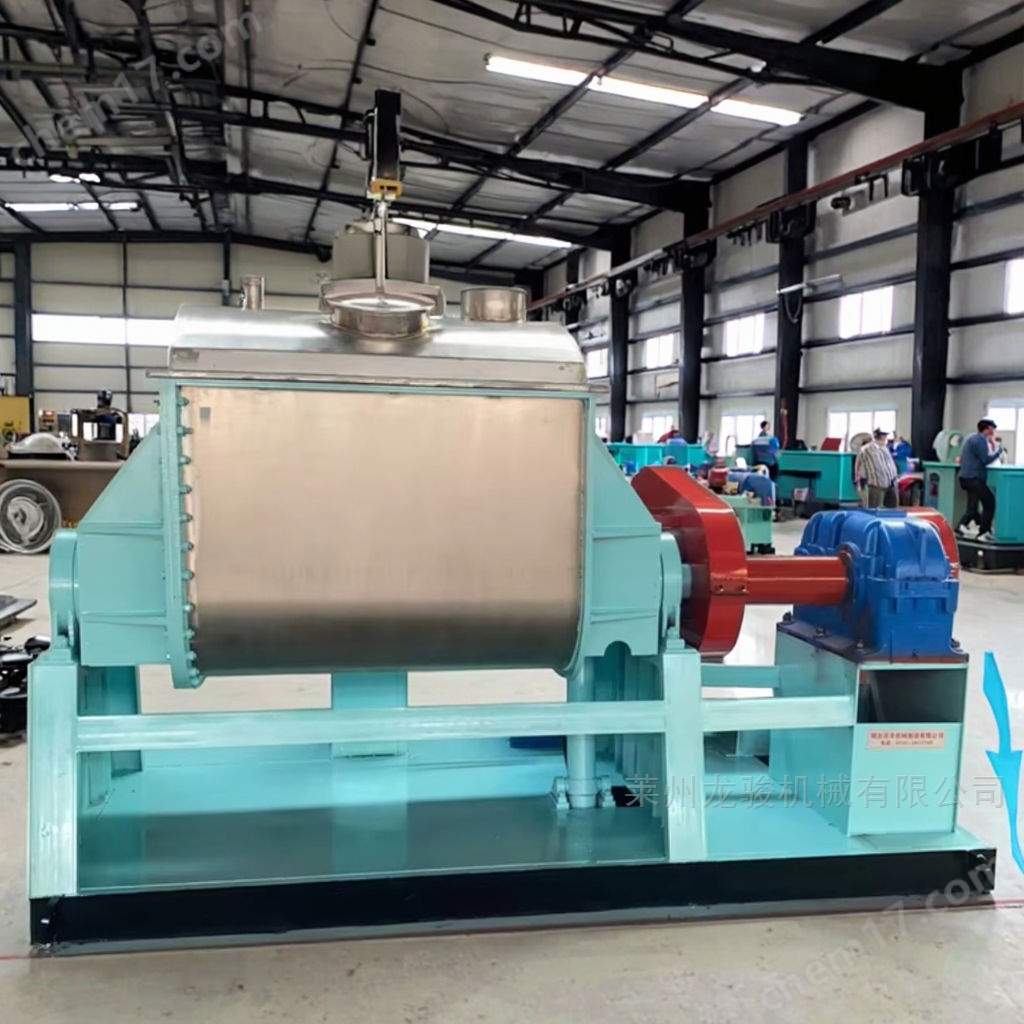
Vacuum kneading machineVacuum Kneader is a type of kneading machine mainly used in chemical production fields such as silicone rubber, glass glue, butyl glue, and hot melt glue. Kneading machine usually consists of several major components such as kneading system, vacuum system, heating system, cooling system, and electrical control system.
Structural features:
1. The kneading machine generally adopts a through chassis for easy installation.
2. Adopting helical gears or hard tooth surface reducers ensures smooth transmission with the main engine, low noise, and long service life.
3. The mixing blades and inner walls of the mixing tank are made of SUS304 stainless steel or SUS316L stainless steel to ensure the purity of the products.
4. The shaft seal structure is excellent and the sealing effect is good. Designed a vacuum box balance structure to ensure that no black material is ground out.
5. Integrated electrical control (host operation, hydraulic cylinder flipping, hydraulic cover opening, and constant temperature control) and temperature control and display for easy operation and process control.
Working principle:
Kneading machine is a strong shear action produced by a pair of interlocking and rotating ∑ blades, which rapidly reacts semi dry or rubber like viscous plastic materials to obtain uniform mixing and stirring.
The kneading machine is mainly composed of five parts: the kneading part, the machine base part, the hydraulic system, the transmission system, and the electronic control system. The hydraulic system is operated by a hydraulic station to control the large oil cylinder and complete the opening and closing functions. The hydraulic system is operated by a hydraulic station to control the oil cylinder and complete functions such as flipping the cylinder and opening the cover. The detailed parameters can be freely selected and requested by the user, and the operation is convenient and reliable. The transmission system consists of an electric motor, a reducer, and gears, and is matched with a motor according to the model of the kneading machine.
The transmission part of the kneading machine is synchronized by a motor, and after passing through an elastic coupling to the reducer, the output device drives the fast slurry to reach the specified speed, which can also be adjusted by a frequency converter.
The kneading machine has two ∑ - shaped blades, and the speed of the two blades is different. Different speeds can be set according to different processes, and the most common speed is 42/28 revolutions per minute.
Kneading machines can be designed in heating and non heating forms according to requirements. Heat exchange methods usually include electric heating, steam heating, circulating hot oil heating, circulating water cooling, etc.
The discharge methods of the kneading machine include hydraulic tilting, ball valve discharge, screw extrusion, etc. The cylinder body, blade and material contact parts are made of SUS304 stainless steel to ensure product quality.
Classification selection:
1. Kneading machines can be made into ordinary, pressure, vacuum, and high-temperature types.
2. According to the material, it can be divided into carbon steel kneading machine, stainless steel kneading machine, and special material kneading machine.
3. The discharge methods include hydraulic tilting, ball valve discharge, screw extrusion, etc.
4. According to the machine design capacity, it is divided into SH-1-SH-3000 liters.
5. According to different heat transfer media, it can be divided into steam heating, thermal oil electric heating, and water cooling types.
6. According to the weight of the load and the degree of impact, it is divided into standard type and heavy-duty type.
Blade structure:
1. The fish tail type stirring blade is suitable for kneading cellulose materials.
Z-type agitator, also known as simple agitator, has a simple shape and is used for dispersing and mixing pigments in resins under high viscosity conditions.
3. The cutting type stirring blade is a strong and tough stirring blade, suitable for kneading ultra-high viscosity substances under high power and heavy load conditions. When using cutting type mixing impellers, the arrangement of two blade tangent type is mostly adopted. Applicable materials: rubber, iron oxide, magnetic recording materials, etc.
4. The ∑ - type stirring blade is the most general type, which is suitable for kneading external substances that require significant movement in the kneading and tank operations. It is mainly used for the arrangement of two blades overlapping, especially in the case of extrusion dehydration operations, and is suitable for use with ∑ - type stirring blades. Applicable materials: chewing gum, chocolate, glass glue, sealant, hot melt adhesive, butyl rubber, manhole cover, carbon materials, etc.
Scope of application:
Kneading machines are widely used for mixing, kneading, crushing, stirring, vulcanization, and re polymerization of high viscosity and high elastoplastic materials. Kneading machines have the advantages of uniform stirring and high kneading efficiency.
Kneading machines have a wide range of functions, varieties, and applications, especially suitable for industries such as chewing gum, bubble gum, toothpaste, plastics, rubber, silicone rubber, dyes, pigments, inks, food adhesives, pharmaceuticals, building coatings, carbon, fiber, high viscosity sealants, neutral glass adhesives, aluminum silver paste, silicone gel, pulp, cellulose, battery pastes, dyes, silicone resins, cosmetics, etc.