- Phone
-
Address
No. 18 Anningzhuang East Road, Haidian District, Beijing
Product Categories
TaiShiTe (Beijing) Testing Technology Co., Ltd


TaiShiTe integrated steel bar detector
NegotiableUpdate on 05/14
- Model
- Nature of the Manufacturer
- Producers
- Product Category
- Place of Origin
Overview
The TST-GJ660 integrated steel bar detector, also known as the integrated steel bar scanner, is a non-destructive testing instrument used to detect the position, spacing, protective layer thickness, and diameter of steel bars in concrete. It is an important tool for quality inspection by construction units and inspection and acceptance units.
Product Details


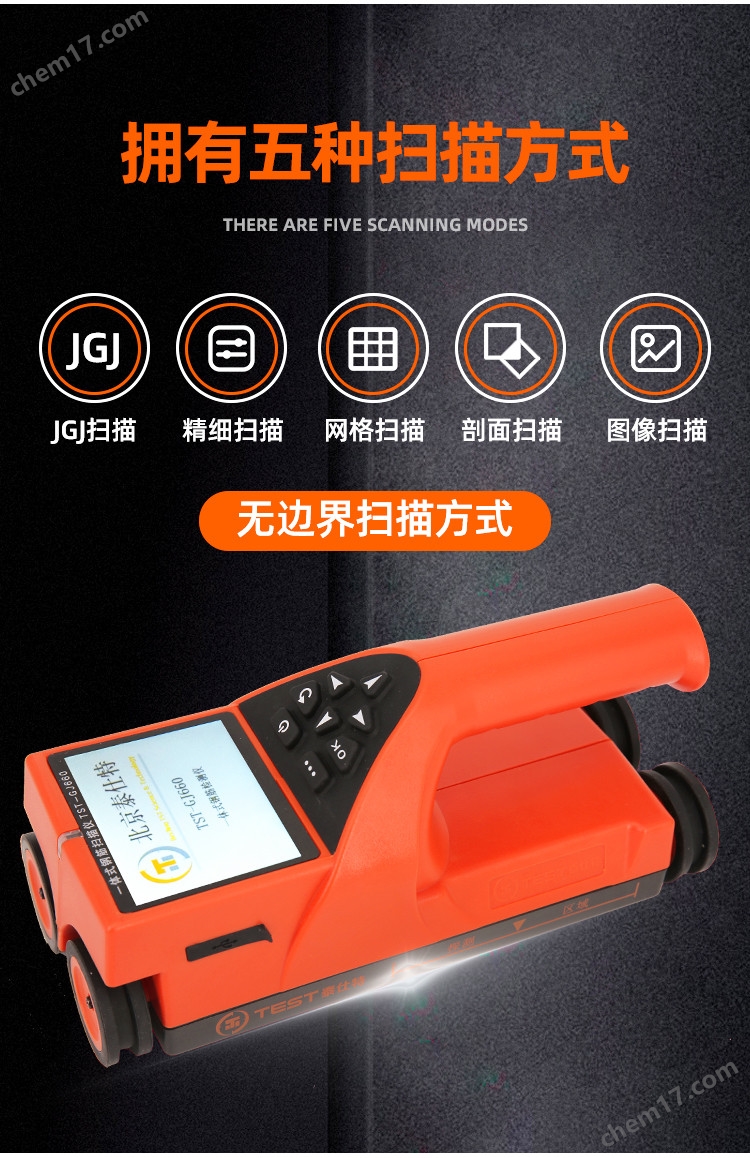


TaiShiTe integrated steel bar detectorTST-GJ660
Scope of application:Also known as steel bar position detector, it detects the position, distribution and direction of steel bars, thickness of protective layer, and diameter of steel bars in concrete structures such as bridges, tunnels, and walls; It can also detect the direction and distribution of ferromagnetic and conductive materials (such as wires and pipelines) in non ferromagnetic media; Quality acceptance and testing of concrete structure construction; Assess the safety and durability of structures under construction; Testing the amount of reinforcement during the evaluation and renovation of existing structures; Detect the distribution and direction of cables, plumbing pipes, etc. inside floor slabs or walls.
Compliant with standards:
JGJ/T152-2008Technical Specification for Steel Reinforcement Testing in Concrete;
GB 50204-2015Code for Acceptance of Construction Quality of Concrete Structures
GB/T50344-2004Technical Standards for Building Structure Inspection
DB11/T365-2016Technical specification for detecting the thickness and diameter of steel reinforcement protective layer using electromagnetic induction method
GBT/50784-2013Technical Standard for On site Inspection of Concrete Structures
JJF 1224 - 2009Specification for Measurement and Calibration of Reinforcement Protection Layer Thickness Measuring Instrument and Floor Thickness Measuring Instrument
Product Features:
The integrated structure of the host and sensor makes it easy and fast to carry and operate on site;
Adopting a multi coil structure design, it has faster speed, higher accuracy, and stronger resolution;
During the measurement process, it can be carried outJGJScanning, fine scanning, grid scanning, profile scanning, image scanning, 3D imaging and other borderless scanning methods;
The three-dimensional imaging function can clearly reproduce the distribution of steel bars inside the tested object;
Each detection mode is intuitive, with the position, spacing, and protective layer thickness of the steel bars displayed on the same screen;
Support detection modes for round steel and threaded steel
By using automatic storage of calibration values, fast measurement can be achieved, eliminating the hassle of each calibration task before detection.
Product Parameters:
name |
parameter indicators |
|
Applicable range of protective layer thickness |
2-205mm |
|
measurement range |
onerange |
2-100mm |
Two range |
2-205mm |
|
Allowable error of protective layer |
2~80mm |
±1 |
81~125mm |
±2 |
|
126~160 mm |
±3 |
|
161~205mm |
±4 |
|
Applicable range of diameter |
∅6mm-∅50mm |
|
Diameter estimation error |
±1mm |
|
JGJscan |
√ |
|
Fine scanning |
√ |
|
Profile scanning |
√ |
|
Grid scanning |
√ |
|
Image scanning |
√ |
|
3D imaging |
√ |
|
scanning range |
borderless |
|
Error correction function (spacing, thickness) |
√ |
|
Data transmission mode |
USB\\wireless |
|
display screen |
320*240 |
|
power supply method |
Built-in lithium battery |
|
Overall Dimensions |
235*95*106mm |
|
Instrument weight |
0.6KG |
|
TaiShiTe integrated steel bar detectorTST-GJ660Precautions to be taken during testing:
1. Avoid the mutual influence between steel bars. Select the testing area and reset the instrument away from ferromagnetic objects before testing. You can first test it, draw the position and direction of the steel bars with chalk, and then repeat the test to confirm the position of the steel bars.
2. The direction of instrument movement should be perpendicular to the direction of steel reinforcement. When the axis of the instrument is parallel to the axis of the steel bar, the sensitivity is high. When the axis of the probe is perpendicular to the axis of the steel bar, the sensitivity is low. During testing, it is necessary to ensure that the axis of the instrument is parallel to the measured steel bar and push the instrument wheel to move in the direction perpendicular to the axis of the measured steel bar.
3. Pay attention to the smoothness of the surface of the tested component. During the testing process, in order to ensure testing accuracy, a flat test surface is selected. When the surface is uneven or the protective layer is very thin, a non-metallic thin plate of known thickness can be placed and subtracted from the measurement results.


