-
E-mail
hualuyb@163.com
-
Phone
18015194111
-
Address
No. 201 Jinhe Road, Jinhu County, Huai'an City, Jiangsu Province
Product Categories
Jiangsu Hualu Instrument Co., Ltd
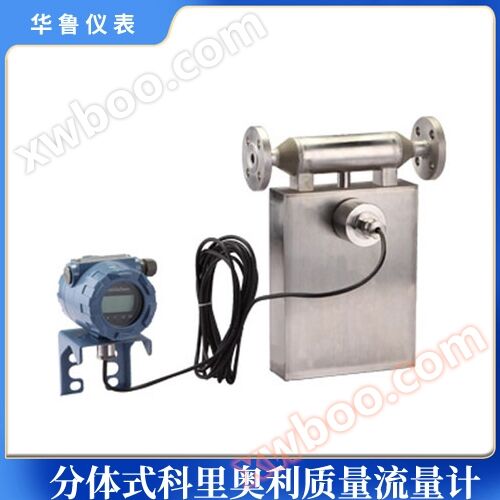
Split type Coriolis mass flowmeter
NegotiableUpdate on 08/15
- Model
- Nature of the Manufacturer
- Producers
- Product Category
- Place of Origin
Overview
Split type Coriolis mass flowmeter
Product Details
Detailed Introduction
1、 Product Overview:
The split type Coriolis mass flowmeter has two parallel U-shaped vibrating tubes inside the sensor, with a drive coil in the middle and pickup coils at both ends. The flowmeter directly measures the mass flow rate of the medium passing through the flowmeter, and can also measure the density of the medium and indirectly measure the temperature of the medium. Due to its excellent performance, it has high measurement accuracy, low requirements for fluid state, and small pressure loss. Various specifications of instruments can directly obtain the mass flow rate, volume flow rate, density, and temperature of the measured liquid or slurry, without the need for manual calculation or estimation.
2、 Working principle:
The structure of the split type Coriolis mass flowmeter is a double bend tube structure, and its measurement principle is to detect the mass flow in the pipeline by measuring the mass flow acting on the double bend tube. In industrial production processes, it is sometimes necessary to measure the mass flow rate of fluids, such as material balance, heat balance, and batching in chemical reactions. Mass flow rate refers to the mass of fluid flowing through a closed pipeline section per unit time.
3、 Structural composition:
A flowmeter consists of three parts: a sensor, a transmitter, and a digital indicator accumulator. The sensor consists of three parts: sensing tube, electromagnetic driver, and electromagnetic detector. The electromagnetic driver causes the sensor to vibrate at its natural frequency, while the introduction of flow causes a distortion under the action of the U-shaped sensor, resulting in a phase difference on its left and right sides, which is proportional to the mass flow rate. The electromagnetic monitor converts the phase difference into a corresponding level signal and sends it to the transmitter for electrical processing such as filtering, integration, and amplification. Convert into two forms of output: 4-20mA analog signal proportional to quality and frequency signal within a certain range.
4、 Application scenarios:
The split type Coriolis mass flowmeter is mainly used to measure the mass flow rate, total amount, and density of the medium. At the same time, it can also measure the volume flow rate and total amount, medium temperature, moisture content, alcohol content, concentration of two liquids mixed evenly, and raw material ratio in the process flow. It is mainly applicable to the following industries:
1. The petroleum industry, such as crude oil production measurement, water content measurement, single well production measurement, and crude oil transportation measurement;
2. Chemical industry;
3. Food industry;
4. The paper industry, such as pulp measurement;
5. Textile printing and dyeing industry;
6. Energy transmission metering, such as liquefied gas metering;
7. Environmental protection industry, such as sewage treatment; Measure the density of the slurry during the desulfurization process.
5、 Main features:
1. Directly measure the mass flow rate of fluid inside the pipeline:
High measurement accuracy and good repeatability, capable of directly measuring fluid mass flow rate over a large range; The accuracy of measurement is high, and the mass flow measurement accuracy of this flowmeter is 0.2 level;
2. Stable and reliable work:
There are no obstacles or moving parts inside the fluid measuring tube, so it has high reliability and long service life;
3. Suitable fluid medium surface width:
In addition to uniformly viscous fluids, it can also measure high viscosity fluids such as honey and oil slurry; Not only can it measure the fluid parameters of a single solution, but it can also measure multiphase flow; Whether the medium is laminar or turbulent, it does not affect its measurement accuracy;
4. Wide range of application environments:
Suitable for industries such as petrochemicals, chemistry, metallurgy, pharmaceuticals, papermaking, food, energy, and environmental protection, it has been widely used in process detection and control, as well as trade handover measurement;
5. Multiple real-time online measurement and control functions:
In addition to mass flow rate, it can also directly measure the density and temperature of fluids. An intelligent flow transmitter that provides display and control functions for multiple parameters is a multifunctional flow measurement and control instrument;
6. Good scalability:
We can design and manufacture flow meters with special specifications, models, and functions according to user needs; Remote monitoring operations can also be performed.
6、 Technical parameters:
1. Accuracy: ± [0.2%+(zero stability/instantaneous mass flow rate x 100%)
2. Repeatability: ± (1/2) × [0.2%+(zero stability/instantaneous mass flow rate × 100%)
3. Density range: 0.2 g/cm3 to 3.5 g/cm3;
4. Density accuracy: ± 0.002g/cm3;
5. Temperature range: -60 ℃ to+200 ℃;
6. Temperature accuracy: ± 1 ℃;
7. Current output: 4mA~20mA;
8. Frequency output: 0Hz~10kHz;
9. Batch control relay contact capacity: 24V/0.1A;
10. Batch control relay contact form: normally open (indicated by the user when ordering, can be changed to normally closed);
11. Fluid medium temperature: -40 ℃ to+200 ℃;
12. Working environment temperature: 0 ℃~+40 ℃;
13. Working environment humidity: ≤ 90% RH, non condensing;
14. Atmospheric pressure: 86kPa~106kPa;
15. Power supply requirements for transmitters: intrinsic safety power supply voltage AC (220 ± 10%) V or (50 ± 5%) Hz, composite power supply voltage (24 ± 10%) V
Whole machine power: < 15W
7、 Installation requirements:
Flow meters are high-precision measuring instruments. In order to ensure measurement accuracy, it is necessary to ensure that the installation environment meets the following requirements:
1. Sensors (primary meters) and transmitters (secondary meters) must not be installed in areas with strong magnetic interference, otherwise it will affect the circuit signal and thus affect the measurement accuracy;
2. The pipeline where the sensor (primary meter) is installed must not have any other vibration interference;
3. For outdoor installations, attention should be paid to the highest and lowest ambient temperatures, and windproof and rainproof measures should be considered to avoid wind and rain to improve the working life of the flowmeter;
4. The intrinsic safety flowmeter transmitter (secondary meter) should be placed in a safe area or a suitable control room;
5. The intrinsic safety flowmeter sensor (primary meter) and transmitter (secondary meter) are connected by a ten core shielded cable;
8、 Installation method and precautions:
1. Horizontal pipeline installation
The main body is facing downwards, measuring the liquid, and the outlet must be at least 0.8 meters high;
2. Invert the main body upwards
Self emptying, measuring the slurry containing solids, the outlet must be at least 0.8 meters above the highest point of the flowmeter;
3. Flag installation (test installation)
Self emptying, measuring liquids or slurries, the liquid must flow from bottom to top.
9、 Fault handling:
In general, flow meters do not malfunction, and it is not a big deal if they do. Careful analysis of the cause can solve the problem, such as whether the working conditions have changed, whether there is air leakage, whether they have just been calibrated and used, etc. Below are a few types of malfunctions and their solutions:
1. Hardware malfunction:
If there is a large error, the integrator does not light up or increase in value, or the display shows kb * * * bits, the reasons are:
a. Improper installation can directly lead to zero drift of the flow meter. For example, if installed close to the pump outlet, the sensor support strength is insufficient, improper welding of the connecting flange generates stress signals, and the cable is subject to electromagnetic interference.
b. Wiring issues
If the monitor does not light up, check the power connection of the integrator. If the fuse is blown, confirm whether the input voltage is consistent with the nominal value of the standard voltage and whether the AC/DC form is the same. If the accumulator does not increase with the flow rate, the wiring of the accumulator should be checked. If the accumulator is equipped with forward/reverse programs, the wiring of the flow meter should be checked. Incorrect wiring of the flow meter can cause the accumulator to not increase in reverse flow.
c. Change in process medium
If the measuring medium exhibits phenomena such as gas entrapment, gasification, or two-phase flow, the transmitter will display an alarm, and in severe cases, the sensor will stop working.
d. The transmitter is malfunctioning.
e. Sensor failure.
f. Pipeline blowing problem.
2. Software issue:
Before installing and using a newly calibrated flowmeter, it is important to pay attention to zero calibration under the current operating conditions. It is necessary to ensure that the flowmeter is filled with medium and close the two end shut-off valves before zero calibration can be performed. There are many specific methods, such as panel operation, manual operation, and using ProLink II software.
a. Zero calibration error;
b. Parameter settings are incorrect;
c. Pulse fluctuations of power supply;
d. I/O configuration error (be sure to pay attention to the range);
e. Operation error.
Selection Table:

Selection Table:


