- Phone
-
Address
No. 1888, Zhonghua Yuan West Road, Yushan Town, Kunshan City, Jiangsu Province
Product Categories
Guangdong Tianrui Instrument Co., Ltd
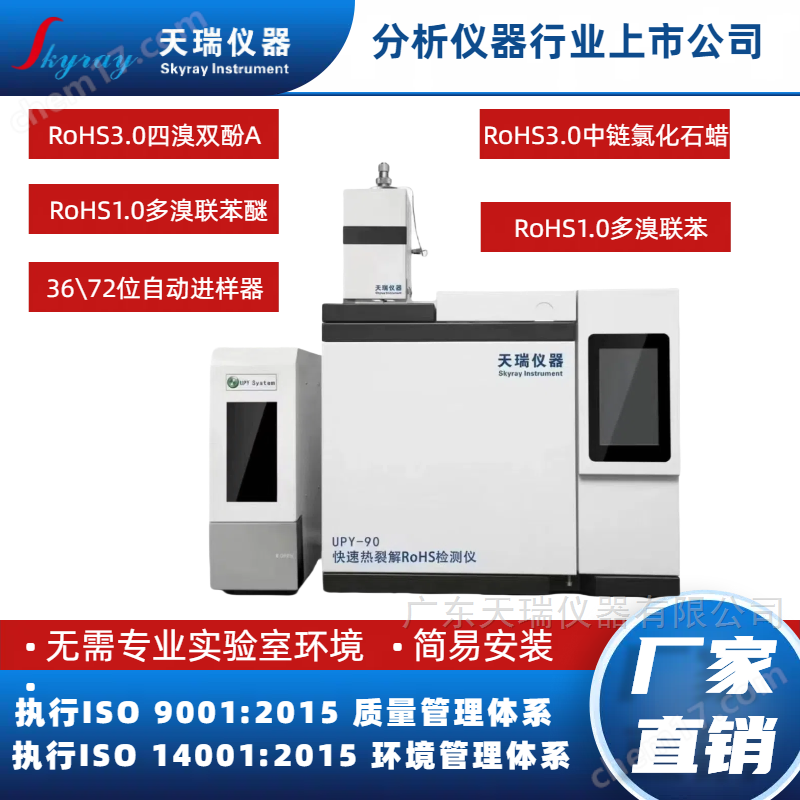


Speaker product RoHS 2.0 tester
NegotiableUpdate on 05/07
- Model
- Nature of the Manufacturer
- Producers
- Product Category
- Place of Origin
Overview
The speaker product RoHS 2.0 tester is carefully crafted by Tianrui Instrument and is suitable for rapid screening and detection of phthalates 4P (DIBP, DBP, BBP, DEHP) in the 2019 new version of the RoHS 2.0 directive (EU 2015/863). The working principle of this instrument is as follows: the cracking system heats the sample at high temperature to crack it, and the sample to be tested becomes cracking gas. Then, it is carried into the GC unit by a carrier gas, separated by a chromatographic column, and subjected to high-precision qualitative and quantitative analysis by a FID detector. Application areas: toys, electronics, food, packaging materials, medical devices, plastics, rubber, adhesives
Product Details
Effective control in speaker productsRoHSHarmful elements are a systematic engineering that needs to run through the entire product lifecycle, from design, supply chain management, production to final product testing. The following are key control measures:
1. Design phase: Prevention oriented
·Green Design Guidelines:Develop and follow internal guidelines“Eco-design”or“Green materials”Standard, clearly prohibited from useRoHSSubstances restricted in instructions(CdThePbTheHgTheCr6+Polybrominated biphenylsPBBsPolybrominated diphenyl ethersPBDEsas well as4Phthalate esters:DEHPTheBBPTheDBPTheDIBP).
·Pre evaluation of material selection:During the design phase of a new project or when selecting new materials:
oChoose ComplianceMaterial library:Prioritize selecting materials (circuit boards, components, connectors, wires, plastic parts, coatings, adhesives, packaging, etc.) from certified and qualified supplier material libraries.
oMaterial declaration:Request potential material suppliers to provide complianceRoHS 2.0Detailed Material Declaration Form (including all)10Assess the authenticity and reliability of the declaration documents for restricted substances.
oHigh risk material avoidance:Clearly identify high-risk materials that may contain restricted substances (such as certain specific pigments, stabilizers, solder, electroplating coatings, elastomers, etc.), and require suppliers to provide alternative solutions without harmful substances.
2. Supply Chain Management: Source Control is the Most Critical
·Supplier qualification review and selection:
oEvaluate the supplier's environmental management system (such asISO 14001)AndRoHSMaturity of compliance system.
oTranslate into EnglishRoHSCompliance is a mandatory condition for supplier selection and a necessary condition for importing new materials.
·Sign environmental protection agreement:Sign legally binding agreements or terms with suppliers, specifyingRoHSCompliance requirements and consequences of exceeding standards (recalls, fines, etc.).
·Request for Compliance Certificate:
oRoHSCompliance Certificate/Declaration of conformity:Require suppliers to provide coverage for each batch of supplyRoHS 10Certificate or declaration of conformity for the substance.
oMaterial Composition Declaration Form:Obtain a more detailed declaration that does not contain restricted substances.
oTest report:Depending on the material risk level, suppliers are required to provide a certificate issued by a qualified third-party laboratoryRoHSTest report (especially for new suppliers, high-risk materials, and materials after design changes).
·Incoming inspection:
oBatch inspection of high-risk materials:For externally purchased components (such asPCBBoards, connectors, plastic parts with specific color powders, solder wires/Tin bars, coatings/Key monitoring of ink and other materials can be carried out using:
§XRFQuick screening:Using Tianrui Instrument EDX1800BXX-ray fluorescence spectrometer for on-site non-destructive rapid screening.XRFCan effectively detect heavy metals(Pb, Hg, Cd, CrHowever, the detection accuracy is limited, and the detection of complex compounds such as bromine and phthalates is difficult and risky.
§Third party laboratory inspection:ForXRFAbnormal results, high-risk materials, new supplier supply, annual periodic verification, etc. must be sent to a third-party laboratory for chemical analysis (usually using gas chromatography)-Mass spectrometer for detecting brominated flame retardants and phthalates, inductively coupled plasma mass spectrometer for detecting heavy metals, etc. Ensure that the laboratory hasILACorCNASWaiting for qualifications.
oMaterial control:clearly markedRoHSStatus, to prevent confusion with non compliant materials.
3. Production and manufacturing process control: prevent pollution
·Lead free process:Ensure that the welding process is carried out in compliance withRoHSLead free solder. The parameters and equipment of wave soldering and reflow soldering furnaces must be optimized for lead-free processes.
·Equipment management:
oSpecialized equipment:As much as possibleRoHSProduction Line and Non ProductionRoHSThe production line is physically isolated to avoid cross contamination. If isolation is not possible, it is necessary to:
oCleaning:Before switching production, strictly clean shared equipment such as surface mount machines, molds, fixtures, and wire processing equipment.
·Tool and accessory control:Ensure that all production auxiliary materials such as manual soldering, flux, cleaning agents, lubricants, adhesives, etc. used in production also comply withRoHSrequirement.
·Employee training:For operators, warehouse personnel, etcRoHSKnowledge training to understand control requirements, pollution risks, material differentiation, and management regulations.
4. Finished product control and traceability
·Regular verification of finished products:In addition to controlling materials, it is also necessary to regularly (such as per batch or plan) inspect the final speaker products:
oconductXRFRapid screening (usually requires multi-point testing at different locations, such as the metal parts of the internal circuit board, the outer plastic shell, wire interfaces, etc.).
oConduct destructive testing on key structural components or the entire machineXRFTesting (for plastic casings, circuit boards, etc.).
oFor high-risk projects or regular verification requirements, send them to a third-party laboratory for complete testingRoHS 10Item testing.
·Traceability:Establish a complete traceability system(BOMList, supplier batch information, inspection records, production records), to ensure that when a material or batch of products is found to be non compliant, the affected area (such as the quantity and model of products already produced) can be quickly identified and corrective measures (such as isolation, recall) can be taken.
5. System assurance and continuous improvement
·Establish management procedures:制定《RoHSThe Hazardous Substance Management Procedure document specifies the responsibilities of each department, control processes (from design to shipment), sampling plans, acceptance criteria, and non conformance handling procedures.
·Internal Audit:regular auditRoHSThe effectiveness of the operation of the control system.
·Response to standard updates:Pay close attention to the European Union and other countries or regionsRoHSUpdate and expand instructions (such as adding restricted substances, such as certain cobalt salts currently under discussion), and update internal requirements and procedures in a timely manner.
·Supplier evaluation:to the supplierRoHSRegularly evaluate performance (speed and accuracy of delivering compliance certificates, authenticity of test reports, speed of problem response, etc.).
Summary of Control Points
Control stage |
Key measures |
Key control points |
Material Selection in Design |
Environmental design guidelines, priority selection of compliance libraries, requirement for supplier declarations, avoidance of high-risk materials |
Preventive controlAvoid using materials containing restricted substances during the design phase |
Supplier Management |
Strictly select compliant suppliers, sign environmental agreements, and requestRoHScertificate/MSDS/Test Report |
source controlEnsure that the input materials meet the requirements |
Incoming Inspection |
XRFRapid screening (batch inspection of key materials), sending high-risk or problematic materials for laboratory testing |
the first line of defenseBy detecting and preventing the flow of unqualified materials into the production line |
production process |
Use lead-free solder (process confirmation), equipment pollution prevention management (isolation)/Cleaning, tools/Auxiliary material control, employee training |
process controlTo prevent pollution and mixing during the production process |
finished goods shipment |
finished productRoHSCertificates and finished productsXRFSampling (regular), high-risk or regularly required laboratory testing, establishment of a complete traceability system |
Final reviewVerify the conformity of the finished product and provide a basis for tracing possible issues |
System assurance |
establishRoHSManagement procedures, supplier performance evaluation, and attention to regulatory updates |
Systematic guaranteeEnsure continuous compliance with requirements |
Conclusion:Speaker productsRoHSControl is a full chain process that runs through design, procurement, production, and finished products. The core lies inSource control and prevention (design material selection and supplier management), supplemented byStrict incoming inspection (especiallyXRFScreening and necessary third-party testingandProduction process controlAnd withDeclaration of conformity and necessary testing of finished productsand*The traceability systemAs the ultimate guarantee. Establishing a continuous improvement quality management system is an effective control measureRoHSHarmful elements, compliance with regulatory requirements, reducing quality risks, and maintaining brand reputation are key factors.

The rapid thermal cracking RoHS detector is carefully crafted by Tianrui Instrument and is suitable for rapid screening and detection of phthalate 4P (DIBP, DBP, BBP, DEHP) in the 2019 new version of the RoHS 2.0 directive (EU 2015/863). The working principle of this instrument is as follows: the cracking system heats the sample at high temperature to crack it, and the sample to be tested becomes cracking gas. Then, it is carried into the GC unit by a carrier gas, separated by a chromatographic column, and subjected to high-precision qualitative and quantitative analysis by a FID detector.
Speaker product RoHS 2.0 testerapplication field
Screening and testing of plasticizers in industries such as toys, electronics, food, packaging materials, medical equipment plastics, rubber, adhesives, cellulose, resins, cables, etc.
Speaker product RoHS 2.0 testerProduct Features
Simplify or avoid environmental impact assessment, and detect phthalate 4P without sample pretreatment process;
An innovative rapid injection system that meets direct injection requirements, facilitates the replacement of sample cups, is suitable for various forms of samples, and reduces operational complexity;
High performance fourth generation fully automatic gas chromatograph with EPC pre column pressure control and EFC column flow control;
Short sample analysis time, meeting the needs of rapid screening;
The heating rate of the cracking chamber is fast, and the repeatability and reproducibility of qualitative and quantitative analysis are achieved;
Adopting a high-definition 7-inch touch LCD screen and intuitive human-computer interaction interface to enhance user experience.


Similar Product Recommend


