-
E-mail
85405976@qq.com
-
Phone
13955096002
-
Address
No. 20 Renhe South Road, Tianchang City
Product Categories
Anhui Tiankang (Group) Co., Ltd

Rubber sheathed cable
NegotiableUpdate on 12/11
- Model
- Nature of the Manufacturer
- Producers
- Product Category
- Place of Origin
Overview
Rubber sheathed cable is a flexible and movable type of cable made of multiple strands of thin copper wire as conductors, wrapped with rubber insulation and rubber sheath. Generally speaking, it includes various types such as universal rubber sheathed flexible cables, welding machine cables, submersible motor cables, radio device cables, and photography light source cables.
Product Details
Rubber sheathed cableIt is a flexible and movable cable variety made of multiple strands of thin copper wire as conductors, wrapped with rubber insulation and rubber sheath. Generally speaking, it includes various types such as universal rubber sheathed flexible cables, welding machine cables, submersible motor cables, radio device cables, and photography light source cables.
Introduction
edit
Rubber sheathed cables are widely used in various electrical equipment, such as mobile power cords for household appliances, electric machinery, electrical devices, and appliances. It can be used both indoors and outdoors. According to the mechanical external force acting on the cable, the product structure is divided into three categories: light, medium, and heavy. There are also appropriate connections on the cross-section.
Generally, lightweight rubber sheathed cables are used in household appliances and small electric equipment, requiring softness, lightness, and good bending performance;
Medium sized rubber sheathed cables are widely used in agricultural electrification, except for industrial applications;
Heavy duty cables are used in applications such as port machinery, searchlights, and large-scale hydraulic irrigation stations in households. This type of product has good universality, complete series specifications, good and stable performance [1].
Scope of application
edit
Waterproof rubber sheathed cables and cables for submersible pumps: mainly used for matching submersible motors, models JHS and JHSB.
Wireless device cables: We mainly produce two types of rubber sheathed cables (one shielded and one unshielded), which can basically meet the requirements. The models are WYHD and WYHDP.
Photography cable products: With the development of new light sources, they have a small structure, good performance, and meet the needs of indoor and outdoor work, gradually replacing some old products that are bulky and have poor heat resistance.
classification
edit
Rubber sheathed cables are divided into heavy-duty rubber sheathed flexible cables (YC cables, YCW cables), medium-sized rubber sheathed flexible cables (YZ cables, YZW cables), lightweight rubber sheathed flexible cables (YQ cables, YQW cables), waterproof rubber sheathed flexible cables (JHS cables, JHSP cables), welding machine cables (YH cables, YHF cables), and YHD cables, which are tin plated power connection wires for outdoor use.
Related instructions
edit
Welding machine cable
Model: YH, YHF
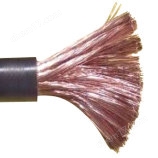
Rubber sheathed cableProduct Description: Suitable for secondary side wiring and connection of welding tongs for welding machines with ground voltage AC not exceeding 200V and pulsating DC peak 400V. It is a dedicated cable for secondary side wiring and connection of welding tongs for welding machines, with a rated voltage AC not exceeding 200V and pulsating DC peak 400V. The structure is a single core and made of multiple strands of flexible wire twisted together. The conductive wire core is wrapped with heat-resistant polyester film insulation tape, and the outermost layer is made of rubber insulation and sheath as a protective layer.
Waterproof rubber sheathed flexible cable
Model: JHS, JHSP

Waterproof rubber sheathed flexible cable
Product Description: JHS waterproof rubber sheathed cable is used for transmitting electrical energy on submersible motors with AC voltage of 500V and below. Under long-term immersion and high water pressure, it has good electrical insulation performance. Waterproof rubber sheathed cables have good bending performance and can withstand frequent movement.
Development Overview
edit
The wire and cable industry is the second largest industry in China after the automotive industry, with a product variety satisfaction rate and domestic * exceeding 90%. Worldwide, China's total output value of wires and cables has surpassed that of the United States. With the rapid development of China's wire and cable industry, the number of new enterprises continues to increase, and the overall technical level of the industry has been greatly improved.
The sustained and rapid growth of the Chinese economy has provided a huge market space for cable products, which has attracted the world's attention to the Chinese market. In the short decades of reform and opening up, the huge production capacity formed by China's cable manufacturing industry has impressed the world. With the continuous expansion of China's power industry, data communication industry, urban rail transit industry, automobile industry, shipbuilding and other industries, the demand for wires and cables will also grow rapidly, and there is still huge development potential for the wire and cable industry in the future.
In November 2008, in response to the global financial crisis, the Chinese government decided to invest 4 trillion yuan to boost domestic demand, of which more than 40% was used for the construction and renovation of urban and rural power grids. The national wire and cable industry has once again had a good market opportunity, and wire and cable enterprises in various regions have seized the opportunity to welcome a new round of urban and rural power grid construction and renovation.
Precautions
edit
1、 Equipment: A small pressure device with automatic temperature control, timing, and multiple specifications of tubular mold cavities.
2、 Rubber material: Consistent with the wire of the supplemented wire, with a higher rubber content than the supplemented material, and a slightly stronger vulcanization system.
3、 Operation method:
1. Set the temperature and time according to the vulcanization system of the rubber material;
2. Wipe the repaired area with rubber and ink thinner, especially the joint should be fully treated;
3. Cut and repair the adhesive material appropriately according to the size of the gap, taking care not to have too much or too little;
4. Insert the cut adhesive material into the gap, taking care not to exceed the circumference of the wire;
5. Wrap it with heat-resistant PP tape. And place it into a tubular mold cavity slightly smaller than the wire diameter, lock the upper and lower molds, and apply a certain amount of pressure to the filled position. Note that the diameter of the mold cavity is slightly smaller than the wire diameter by 0.1~0.2mm;
6. When the vulcanization time is up, take out the product. If a small amount of rubber material overflows, use a sharp blade to clean it up and wipe it off with diluent.
4、 Verification method:
Press an appropriate amount of air into the supplied wire and place it in water. Check for any air leakage to determine its quality.
Reasons for appearance defects
edit
In the production process of rubber sheathed cables, appearance defects often occur, such as uneven surfaces; There are clinker particles (early vulcanized rubber particles) or impurities on the surface; Scratches and abrasions on the surface of wires and cables; Surface collapse; There are Fried Dough Twists patterns on the surface. Here are five common reasons for appearance defects in rubber sheathed cables:
1. The supporting wire of the mold sleeve is too long or too short, the mold mouth is not smooth, and the aperture is too large; Low temperature of the machine head, die or body; Rubber materials with low plasticity may cause the surface of rubber sheathed cables to be uneven.
2. The supplied rubber is not clean and contains impurities; The burning time of the rubber material is too short; The temperature of the extruded rubber body, nose or mouth mold is too high; The rubber flow inside the machine head is not smooth, and there are blind spots where rubber material is trapped; Unsmooth screws, adhesives, and other factors may lead to the appearance of clinker particles (early vulcanized rubber particles) or impurities on the surface of rubber sheathed cables.
3. The mold sleeve is not smooth and has no chamfer; Impurities or cooked glue particles block the mold mouth; Scratches caused by dragging the vulcanized tube inside; The small aperture of the sealing rubber gasket at the outlet of the vulcanized pipe may cause scratches and abrasions on the surface of the rubber sleeve cable.
4. The aperture of the mold sleeve is too large; The gaps between the outer layers of the conductive wire core and between the single wires are too large, and the outer diameter of the cable core is uneven; Rubber has low plasticity and poor viscosity; There are impurities in the rubber material; Small distance between molds and low pressure may lead to surface collapse of rubber sheathed cables.
5. The aperture of the mold sleeve is too small; Insufficient extrusion of rubber material and insufficient filling of gaps in the wire core; Conductive wire core or cable core jumper; The short distance between two molds may cause Fried Dough Twists on the surface of the rubber sheathed cable.


