- Phone
-
Address
Era Wealth World
Product Categories
Beijing Century Jiantong Technology Co., Ltd


Radiant heat sensor heat flow meter
NegotiableUpdate on 05/15
- Model
- Nature of the Manufacturer
- Producers
- Product Category
- Place of Origin
Overview
The JT1500 series radiation heat sensor heat flux meter is an innovative product independently developed, based on flexible sensing technology and current excellent processing technology, which realizes the detection of radiation heat intensity with small volume and large signal. The JT1500 series thin film flexible, with its excellent performance characteristics, can meet the testing needs of multiple fields, and its comprehensive performance indicators have achieved the blank of domestic substitution for independent products.
Product Details
JT1500 seriesRadiant heat sensor heat flow meter
(Flexible Sensor Technology)-Sensor for measuring heat flux density/heat flux during radiative heat transfer process
JT1500 seriesRadiant heat sensorThe independently developed innovative product, based on flexible sensing technology and processing technology, achieves radiation heat intensity detection of small volume and large signal.JT1500 series thin film flexibleRadiant heat sensorIts excellent performance characteristics can meet the testing needs of multiple fields, and its comprehensive performance indicators have achieved the blank of domestic substitution for domestic independent products.
Applicable standards:
GB/T 18204.17-2000: Method for determination of radiated heat in public places
GB/T 17050-1997: Terminology for Thermal Radiation
GB/T 18204.1-2025 "Methods for hygiene inspection in public places - Part 1: Physical indicators"
Features:
Wide temperature range -40-200 ℃: The JT1500 series has a low-temperature type of 120 ° C and a medium high temperature type of 200 ° C, which can meet different testing needs in multiple fields.
Fast response<10S: The ultra-thin sensor substrate makes the temperature sensing speed faster, the time to reach thermal equilibrium shorter, and the overall response faster.
Flexible material (sensor bendable): According to industrial grade design, all are subjected to high and low temperature tests, vibration tests, salt spray tests, etc.
Small volume (10 × 10mm): Thermal sensor based on flexible sensing technology. The thickness can be as low as 0.5mm or less, and the external dimensions can be as small as 10x10mm.
Typical applications:
Industrial production process
Paper and Printing Industry:
Scenario: Installed in drying equipment for paper, film, and fabric.
Application: Measure the combined heat flux of radiation and convection applied by infrared, hot air and other drying units on the surface of materials, accurately control the drying process, prevent excessive or uneven drying, and save energy.
In the field of architecture and energy conservation
Thermal comfort assessment: The human body's thermal sensation is not only affected by air temperature, but also significantly affected by radiant heat from windows, cold walls, radiators, and other sources. Sensors are used to measure "radiation temperature asymmetry" and evaluate whether there are uncomfortable conditions such as "cold radiation" or "hot radiation".
Floor heating/radiant panel system monitoring: measures the actual radiant heat flux emitted by floor heating or ceiling radiant cooling/heating systems for system control and energy efficiency management.
Meteorology and Solar Energy Utilization
Net radiation measurement: Two back-to-back sensors (one facing up and one facing down) are used to measure the balance between solar shortwave radiation and ground longwave radiation, known as net radiation. This is the core parameter for studying the energy balance on the Earth's surface and climate change models.
Solar radiometer: a sensor specifically used to measure total solar radiation (direct+scattered radiation), which is a key equipment for solar energy resource assessment, photovoltaic power plant site selection, and efficiency monitoring.
Application of fire engineering
Scenario: Installed on the top or wall of cable tunnels, computer rooms, warehouses, and clean energy power stations (such as lithium battery compartments and energy storage stations).
Application: As a heat flux meter, used for early fire detection. Before the appearance of an open flame, potential overheating faults or smoldering can generate abnormal thermal radiation. Heat flow sensors respond earlier and more sensitively than traditional temperature detectors, providing valuable time for early warning and fire extinguishing.
Aerospace field
Spacecraft thermal control system testing: In the thermal vacuum chamber that simulates the space environment on the ground, it is pasted on the surface of spacecraft models such as satellites and probes to calibrate and verify the thermal mathematical model of the spacecraft, ensuring that its thermal control design can work normally in the real space environment.
Clothing and equipment testing: Place it on the surface of a dummy's skin or on the outer layer of special clothing to quantitatively measure the thermal shock (heat flux density) that the human body model can withstand in simulating harsh environments such as extreme cold and high temperature, in order to evaluate the thermal insulation performance level of professional clothing.
Sensor features:

Specifications and dimensions:
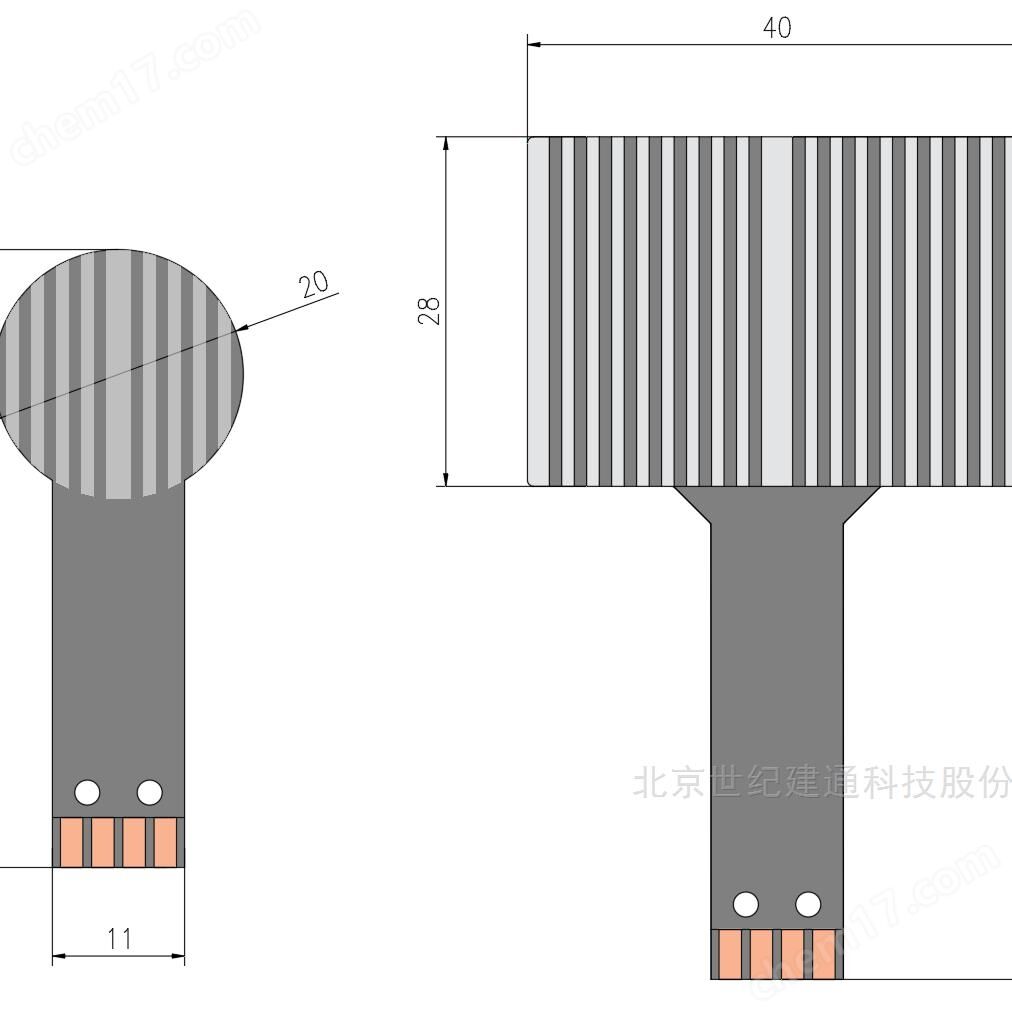
40X28 rectangle, total radiation, full band, no shell
Measurement range: 0~10000W/m2
Nominal sensitivity: 3.00-8.00 μ V/(W/m2)
Response time:<10s
Measurement accuracy: ± 5%
Output signal: DC 0~106 μ V
D20 circular, total radiation, full band, no shell

Measurement range: 0~10000W/m2 nominal sensitivity: 3.00-8.00 μ V/(W/m2)
Response time:<10s
Measurement accuracy: ± 5%
Output signal: DC 0~106 μ V
JT1500 seriesRadiant heat sensor heat flow meter
Technical specifications:
Measurement range: 0~10000W/㎡
Measurement value expressed in SI units: heat flux density/irradiance (W/m ²)
Sensor type: Thermopile
Nominal sensitivity: 3.00-8.00 μ V/(W/㎡)
Response time:<10s
Measurement accuracy: ± 5%
Rated working range: -40~120 ° C; 0~100% RH (customizable to 200 ° C)
Standard cable length: 2 meters
Output signal: DC 0~106 μ V
Spectral range: infrared+visible light
Measurement angle: 180 °
Black coating emissivity: 0.92 (estimated value)
Interface form: Standard 3.5 headphone jack or bare wire
Storage temperature: -30-80 ℃
Note:
JT1500 seriesRadiant heat sensorHaving a linear output signal and constant sensitivity, without the need for power supply or cold end compensation. It is a true differential sensor that users can directly connect to a voltmeter or any data acquisition device with DC voltage acquisition. Each sensor is calibrated in units of μ V/(W/m2).
Similar Product Recommend


