- Phone
-
Address
Building 4, China Railway Zhonghuan Times Square, Lane 299 Jiangchang West Road, Shanghai
Product Categories
Shanghai Luozhong Technology Development Co., Ltd

Q-FOG cyclic corrosion salt spray box, Luozhong Technology
NegotiableUpdate on 05/06
- Model
- Nature of the Manufacturer
- Producers
- Product Category
- Place of Origin
Overview
Q-FOG cyclic corrosion salt spray box from Luozhong Technology can simulate various salt spray environments and is suitable for salt spray aging testing of various materials such as clothing metal parts, electroplated parts, painted parts, automotive parts, electronic components, etc.
Product Details
Q-FOG cyclic corrosion salt spray box, Luozhong Technology
Q-FOG cyclic corrosion salt spray box from Luozhong Technology,It can simulate various salt spray environments and is suitable for salt spray aging testing of various clothing metal parts, electroplated parts, painted parts, automotive parts, electronic components and other materials. Research has shown that the results of cyclic corrosion testing are similar to those of outdoor testing in terms of structure formation, morphology, and relative corrosion rate.
Before the emergence of cyclic corrosion testing, traditional salt spray (35 ° C continuous salt spray) testing was the standard way to simulate corrosion in the laboratory. Due to the inability of traditional salt spray testing methods to simulate natural wet/dry cycles outdoors, the test results often have poor correlation with outdoor conditions.
In the Q-FOG cyclic corrosion salt spray chamber, the sample is exposed to a series of different environments that simulate outdoor conditions and repeat cycles. Simple cycles, such as the Prohesion cycle, can cycle between salt spray and drying. More complex automotive testing methods may require a multi-step cycle that combines humidity or condensation, along with salt spray and drying.
In a Q-FOG cyclic corrosion salt spray box, it can circulate through a series of important corrosion environments. Even complex testing cycles can be easily programmed and implemented using Q-FOG controllers.
There are three models of Q-FOG cyclic corrosion salt spray box. The SSP model is used for traditional salt spray and Prohesion testing. The CCT model is used for cyclic automotive testing with salt spray, Prohesion, and 100% humidity. The CRH model is used for traditional salt spray, Prohesion (wet dry mixed salt spray test), and most automotive cyclic corrosion tests. Its features include the ability to adjust relative humidity and precisely control rise time, as well as an optional flushing function.
Main features:
1. Each model has two size specifications
All models of Q-FOG (SSP, CCT, and CRH) come in two salt spray box size specifications (600 liters and 1100 liters) to meet the testing requirements for both small and large sample sizes. Wheel sets can be provided for moving salt spray boxes within the laboratory space.
2. Convenient placement of samples
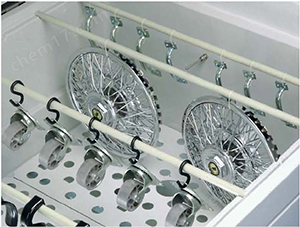
The low waistline design and easy to open top cover of the Q-FOG salt spray box make sample placement more convenient. The test board bracket, hanging rod kit, and flat grille can conveniently place specimens of any shape, size, and 554kg weight.
3. Enhance the glass fiber structure
The Q-FOG salt spray box is made of sturdy fiber-reinforced plastic. The sturdy and thick walls and top cover of the box have good insulation performance, which can effectively and accurately control the temperature inside the box. Heat resistant resin materials can withstand higher test conditions than ordinary salt spray boxes.
4. Built in solution storage tank
The Q-FOG salt spray box is equipped with a built-in solution storage tank, which improves space utilization and reduces maintenance. A storage tank capacity of 120 liters can meet the needs of most experiments for a week or longer. The storage tank is also equipped with a salt spray filter and a built-in liquid level alarm function, which can send an alarm signal to remind the operator when the liquid level is too low.
6. The user interface is very simple
The user interface design of Q-FOG salt spray box has strong functionality, high reliability, and easy operation. The controller has a complete self diagnosis and error detection function, and the operating interface is available in 5 languages (English, German, Spanish, French, and Italian are optional).
7. Rapid box temperature cycling
The Q-FOG salt spray box has a unique internal heater and high-power drying and cooling fan, which can quickly change the temperature of the test box. The additional air heater allows the sample to undergo salt spray corrosion testing under low humidity and dry conditions. Ordinary water jacket salt spray boxes cannot achieve low humidity environments or rapid circulation.
8. Accurate control of salt spray diffusion
Compared with the ordinary salt spray box, the Q-FOG salt spray box has a much better salt spray diffusion effect. The ordinary salt spray box cannot independently adjust the spray amount and spray distance. Q-FOG uses compressed air pressure regulator to control the distance of "spray", and variable speed peristaltic pump to control the flow of corrosion solution.
9. Easy operation and maintenance

All control components of the Q-FOG salt spray box are fixed in positions that are convenient for calibration, inspection, and daily preventive maintenance. All subsystems adopt modular design, making maintenance very convenient. The Q-FOG controller has complete self diagnostic functions, including prompt alarm information and automatic safe shutdown.
10. Spray module with self-cleaning nozzle
The Q-FOG CRH salt spray box can be equipped with a spray module for uniform spraying of the entire salt spray box, which meets many automotive cyclic corrosion test standards. The quick connect nozzle has innovative self-cleaning function, which can prevent sediment blockage that usually occurs in ordinary salt spray boxes.
Salt spray testing can be divided into two categories: natural environment exposure testing and artificial accelerated simulated salt spray environment testing. Compared with natural environments, the chloride concentration in artificial salt spray environments can be several times or tens of times higher than the salt spray content in general natural environments, greatly increasing the corrosion rate. The time required to obtain results from salt spray tests on products is also greatly reduced.
If a product sample is tested under natural exposure conditions, it may take up to 1 year for it to corrode, while testing under artificial simulated salt spray conditions may only take 24 hours to obtain similar results.
The artificial simulated salt spray test includes neutral salt spray test, acetic acid salt spray test, copper salt accelerated acetic acid salt spray test, and alternating salt spray test.

Q-FOG cyclic corrosion salt spray box
1. Neutral salt spray test (NSS)
Use 5% sodium chloride saline solution, and adjust the pH value of the solution in the neutral range (6.5~7.2) as the solution for spray. The experimental temperature is set at 35, and the settling rate of salt spray is required to be within1~3ml/80cm2Between. h, the settlement amount is generally 1-2ml/80cm2between.
2. Acetate salt spray test (ASS)
It was developed based on the neutral salt spray test. It involves adding some glacial acetic acid to a 5% sodium chloride solution to lower the pH value of the solution to around 3, causing the solution to become acidic. The resulting salt spray also changes from neutral to acidic. Its corrosion rate is about three times faster than the NSS test.
3. Copper salt accelerated acetate spray test (CASS)
It is a recently developed rapid salt spray corrosion test abroad, with a test temperature of 50 degrees Celsius. A small amount of copper salt, copper chloride, is added to the salt solution to strongly induce corrosion. Its corrosion rate is approximately 8 times that of the NSS test.
4. Alternating Salt Spray Test (CCT)
It is a comprehensive salt spray test, which is actually a neutral salt spray test plus a constant humidity and heat test. It is mainly used for cavity type whole machine products, and through the infiltration of humid environment, salt spray corrosion not only occurs on the surface of the product, but also inside the product. It alternates the product between two environmental conditions of salt spray and humid heat, and finally assesses whether the electrical and mechanical properties of the entire product have changed.
SSP model: used for Prohesion testing or traditional salt spray testing
The Q-FOG SSP salt spray box can perform numerous accelerated corrosion tests, including Prohesion, ASTM B117 and G85, BS 3900 F4 and F9, DIN 50.021, and ISO 9227 tests.
The Prohesion test uses fast cycling, rapidly changing low humidity drying cycles, and different corrosive solutions to provide more realistic testing. Many researchers have found that this test is very useful for industrial coatings.
Continuous salt spray exposure test is a corrosion resistance test of the parts and coatings used. The application scope includes electroplating and coating surfaces, aerospace and military components, as well as electrical/electronic systems.
CCT model: used for corrosion research and automotive cyclic testing functions
The Q-FOG CCT model not only has the advantages of all SSP models, but also adds high humidity function, that is, 100% relative humidity.
Nowadays, automotive corrosion testing methods typically require exposing the sample to repeated cycles of salt spray, high humidity, low humidity, dry and static environments. These testing methods were initially converted manually between several testing boxes. The multifunctional Q-FOG CCT corrosion tester can automatically perform these cyclic tests in a single box. The CCT model is equipped with a viewing window on the cover and also has lighting inside, which can easily monitor the testing situation.
CRH model: used for traditional salt spray, Prohesion (wet dry mixed salt spray test), and most automotive cyclic corrosion tests.
The introduction of Q-FOG CRH has truly broken through the cost-effectiveness of corrosion salt spray boxes with RH control. It can meet the vast majority of automotive corrosion testing standards, such as GMW 14872 and SAE J2334, as well as other standards such as Ford, ISO, GB/T, VW, Volvo, Chrysler, and Renault.
In addition to all the features and advantages of the CCT model, this salt spray box also features a newly developed air pre conditioning device for relative humidity control. In addition, the CRH model also has an optional spray function. The droplets are larger, the flow rate is higher, and the spraying time is shorter than that of atomizing the solution under salt spray function. The CRH salt spray box has a nozzle cleaning function that can prevent nozzle blockage, which is also a common problem encountered by other products in the market.
Different salt spray testing conditions can be achieved by cycling between a series of experimental conditions in a Q-FOG CRH salt spray box. Even extremely complex test cycles can be easily programmed through the Q-FOG controller.
Technical parameters of various models of Q-FOG salt spray box
model |
SSP600 and CCT600 |
CRH600 |
SSP1100 and CCT1100 |
CRH 1100 |
|
Sample Room Size Capacity (excluding top cover) Capacity (including top cover) Built in salt solution storage tank |
511 liters 640 liters 120 liters |
857 liters 1103 liters 120 liters |
||
|
Temperature range of sample room Spray or stand still dry Humidity/relative humidity sprinkler |
20-60℃ 20-70℃ 25-60℃ - |
20-60℃ 20-70℃ 20-60℃ 20-50℃ |
20-60℃ 20-70℃ 25-60℃ - |
20-60℃ 20-70℃ 20-60℃ 20-50℃ |
|
Test board capacity 100x300mm 75x150mm |
128 (8 test racks x 16 slots) 160 (10 test racks x 16 slots) |
200 (10 test racks x 20 slots each) 240 (12 test racks x 20 slots each) |
||
|
Sample capacity Each test board bracket Each hanging pole Total Sample Room (Distribution) |
113KG 45KG 544KG |
113KG 45KG 544KG |
||
Purity and pressure of water supply |
At a pressure of 0.2-0.38 bar, the total dissolved solids are less than 8ppm and greater than 50kOhm-cm |
|||
water consumption |
2 liters per hour |
5 liters per hour |
2 liters per hour |
5 liters per hour |
emission |
32mm pipe |
|||
ventilation duct |
Minimum diameter of 102mm |
|||
compressed air |
1.7lps 3-8bar |
1.7lps 4-10bar |
1.7lps 3-8bar |
1.7lps 4-10bar |
|
Internal dimensions of the sample chamber Width x Depth x Height (excluding top cover) Width x Depth x Height (including top cover) |
109 x 66 x 46 cm 109 x 66 x 72 cm |
146 x 82 x 46 cm 146 x 82 x 78 cm |
||
|
External dimensions Width x Depth x Height (with the top cover closed) |
188 x 102 x 122 cm |
275 x 102 x 122 cm |
225 x 119 x 127 cm |
311 x 119 x 127cm |
Weight (without water) |
224kg |
333kg |
269kg |
378kg |
Note:
Based on a laboratory temperature of 20 ℃, other laboratory conditions may have different limitations
2. The CRH salt spray box replaces the static, humid, and dry functions with an adjustable RH function. The SSP type salt spray box does not have humidity control function, while the CCT type has 95-100% humidity control function.
3. The water consumption value refers to the value of CCT and CRH salt spray boxes under humid/relative humidity conditions. The size of the deionized water system must be adapted to the peak requirements during the infusion of the bubbling tower at a rate of 0.4 liters per minute.
4. The calculated width of the CRH air pre regulator located on the right side of the CRH salt spray box (with a minimum gap of 125px). The air pre regulator can be installed behind the CRH salt spray box. The size of the air conditioner (width x depth x height) is 82 x 93 x 101 cm.
category |
test method |
SSP |
CCT |
CRH |
car testing |
BMW CCT BMW AA-1029 BMW AA-0213 BMW AA-0224 BMW AA-P175 BMW AA-P224 BMW AA-P184 BMW AA-0324 CCT I (also known as CCT-A) CCT IV (also known as CCT-D) Chrysler LP-461H-122 Chrysler LP-463PB-52-01 Ford CETP:00.00-L-467 Ford BI-123-03 GMW 14872 GM 4298P GM 4465P GM 9540P Mazda MCT-1M Mazda MCT-2M Mazda MCT-3M Nissan NES-M0007 Renault D17-2028 SAE J1563 SAE J2334 SAE J2721 Toyota TSH1555G VDA 621-415 Volkswagen PV-1210 Volvo 1027, 1375 Volvo VCS-1027, 149 Volvo VCS-1027, 14 Volvo VCS-423,0014 |
X √ X X X X √ √ X X 乄 (Japanese character indicating completion or signature) X X X X √ √ X X X X X X X X X X X X X X X X |
√ √ √ √ √ √ √ √ √ √ 乄 (Japanese character indicating completion or signature) X X X X √ √ X 乄 (Japanese character indicating completion or signature) 乄 (Japanese character indicating completion or signature) √ 乄 (Japanese character indicating completion or signature) X 乄 (Japanese character indicating completion or signature) X X X √ X X X X X |
√ √ √ √ √ √ √ √ √ X 乄 (Japanese character indicating completion or signature) √ √ √ √ √ √ √ √ √ √ 乄 (Japanese character indicating completion or signature) 乄 (Japanese character indicating completion or signature) 乄 (Japanese character indicating completion or signature) √ √ √ √ √ √ √ √ √ |
ISO, IEC |
IEC 60068-2-52 IEC 60068-2-11 ISO 4623 ISO 6270-2 ISO 9227 (supercedes ISO 3768 and 7253) ISO 16701 |
X √ X X √ X |
√ √ X √ √ X |
√ √ √ √ √ √ |
American Standard |
Prohesion ASTM B117 ASTM D1735 ASTM D2247 ASTM D2803 ASTM D5894 ASTM D6899 ASTM G85, Annex 1, 2, 3 & 5 MIL STD 202G MIL STD 810G MIL STD 883J MIL STD 1344, 1001.1 EIA 364.26 |
√ √ √ X X √ X √ √ √ √ √ √ |
√ √ √ √ X √ 乄 (Japanese character indicating completion or signature) √ √ √ √ √ √ |
√ √ √ √ √ √ 乄 (Japanese character indicating completion or signature) √ √ √ √ √ √ |
British Standard |
BS 3900, F4 (formerly DEF 1053 M24) BS 7479 BS 7479 AASs |
√ √ √ |
√ √ √ |
√ √ √ |
Chinese Standard |
GB/T 20853 |
x |
x |
√ |
German standard |
DIN 40.046 VG 95210 VG 95332 |
√ √ √ |
√ √ √ |
√ √ √ |
other standards |
Synthetic Sweat Simulated Acid Rain (SART) Japan Acid Rain CCT |
√ √ x |
√ √ √ |
√ √ √ |
Remarks: √ Meets x, does not meet requirements, partially meets requirements
certificate

Similar Product Recommend