-
Phone
18994599789
-
Address
Jiangsu Jinhu Industrial Park has been changed to No. 8 West Road
Product Categories
Long March Instrument (Jinhu) Co., Ltd

Punch plate flowmeter
NegotiableUpdate on 08/14
- Model
- Nature of the Manufacturer
- Producers
- Product Category
- Place of Origin
Overview
Introduction: 1. Product Overview Orifice flowmeter is a high range ratio differential pressure flow device composed of a standard orifice plate and a multi parameter differential pressure transmitter (or differential pressure transmitter, temperature transmitter, and pressure transmitter). It can measure the flow of gas, steam, liquid, and induced flow. It should
Product Details
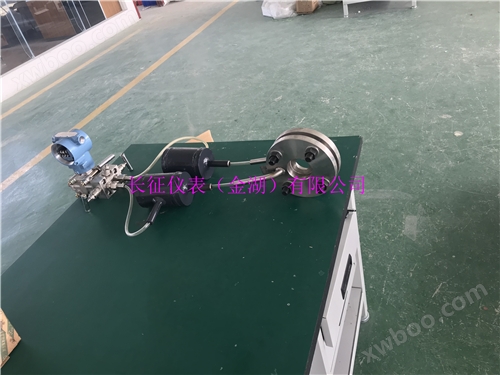
1、 Product Overview
Orifice flowmeter is a combination of a standard orifice plate and a multi parameter differential pressure transmitter (or differential pressure transmitter, temperature transmitter, etc.)pressure transmitter)A high range differential pressure flow device composed of supporting components, capable of measuring gases and vapors
The flow rates of steam, liquid, and water are used for process control and measurement in fields such as petroleum, chemical, metallurgical, power, heating, and water supply. The throttling device, also known as the differential pressure flowmeter, is composed of a primary detection component
(Throttle element) and secondary devices (differential pressure transmitter and flow accumulator) are used for gas applications. Flow measurement of steam and liquid.
2、 Working principle
The principle of measuring flow rate with a throttling device is based on the principles of Bernoulli fluid mechanics. Placing a throttle in the pipeline will create a pressure difference on both sides of the throttle when fluid flows through it(
At this point, the flow rate is proportional to the square root of the differential pressure (P). (You can refer to the working principle video of orifice flowmeter)
3、 Purpose, characteristics, and scope of application
1. Purpose: The throttling differential pressure flowmeter consists of three parts: throttling device, differential pressure transmitter, and flow accumulator. The throttling device is a primary component directly installed on the pipeline, consisting of a differential pressure transmitter and an accumulator
The calculator is a secondary element. It is mainly used for various gases (pure or dusty), vapors (saturated or superheated), and liquids (conductive or non-conductive; highly corrosive; viscous or containing) flowing through pipelines
Flow rate with small particles of dirt. It can directly measure volumetric flow rate or mass flow rate.
2. The usage conditions, characteristics, and scope of application of differential pressure flowmeter (standard orifice plate)
a、 Usage conditions:
1. In the measurement section, the fluid must fill the circular tube and continuously flow through the throttling device;
2. The fluid must be a homogeneous single-phase fluid both physically and thermodynamically;
3. The fluid measured by the throttling device must be a stable flow, or can be regarded as a stable slowly changing fluid, and is not suitable for pulsating flow and critical flow measurement;
b、 Characteristics and scope of application:
1. The standard throttling device does not require real flow calibration to ensure its measurement accuracy. (* in all flow meters);
2. It is widely applicable to the measured medium and can be used for flow measurement of almost all gases, vapors, and liquids;
3. Applicable diameter ratio β is 0.22-0.75, Reynolds number ReD ≥ 5000, pipeline diameter DN50~1000mm, allowing extrapolation to 5000mm. β=d/D, d - orifice plate opening diameter; D - Actual inner diameter of pipeline
4. The pressure can reach up to 32MPa and can also be used for negative pressure;
5. Medium temperature range: -30 ℃ to+650 ℃;
6. The intelligent differential pressure flowmeter adopts an intelligent differential pressure transmitter, which can set the differential pressure value (within the specified range) on site through buttons or communication methods according to the changes in the flow rate of the measured object, thereby changing the flow rate
Scope, greatly expanding the range of system traffic;
Scope, greatly expanding the range of system traffic;
7. No movable parts, the mechanism is safe and reliable, easy to use and operate, easy to master, and maintenance free;
According to the national standard GB/T2624-93 of the People's Republic of China and the international standard ISO5167-1, the flow range ratio applicable to throttling devices is 3 (i.e. the ratio of * to * applicable flow). In some cases
Under certain circumstances, a range ratio of 4 is allowed. If the range ratio is greater than the above value, the measurement error at low flow rates using the same differential pressure gauge will be significant.
Under certain circumstances, a range ratio of 4 is allowed. If the range ratio is greater than the above value, the measurement error at low flow rates using the same differential pressure gauge will be significant.
4、 Classification and structural diagram
1. Classification
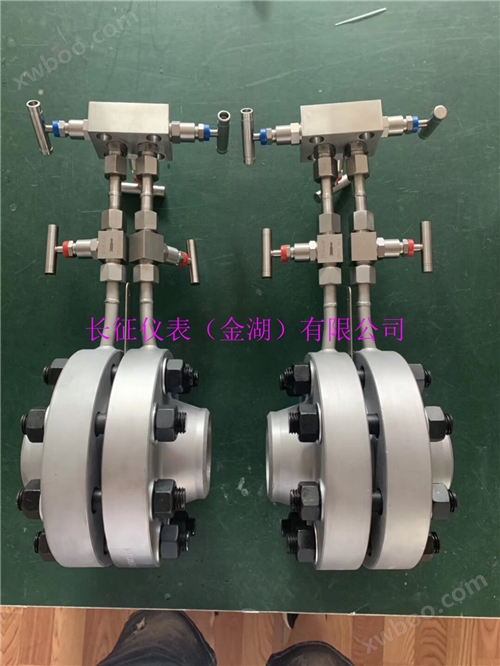
① Classified by flange clamping method
1. Welding type 2, flange clamping type
② Classified by pressure collection method
1. Corner drilling for pressure measurement; 2. Pressure measurement for corner joint chamber 3 and flange pressure measurement; 4. Radial pressure measurement;
2. Structure and schematic diagram
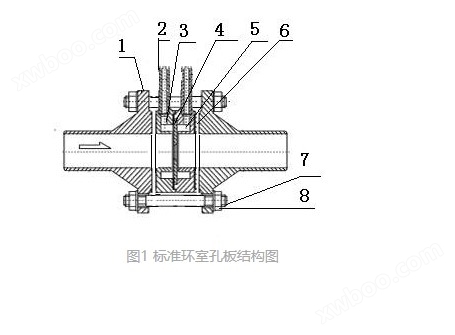
① Figure 1 Structure diagram of standard annular orifice plate throttling device
1. Flange 2, pressure pipe 3, front ring chamber 4, throttling element 5, rear ring chamber 6, sealing gasket 7, bolt 8, nut
5、 Structure and schematic diagram
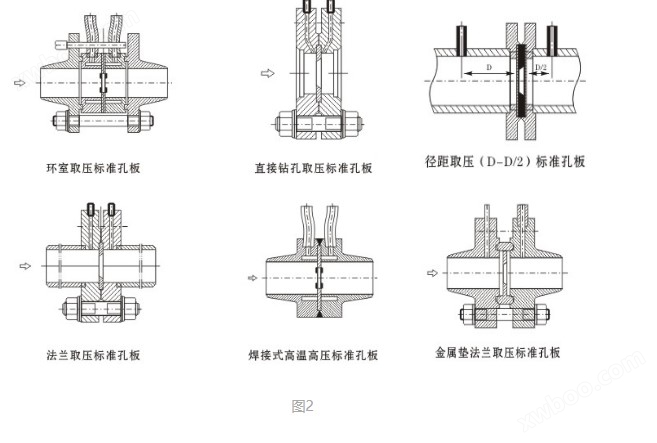
1、 Various standard orifice plate structures, as shown in Figure 2
6、 Product selection
| model | Type spectrum description | ||||||||
| CZ | Long March Instrument (Jinhu) Co., Ltd | ||||||||
| LG | Flow throttling device | ||||||||
| code | Pressure collection method | ||||||||
| H | Pressure measurement of corner joint chamber | ||||||||
| Z | Corner drilling for pressure measurement | ||||||||
| F | flange taps | ||||||||
| J | Radial pressure measurement | ||||||||
| code | Description of throttling device | ||||||||
| K | standard orifice plate | ||||||||
| code | nominal pressure | ||||||||
| -0.6 | 0.6 | ||||||||
| -1 | 1 | ||||||||
| -1.6 | 1.6 | ||||||||
| -2.5 | 2.5 | ||||||||
| code name | Nominal diameter | ||||||||
| DN10 | DN10~DN50 (threaded, flange) | ||||||||
| DN50 | DN50~DN800 (flange) | ||||||||
| code | flange material | ||||||||
| C | carbon steel | ||||||||
| P | stainless steel | ||||||||
| H | alloy steel | ||||||||
| code | medium | ||||||||
| 1 | liquid | ||||||||
| 2 | gas | ||||||||
| 3 | steam | ||||||||
| code | attachment | ||||||||
| N | Excluding attachments | ||||||||
| F | Equipped with three valve groups, etc | ||||||||
| I | Equipped with F and transmitter (accessories can be selected according to the medium and requirements) | ||||||||
| DC | Equipped with F and multi parameter transmitter | ||||||||
| O | User specified configuration attachments | ||||||||
7、 Installation and usage precautions
1. Approval parameters: Before installation, it is necessary to verify the on-site working conditions and confirm that all parameters in the throttling device calculation sheet are exactly the same as the installation point working condition parameters before proceeding
Install it properly, otherwise necessary corrections or compensation must be made.
2. Direction: There are "+" and "-" marks on the lifting handle of the orifice plate or the outer surface of the flange of the throttling device, respectively. "+" represents the upstream side (facing the direction of fluid flow) and must not be installed in reverse.
3. Insertion depth: The pressure tapping hole plate in the ring chamber is inserted at a depth of 2-5mm between the pipeline and the ring chamber, but the pipeline cannot be pushed to the ring chamber, otherwise the pipeline will expand due to heat and be pushed
Bad environmental chamber. Drill a pressure tapping hole plate, and the pipeline protruding into the hole plate must not block the pressure tapping hole at any point.
Bad environmental chamber. Drill a pressure tapping hole plate, and the pipeline protruding into the hole plate must not block the pressure tapping hole at any point.
4. System blowing: After the installation of the throttling device is completed, it should be blown. At this time, the throttling element (orifice plate) should be removed first to prevent debris in the pipeline from scratching the orifice plate or blocking the pressure pipe
After the blowing is completed, reinstall it in the same direction as the arrow on the orifice plate in the direction of fluid flow. Pay attention to tightening to ensure sealing.
After the blowing is completed, reinstall it in the same direction as the arrow on the orifice plate in the direction of fluid flow. Pay attention to tightening to ensure sealing.
5. Zero adjustment: After the purging and installation are completed, open the middle valve of the three valve group. At this time, the differential pressure value should be zero. If it is not, it must be reset to zero by holding down the button in the lower left corner
20 seconds, release it.
20 seconds, release it.
6. Slowly close the middle valve of the three valve group (it must be tightly closed), open all the shut-off valves on the upper part of the positive and negative pressure pipes, and the orifice plate can work normally.
7. Installation coaxiality requirements: The throttling element and the pipeline must be concentric, with an eccentricity distance of no more than 0.0025D. Users should pay attention to or take necessary measures during welding operations.
8. Orifice plates are generally used in conjunction with differential pressure transmitters. When connecting the pressure conduit to the differential pressure transmitter, attention should be paid to not installing the positive and negative pressures in reverse, with "H" indicating positive and "L" indicating negative;
9. The pressure pipes led out from the positive and negative pressure ports must be kept parallel in any situation;
10. If it is necessary to install a regulating valve, it is recommended to install the regulating valve after the required length of the straight pipe section on the downstream calculation sheet.
11. When the measured medium is gas or steam and there are significant fluctuations in temperature and/or pressure, temperature and/or pressure compensation should be performed. The pressure transmitter is installed at 1D upstream, and is heated
The thermocouple is installed 1D downstream.
The thermocouple is installed 1D downstream.
12. There should be no bag shaped space on the differential pressure signal pipeline where liquid or gas may accumulate. If unavoidable, a gas collector (or exhaust valve) and a settling device (or drain) should be installed.
13. Zero drift of the transmitter can also cause measurement errors, and the differential pressure transmitter should be calibrated regularly during use.
14. In addition to regularly inspecting the pressure pipes to prevent blockage, outdoor pressure pipes should be properly insulated to prevent solidification or freezing. If the pipeline (vertical section) is quite long, it should be avoided
To avoid false pressure difference caused by temperature difference, it is recommended to lay two differential pressure pipelines close to each other and wrap them together in the insulation layer.
To avoid false pressure difference caused by temperature difference, it is recommended to lay two differential pressure pipelines close to each other and wrap them together in the insulation layer.
15. Differential pressure pipelines should have brackets to prevent vibration and strong forces from acting on the differential pressure gauge.
16. When hoisting the throttling device on site, it is strictly prohibited to use iron wire, steel wire, or hook to penetrate the throat hole of the throttling element to prevent sharp mouth damage and affect accuracy;
17. After using the throttling device for a period of time, due to the presence of solid particles in the liquid and liquid droplets or other impurities in the gas, the sharp inlet will be blunted, thereby increasing the outflow coefficient
Large, causing additional errors, at this time, consideration should be given to replacing the throttling component; In addition, after long-term use of the throttling device, dirt is prone to accumulate at the lower corner of the upstream side of the orifice plate, which can cause changes in the outflow coefficient,
Therefore, regular inspections should be carried out to eliminate dirt.
Large, causing additional errors, at this time, consideration should be given to replacing the throttling component; In addition, after long-term use of the throttling device, dirt is prone to accumulate at the lower corner of the upstream side of the orifice plate, which can cause changes in the outflow coefficient,
Therefore, regular inspections should be carried out to eliminate dirt.
18. Pressure tube: The material of the pressure tube should be determined according to the properties and parameters of the measured medium. If the inner diameter is too small or the length is too long, it will cause serious signal lag or distortion. It is recommended to refer to Table (1) for determination.
1、 Installation requirements on horizontal pipelines
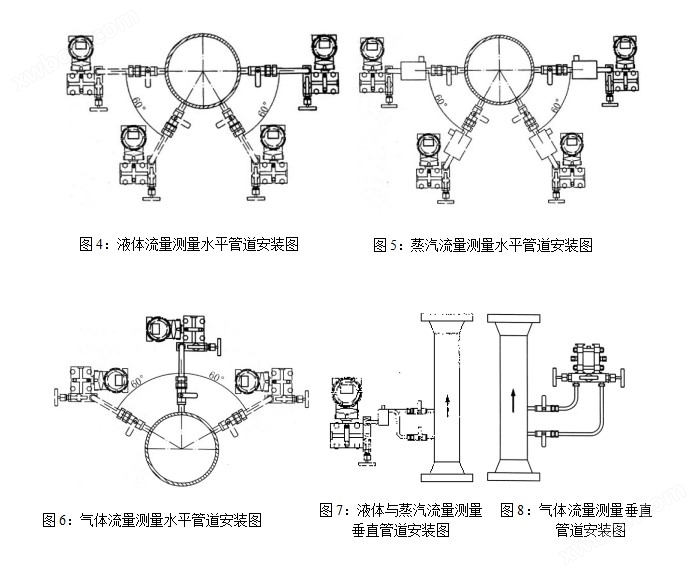
1. As shown in Figures 4 and 5, when measuring the flow rate of liquid and water vapor media, the installation angles of the pressure tapping pipe are 0 ° and 180 °; If installation is not possible at 0 ° and 180 °, it can be done between 0 ° and 60 °
Select within the range of 120 ° to 180 °. But the differential pressure transmitter must be installed vertically on the vertical end face of the three valve group.
Select within the range of 120 ° to 180 °. But the differential pressure transmitter must be installed vertically on the vertical end face of the three valve group.
2. As shown in Figure 6: When measuring the flow rate of gas medium, the installation angle of the pressure tapping tube is 270 °. If it is impossible to install at 270 °, it can be installed in the range of 210 °~270 ° and 270 °~330 °
Internal installation. But the differential pressure transmitter must be installed horizontally on the top horizontal plane of the three valve group.
Internal installation. But the differential pressure transmitter must be installed horizontally on the top horizontal plane of the three valve group.
2、 Installation requirements on vertical pipelines
1. As shown in Figure 7, when measuring the flow rate of water vapor and liquid media, the differential pressure transmitter is installed on one side of the pressure tap at the lower end of the vertical pipeline, and vertically installed on the vertical end face of the three valve group plate below the pressure tap.
2. As shown in Figure 8, when measuring the flow rate of gas medium, the differential pressure transmitter is installed on one side of the high-end pressure tap of the vertical pipeline, and horizontally installed on the horizontal end face of the three valve group plate higher than the pressure tap.
8、 Integrated throttling device
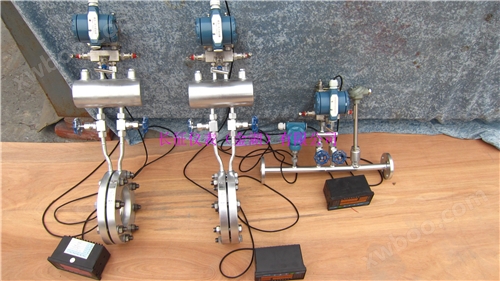
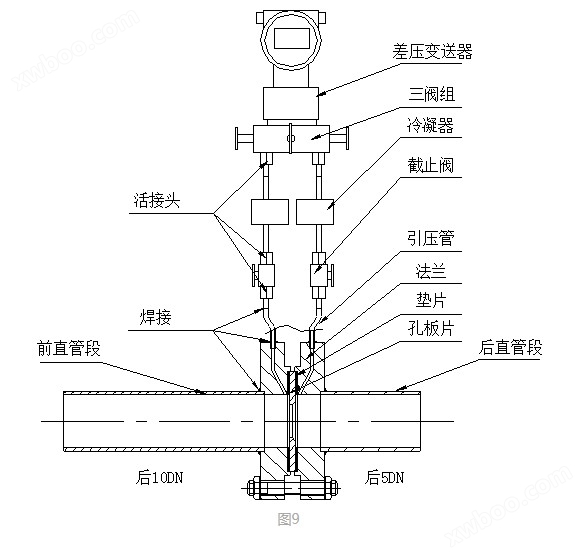
The integrated throttling device is assembled by the flowmeter manufacturer according to the user's requirements, including the throttling device, globe valve, condenser (or condensing ring), impulse pipe, three valve group, and differential pressure transmitter.
Simply weld the flange to the pipeline and connect it to the differential pressure transmitter cable upon arrival to put it into use. The schematic diagram of its structure and composition is shown in Figure 9.
9、 Ordering Notice:
Simply weld the flange to the pipeline and connect it to the differential pressure transmitter cable upon arrival to put it into use. The schematic diagram of its structure and composition is shown in Figure 9.
9、 Ordering Notice:
1. After installing the orifice plate flowmeter with throttling components, it is necessary to confirm that there are flammable and explosive materials in the surrounding environment. If there are, please choose an explosion-proof flowmeter.
2. The pressure measurement methods for orifice flow meters with throttling components are indicated as follows: flange pressure measurement, corner pressure measurement, radial pressure measurement
3. When the purchase quantity is large, a company technician should be sent to our company to have a face-to-face meeting with our technical personnel, so that the selection of instrument parameters will not be wrong.
4. Please specify the model, nominal diameter, nominal pressure, working medium, working pressure, medium temperature, medium density, flow range, and pipeline material when placing an order.


