- Phone
-
Address
22nd Floor, Qifengda Building, Songgang Innovation Branch Park, Taohuayuan, Bao'an, Songgang Town, Bao'an District, Shenzhen, China. Tianrui Industrial Park, 1888 Zhonghua Yuan West Road, Yushan Town, Kunshan City, Jiangsu Province, China
Product Categories
Shenzhen Tianrui Instrument Co., Ltd


Petroleum coke trace metal element detector Tianrui Instrument
NegotiableUpdate on 05/07
- Model
- Nature of the Manufacturer
- Producers
- Product Category
- Place of Origin
Overview
Petroleum coke trace metal element detector Tianrui Instrument is equipped with a large-area graphene ultra-thin window electric cooling semiconductor SDD detector, ultra low loss testing optical path, and high-precision micro focal spot X-ray
Product Details
Petroleum coke trace metal element detector Tianrui Instrument
---Oil content detection of petroleum coke and full component analysis of petroleum coke
The quality and performance indicators of petroleum coke are important criteria for evaluating its value, such as sulfur content, nitrogen content, moisture, etc. The main elemental composition of petroleum coke is carbon, accounting for80%above,hydrogen-containing1.5%-8%The rest are oxygen, nitrogen, and trace elements such as carbon, sulfur, silicon, vanadium, iron, calcium, nickel, sodium, etc.
| |||
needle coke |
Sponge coke |
Projectile focus |
Powder coke |
(Needle like structure and fiber texture, used for graphite electrodes and negative electrode materials) |
(Low impurity content, used in the aluminum refining industry) |
(Produced from high sulfur and high asphalt mixed oil, can only be used for power generation and cement use) |
(High volatile matter) |

Petroleum coke trace metal element detector Tianrui InstrumentScope of coverage:
Elemental analysis: Determine the content of major elements such as carbon, hydrogen, nitrogen, sulfur, oxygen, as well as trace elements such as silicon, iron, calcium, etc.
Petroleum coke iron, nickel, vanadium, manganese, copper, zinc element analyzerAnalysis method:
Elemental analyzer: used for rapid and accurate determinationCTheHTheNTheSWaiting for elements.
XX-ray fluorescence spectroscopy(XRF)Used for detecting trace elements.
The standards and specifications involved: When conducting these analyses, the following are usually followed:SH/T 0026TheSH/T 0029TheGB/T 26310Series of national or industry standards to ensure accuracy and comparability of results

Why measure sulfur, silicon, vanadium, iron, calcium, nickel, and sodium in petroleum coke,STheSiTheVTheFeTheCaTheNiTheNaElements?
according toNB/SH/T 0527-2019The requirements for petroleum coke (raw coke) require the above elements to be inspected before leaving the factory, so accurate determination of sulfur content in petroleum coke is crucial. The sulfur content of petroleum coke varies, so high requirements are also placed on analytical instruments. Tianrui Instrument is equipped with30A manufacturer with years of experience in elemental analysis, with multiple products in elemental analysis to meet customers' different testing needs.
Petroleum coke is a solid residue in the refining process and an important raw material for producing various carbon materials such as graphite electrodes, negative electrode materials, and carbon. The impurity elements in petroleum coke are mainly inherent elements such as S, Fe, Ni, V, and Ga in crude oil. The deterioration of crude oil is becoming increasingly severe, leading to an increase in the content of impurity elements in petroleum coke. The control of trace element content in petroleum coke is an important link in producing high-quality petroleum coke and improving its market competitiveness.

Figure 1: Physical image of petroleum coke
The testing methods for trace elements in petroleum coke include atomic absorption spectroscopy (AAS), inductively coupled plasma optical emission spectroscopy (ICP-OES), etc. Most of these detection methods require strict pretreatment and are complex to operate, relying heavily on the subjective operational experience of experimenters,In the new version of the petroleum coke product standard "NB/SH/T 0527-2019 for petroleum coke (raw coke)", XRF method has replaced the original ICP-OES method as the arbitration method for the determination of trace elements in petroleum coke.
Table 1: Quality Standards for Ordinary Petroleum Coke (Raw Coke) and Petroleum Needle Coke (Raw Coke)

Compared to wavelength dispersive XRF instruments, energy dispersive XRF instruments are more lightweight, suitable for various scenarios, and easier to maintain. The use of ED-XRF can increase daily monitoring of trace elements in petroleum coke, meet the rapid evaluation of raw materials in production sites, and have important guiding significance for adjusting and optimizing process parameters of the device.
1. Equipment and reagents


EDX 6000C Energy Dispersive X-ray Fluorescence Spectrometer
2. Sample collection, storage, and pre-processing
According to the sampling standard for petroleum coke, take 100g of petroleum coke sample and dry it in a drying oven at 105 ℃ for 2 hours. Use a grinder to grind the petroleum coke sample to 0.074mm or below. Weigh 3.0g of petroleum coke sample and 10.0g of boric acid powder, use boric acid powder as filler, and press them into tablets under a pressure of 15-20 T. Then, label the sample and place it in a sample bag for later use.
3. Establishment of working curve and sample analysis
Set appropriate measurement conditions and use an X-ray fluorescence spectrometer to scan a series of secondary standard samples of petroleum coke (raw coke) with known content (petroleum coke calibrated according to industry standards). Establish a first-order linear correction curve for the content and intensity of the elements of interest S, V, Fe, and Ni in petroleum coke. Then, measure the unknown petroleum coke (raw coke) sample.

Figure 2: Linear relationship between S, V, Fe, Ni element content and intensity
The above figure shows the measurement of secondary standard samples of petroleum coke with different contents using EDX 6000C energy dispersive fluorescence spectrometer, and the establishment of primary or secondary calibration curves for the content and intensity of S, V, Fe, and Ni elements. As shown in the figure, there is a very good linear relationship between the content of S, V, Fe, and Ni components and strength.
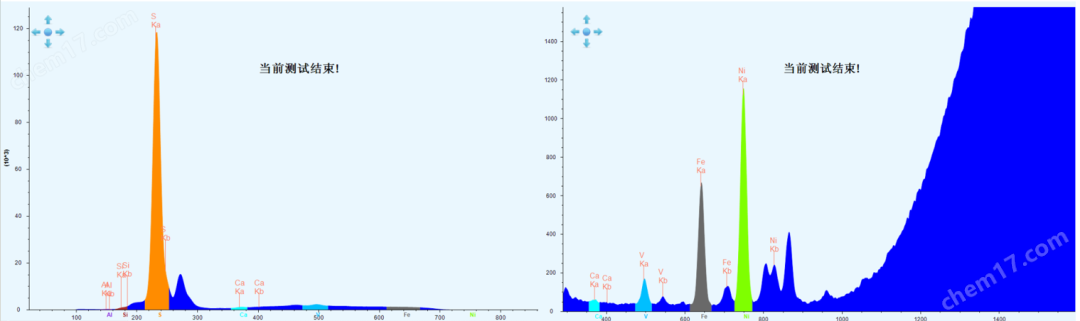
Figure 3: Fluorescence spectrum of petroleum coke sample
Figure 3 shows the test spectrum of an unknown sample (named petroleum coke 1 #) used in the test. The characteristic peaks of S, V, Fe, and Ni elements can be clearly observed in the spectrum, and trace amounts of Al, Si, Ca, and Zn elements are also present in this sample. After conducting repeatability tests on the sample, the repeatability of S, V, Fe, and Ni elements in the test results reached 0.28%, 3.33%, 1.10%, and 0.71%, respectively, indicating that the instrument has a good detection effect on petroleum coke samples.
Table 2: Repeatability test data of petroleum coke 1 # sample

Petroleum coke trace metal element detector Tianrui InstrumentApplication fields:
Gasoline, diesel, kerosene, naphtha, petroleum coke, catalysts, etc;
Analysis of additive and wear metal element content in lubricating oil;
Analysis of additive and wear metal element content in lubricating grease;
Analysis of sulfur, chlorine, iron, nickel, vanadium and other elements in crude oil and marine fuel oil;
Catalysts: palladium, platinum, rhodium, ruthenium, etc;
Terephthalic acid (TPA): cobalt, manganese, iron, etc;
Dimethyl terephthalate (DMT): heavy metal.




Similar Product Recommend