-
E-mail
531172201@qq.com
-
Phone
13560799601
-
Address
5th Floor, Building 6, Longbi Industrial Zone, Bantian Street, Longgang District, Shenzhen
Product Categories
Shenzhen Dongri Yingneng Technology Co., Ltd


Online ammonia gas detector
NegotiableUpdate on 01/28
- Model
- Nature of the Manufacturer
- Producers
- Product Category
- Place of Origin
Overview
The online ammonia gas detector is not just a simple alarm, but an active safety system that integrates real-time monitoring, early warning, automatic control, and data recording. It transforms intangible ammonia risks into clear and visible data and timely and effective actions through 24-hour uninterrupted protection. It is a key equipment for modern chemical, refrigeration and other enterprises to ensure personnel safety, protect the environment, and achieve stable production.
Product Details
The online ammonia gas detector is not just a simple alarm, but an active safety system that integrates real-time monitoring, early warning, automatic control, and data recording. It transforms intangible ammonia risks into clear and visible data and timely and effective actions through 24-hour uninterrupted protection. It is a key equipment for modern chemical, refrigeration and other enterprises to ensure personnel safety, protect the environment, and achieve stable production. It is a professional equipment installed in a specific location, which continuously monitors the concentration of ammonia in the air in real-time 24 hours a day, and automatically issues an alarm or even initiates protective measures when the concentration exceeds the standard.
Its core function and purpose
1. Ensure personnel safety and prevent poisoning accidents
The hazards of ammonia: Ammonia has a strong pungent odor and is toxic to the human body. Short term exposure can severely irritate the eyes and respiratory tract, causing coughing, tearing, and difficulty breathing; High concentration leakage can lead to pulmonary edema and even death.
Instrument function: Real time monitoring of ammonia concentration in the environment. Once the preset safety threshold is reached or exceeded, an audible and visual alarm will be immediately issued to remind staff to evacuate quickly or take emergency measures, effectively preventing poisoning accidents from occurring.
2. Prevention of fire and explosion risks
Characteristics of ammonia: Although ammonia is not flammable, it may explode when mixed with air and exposed to open flames or high heat within a specific concentration range (15% -28%).
Instrument function: Monitor the concentration of ammonia gas, prevent its accumulation in the explosion range, and provide assurance for safe production.
3. Implement early leak detection and locate the leak source
Function: It can sensitively capture small ammonia leaks at pipeline, valve, storage tank or equipment connections, and display the specific leak location in the central control room. This helps maintenance personnel respond quickly, perform precise repairs, nip leaks in the bud, and reduce material loss and environmental pollution.
4. Automatic linkage control, building an active safety system
This is one of the major functions of online detectors. It can not only sound an alarm, but also automatically perform a series of safety operations:
Activate the accident ventilation system: forced ventilation to dilute the concentration of ammonia in the air.
Close the emergency shut-off valve: automatically cut off the ammonia supply source.
Linkage spray absorption system: Start the water curtain or acid spray tower to neutralize the leaked ammonia gas.
Send signals to the control center to achieve remote monitoring and emergency dispatch.
5. Meet environmental and safety production regulations
National and industry regulations (especially in the fields of chemical, refrigeration, food processing, etc.) require continuous monitoring of toxic and harmful gases. Installing an online ammonia detector is a necessary condition for compliant production and passing safety inspections.
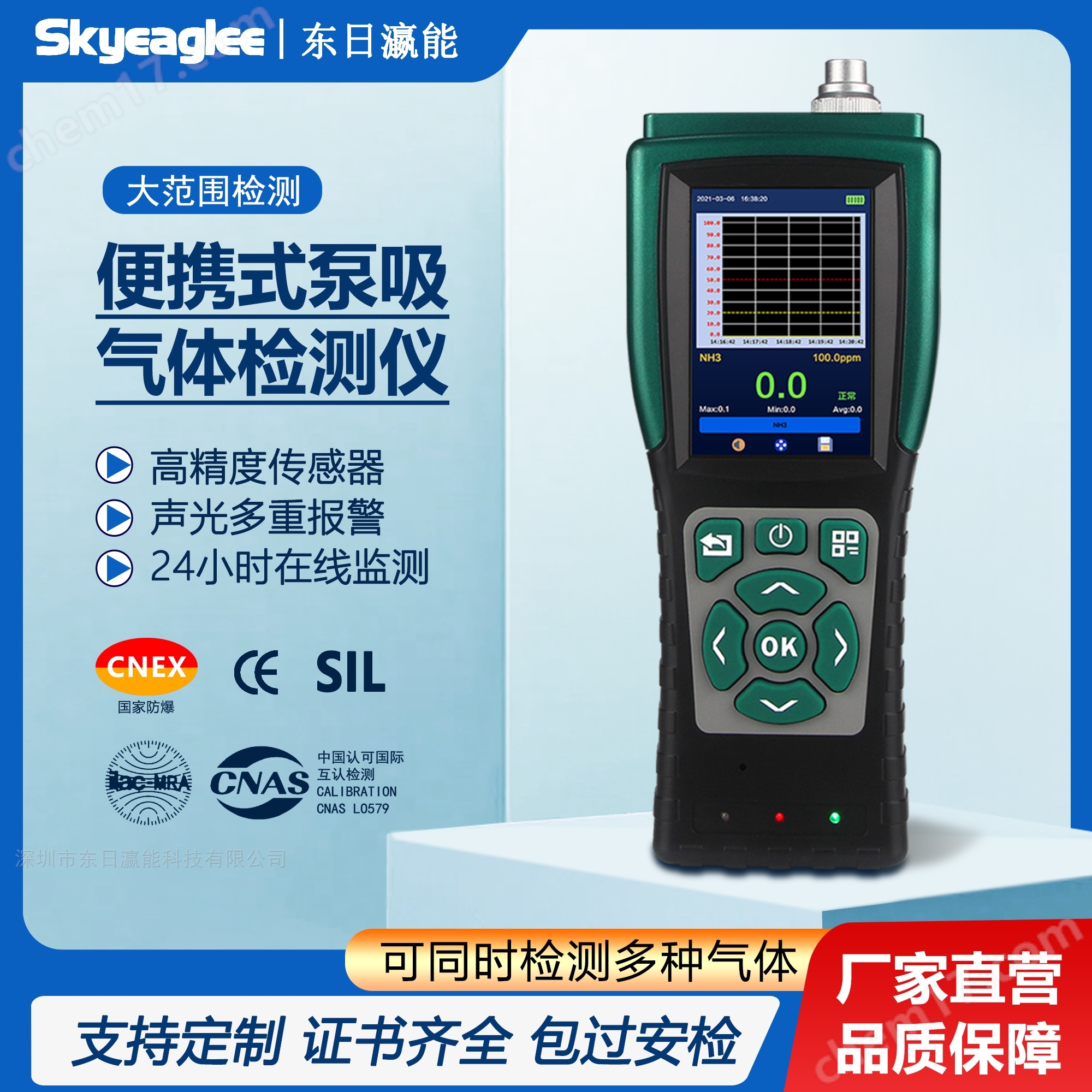
Performance indicators of handheld online ammonia gas detector for toxic and harmful gases:
| Tested gas | Ammonia NH3 | ||
| Detection Principle | electrochemistry | ||
| sampling method | Diffuse or pipeline type | ||
| Range | 0-100ppm, 0-200ppm, 0-1000ppm (range optional, customizable) | ||
| resolution | 0.001ppm, 0.01, 0.1ppm, 1ppm (resolution optional) | ||
| Electrical interface thread | M20 * 1.5 internal thread, optional G3/4, G1/2, 1/2NPT, 3/4NPT | ||
| response time | T90<30s | display | have |
| power supply | 24-30VDC | Intelligent Platform | optional |
| repetitiveness | ≤±2% | linear error | ≤±1% |
| zero drift | ≤± 1% (F.S/year) | precision | ≤± 3 % F.S. |
| output signal | RS485 or 4~20mA (two-wire or three wire system) optional | pressure range | 860-1060hpa |
| Operating Temperature | -40℃~70℃ | power consumption | <2.0W |
| Explosion-proof rating | ExdⅡCT6 Gb | Operating Humidity | 0-95% RH (non condensing) |
| audible and visual alarm | Optional | protection | IP65 |
| Size | 258X178X80MM | relay | Two sets of switch output (optional) |
| main material | ADC12 aluminum alloy/316 stainless steel | Weight | 1.0kg (aluminum alloy shell) |
| Explosion-proof certification | CT6 | Metrological certification | CMC |
Portable online ammonia gas detectorProduct Features
*The microprocessor technology
*Anti design, fast, reliable, and stable
*12-30V DC power supply
*The output signal can be determined by the user according to actual requirements
1. Standard three wire 4-20mA analog signal output
2. Two wire 4-20mA analog signal output (optional)
3. Relay output (optional)
4. RS485 bus output (optional)
*Fast response speed and high measurement accuracy
*Excellent performance and lower installation costs
*Low maintenance costs
The technical points of online ammonia gas detector mainly involve the following aspects:
Sensor technology: The sensors of online ammonia gas detectors usually use electrochemical sensors and utilize three electrode electrochemical measurement methods for detection. Sensors need to have high sensitivity, fast response, and long-term stability to ensure accurate and rapid detection of changes in ammonia concentration.
Instrument structure and design: The structure of the online ammonia gas detector should be designed to be reasonable and compact, easy to install and use. At the same time, the instrument should have dust-proof, waterproof and other characteristics to adapt to harsh industrial environments. Some instruments will also adopt modular design for easy maintenance and upgrading in the future.
Detection range and accuracy: The online ammonia gas detector should be able to cover a wide detection range and meet the needs of different industrial scenarios. Meanwhile, detection accuracy is also an important indicator, and high-precision detectors can ensure the accuracy and reliability of measurement results.
Data processing and transmission: The online ammonia gas detector should have data processing functions, which can perform real-time analysis, storage, and display of the detected ammonia concentration data. In addition, the instrument should also support data transmission function to remotely transmit the detection results to the control center or upper computer for further processing and analysis.
Safety and alarm functions: The online ammonia gas detector should have multiple alarm functions, such as sound and light alarms, relay outputs, etc. When the ammonia concentration exceeds the set value, the instrument should immediately issue an alarm signal to remind the operator to take corresponding safety measures.
Calibration and maintenance: Regular calibration and maintenance are required to ensure the accuracy and stability of the online ammonia gas detector. Calibration can ensure the sensitivity and accuracy of sensors, while proper maintenance can extend the lifespan of instruments and reduce failure rates.
Application places of mobile concentration gas detector:
Paint room, incineration plant, pharmaceutical research, pharmaceutical production workshop, company, environmental monitoring, school research, building construction, fire alarm, sewage treatment, industrial gas process control, petroleum and petrochemical, chemical plants, smelters, steel plants, coal plants, thermal power plants, boiler rooms, garbage disposal plants, tunnel construction, oil pipelines, gas stations, underground gas pipeline maintenance, indoor air quality testing, monitoring of safety protection equipment in hazardous areas, etc.
(The information is for reference only; please make the corresponding selection based on your actual working conditions) The information shows that the typical temperature range is -20 ℃ to+50 ℃, humidity is 10% RH to 95% RH, and there is no condensation. The absolute pressure is 106KPa ± 20KPa, where ± 20KPa is the relative pressure, which is the pressure relative to atmospheric pressure.