-
E-mail
info@tvscope.cn
-
Phone
15261811715
-
Address
Super dimensional scenery
Product Categories
Beijing Chaoweijing Biotechnology Co., Ltd

Miniature two-photon microscope for free movement of mice
NegotiableUpdate on 02/05
- Model
- Nature of the Manufacturer
- Producers
- Product Category
- Place of Origin
Overview
The Miniature Two Photon Microscope Mouse Free Movement SUPERNOVA-600 is a new generation platform flagship product that integrates two-photon imaging technology and miniaturization technology, providing flexible and diverse combination configurations. It can synchronize the activity of micro neurons and synapses with the overall information processing and individual behavior of the brain in real time, panoramic analysis of connection maps and functional dynamic maps, and more efficiently, stably, and continuously output high-quality data, providing users with an ideal comprehensive imaging solution.
Product Details
integratedMiniature two-photon microscope for free movement of miceSUPERNOVA-600 is the latest generation platform flagship product of Super Vision, which integrates two-photon imaging technology and miniaturization technology, providing flexible and diverse combination configurations. It can synchronize the activity of micro neurons and synapses with the overall information processing and individual behavioral information of the brain in real time, and provide panoramic analysis of connection maps and functional dynamic maps. It efficiently, stably, and continuously collects and outputs high-quality data, providing users with efficient and comprehensive imaging and processing solutions.
2.6g miniaturized probe
The highly integrated miniaturized probe has the characteristics of undistorted transmission of femtosecond laser pulses, high-speed scanning in small spaces, high-quality laser convergence, efficient fluorescence excitation and collection, etc., achieving high-resolution imaging of neurons and synaptic activity in freely moving mouse brains. At the same time, real-time data acquisition of 3D imaging in a free state is achieved by wearing a miniaturized 3D zoom module ETL.
The lightweight probe weighs only about 2.6g and can be installed on the head of mice to "wear and run"
Small size, suitable for wearing on small animal heads and other positions
High resolution, allowing for clear observation of structural changes in individual dendritic spines
Deep working distance up to 1mm, compatible with GRIN lens, meeting the needs of deep brain imaging

| Miniature probe | COMPANY-HR | COMPANY | COMPANY-LF |
| Horizontal resolution @ 920nm* | 0.68 μm | 0.79 μm | 1.46 μm |
| Axial resolution @ 920nm* | 3.73 μm | 7.04 μm | 23.68 μm |
| Imaging field of view (diagonal)* | 397 μm | 656 μm | 1.28 mm |
| working distance | 1.08 mm | ||
| Imaging speed | > 9Hz@512x440 / > 18Hz@256x220 | ||
Animal free movement imaging
Ultra fine detail resolution under 418 μ m (diagonal) field of view

Single dendritic spine level resolution in 640 μ m (diagonal) field of view

Resolution of Neuronal Axons and Subcellular Structures in a 1.33 mm (Diagonal) Field of View

Free acting mouse two-photon imaging combined with optogenetic stimulation
Miniature two-photon microscope for free movement of miceSUPERNOVA-600 can be paired with optogenetic stimulation modules of different wavelengths to efficiently perform optogenetic stimulation on the imaging field while performing miniaturized two-photon microscopy imaging.
Single photon light stimulation module wavelength options: 473nm, 589nm, 635 nm
● Can freely switch between automatic and manual stimulation modes
● Automatically mark stimulation signals

Reuse imaging fiber bundles to achieve simultaneous two-photon imaging and optogenetic stimulation in freely moving mice
Efficient and versatile imaging, worry free expansion and upgrade
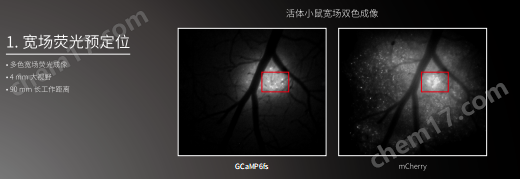
SUPERNOVA-600 breaks through the barriers between wide field fluorescence imaging, fixed imaging, and free motion imaging, supporting full-color imaging, dual probe dual color imaging, optogenetics, and other functions with more comprehensive, optimized processes, and higher efficiency, bringing you a new research experience.
Simplified operation process


The host can be paired with various behavioral devices
The SUPERNOVA-600 imaging host can be combined with a multifunctional behavioral cabin to achieve synchronization between multi-channel millisecond level precision behavioral monitoring and fluorescence imaging. The 1.3-meter large space can adapt to various behavioral paradigms, meeting the diverse experimental needs of users.
The behavioral module has complete functions and ample space, and can be equipped with different types of behavioral devices to meet the needs of various types of behavioral experiments
The host can be configured with one or more behavioral learning modules to achieve flexible combination and matching of one to many, suitable for various experimental application scenarios, and achieve parallel implementation of multiple projects
Neuroscience Applications


