- Phone
-
Address
2nd Floor, First Accelerator, Optoelectronic Industry Park, No. 155 Hatching Second Lane, High tech Zone, Weifang City, Shandong Province
Product Categories
Shandong Wanxiang Environmental Technology Co., Ltd


Insect situation online monitoring system
NegotiableUpdate on 05/07
- Model
- Nature of the Manufacturer
- Producers
- Product Category
- Place of Origin
Overview
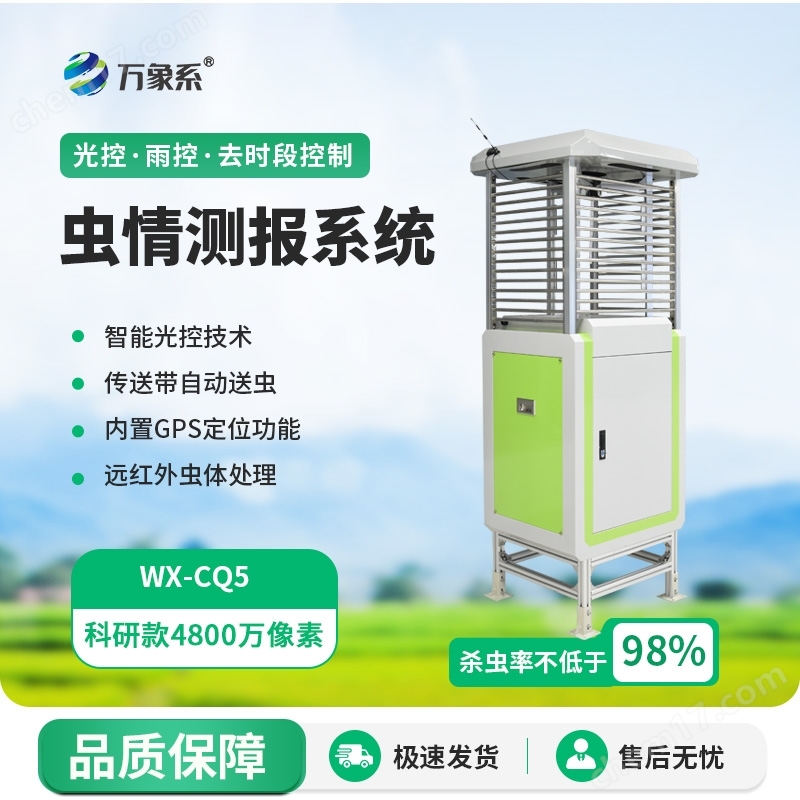
The online monitoring system for insect infestations analyzes and predicts the occurrence and development of pests, providing services for modern agriculture and meeting the needs of pest forecasting and specimen collection.
Product Details
1Insect situation online monitoring systemProduct Introduction
Working principle: Utilizing light, electricity, and numerical control technology to achieve functions such as insect attraction, pest control, and packaging. In the absence of supervision, the system can automatically complete tasks such as insect attraction, pest control, dispersal, photography, transportation, collection, and drainage. Then, wireless transmission technology and Internet of Things technology can be used to upload the environmental weather and pest situation in real time to the designated agricultural cloud platform.
Main purpose: To analyze and predict the occurrence and development of pest infestations, provide services for modern agriculture, and meet the needs of pest forecasting and specimen collection.
IIInsect situation online monitoring systemmain structure
Host material: spray coating
Base: The base height is 320mm, used to prevent rainwater from pouring into the central control box during the rainy season
Louvers: Bird and beast proof
Screen: 10.1-inch touchscreen
Insect trap: 8-bit automatic transfer bin
Overall dimensions: 710 * 600 * 2120mm (including base)
Components: insect lure device, impact screen, insecticide device, high-definition camera, main control system, mechanical components, rain and snow sensor, light sensor, professional metal box frame
3、 Technical parameters
1. Meet the safety and technical requirements of GB/T 24689.1-2009 standard for insect detection and alarm lights in plant protection machinery.
2. Automatic insect feeding and cleaning on the conveyor belt
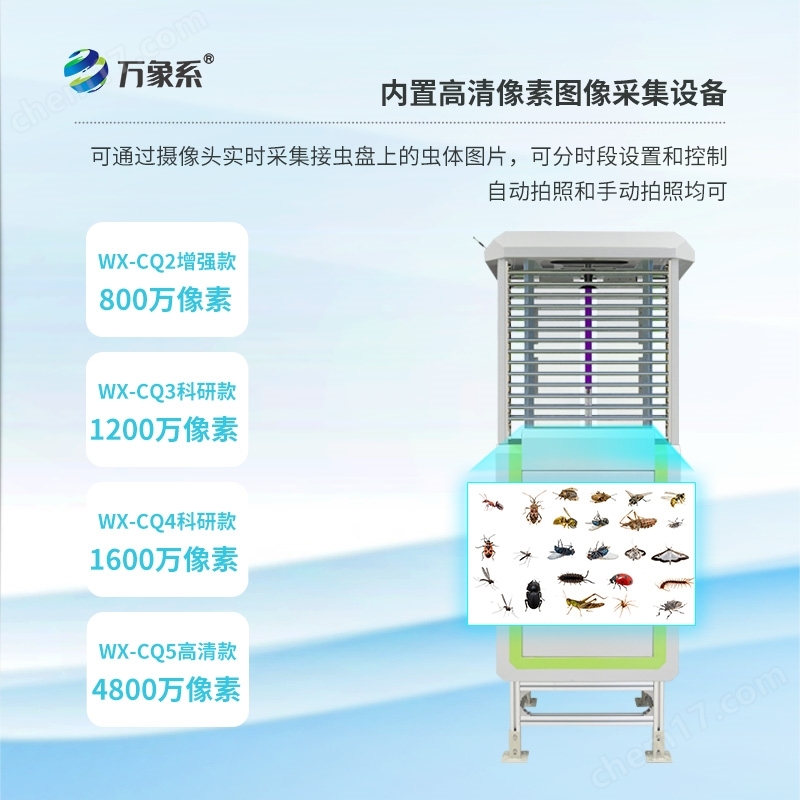
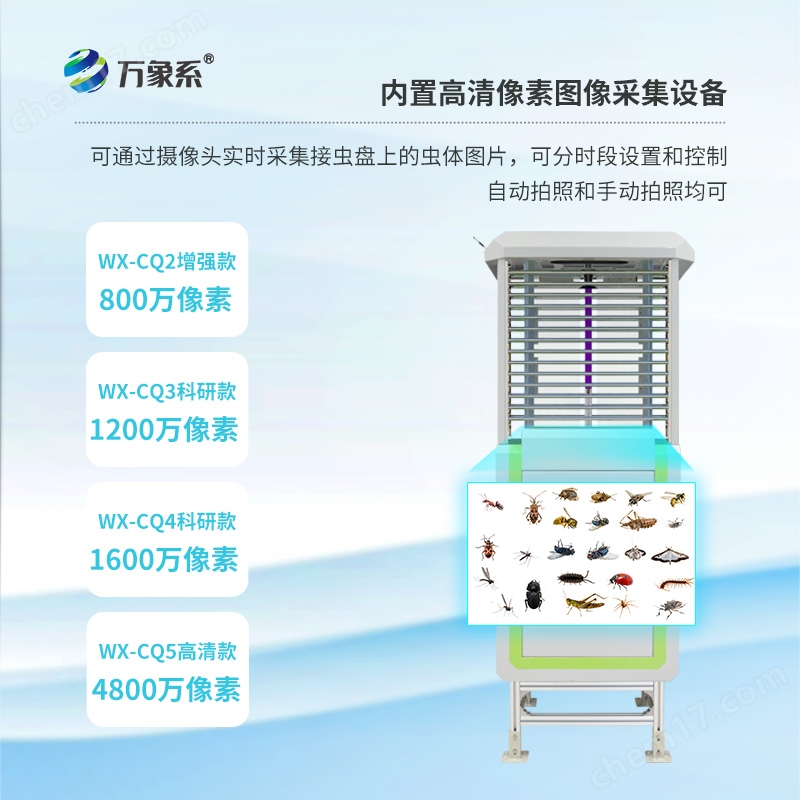
3. It can be set and controlled in different time periods, and both automatic and manual photography are available
4. Automatic conversion of insect traps, with an eight digit automatic conversion system, ensures that the insects collected in 8 time periods are not confused
5. The insect bodies are evenly scattered and laid flat on the conveyor belt. The conveyor belt can accurately deliver all the collected insect bodies to the high-definition camera shooting area, and perform vibration dispersion and leveling treatment on the collected insect bodies to ensure that the characteristics of each insect body are clearly captured.
6. Work mode can be remotely set, wireless photography can be done remotely, and terminal device parameters can be set remotely.
7. Built in GPS positioning function, view device site and other data in the map, and track device theft.
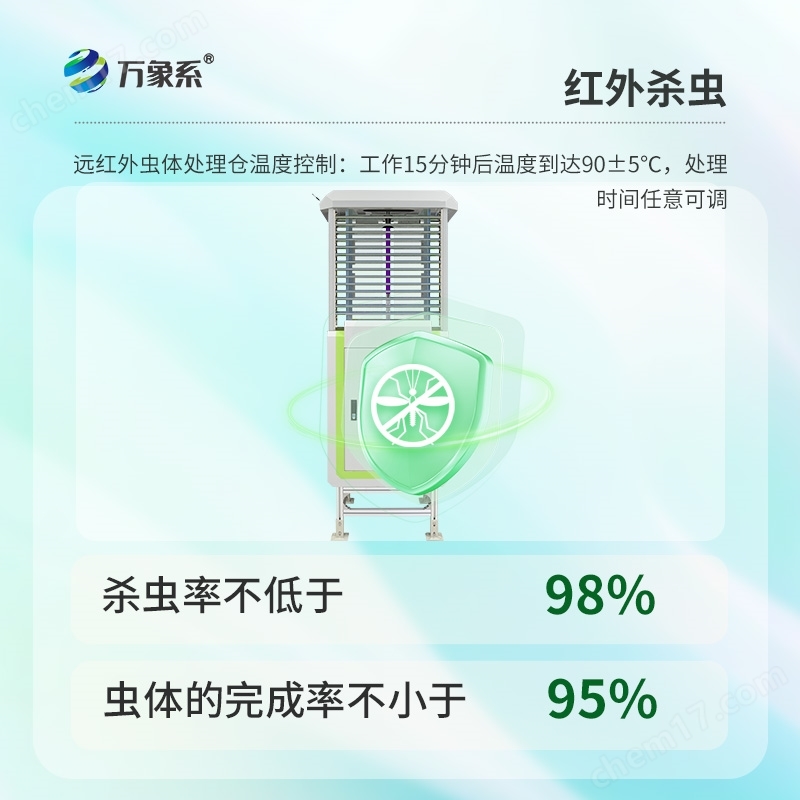
8. Infrared insecticidal and far-infrared insect body treatment chamber temperature control: After working for 15 minutes, the temperature reaches 90 ± 5 ℃, and the treatment time can be adjusted arbitrarily.
The mortality rate of far-infrared insect body treatment is not less than 98%, and the integrity rate of the insect body is not less than 95%.
9. Light control: Automatically turn on the lights at night and turn off the lights during the day (standby). In the working state at night, it is not affected by momentary strong light exposure to change the working state.
10. Time period control: Set working time periods based on the living habits of target pests.
11. Rain control system device: a separate drainage system structure that automatically discharges rainwater, effectively separates rain insects, and prevents water accumulation inside the box.
12. Power supply: Voltage fluctuation range: 220V ± 60V, with leakage protection device.
13. Lightning protection device: effectively prevents lightning strikes.
14. Multiple environmental parameter interfaces such as wind speed and direction, ground temperature and humidity, light intensity, and rainfall can be added.
15. Network mode: Multiple networking methods, 4G, WIFI wired can be freely selected, and network management can be carried out anytime and anywhere.
The 16 test signal light is equipped with a 1200W pixel image acquisition device, which can capture real-time images of insects on the insect receiving tray through a camera.
4、 Installation method:
1. Determine the installation location of the insect detection equipment and prefabricate a cement platform of a certain thickness in advance.
2. Place the base on the cement platform and drill holes according to the fixed foot positions of the base. Make two fixing holes for each fixed foot,
3. Insert the 8 expansion screws in the accessories into the drilled holes, align the base fixing holes with the 8 expansion screw holes, and tighten and fix them with a wrench.
4. After confirming and testing the stability of the base and cement platform, lift the equipment onto the base, match the installation holes, and fix the equipment to the base with screws.
5、 Insect detection and reporting platform:
The insect monitoring platform is a system that integrates excellent technology and intelligent management, designed specifically for agriculture, forestry, and other ecological environment monitoring fields, aiming to improve the accuracy and efficiency of pest monitoring. The following is a detailed analysis of the main features of the platform:
1. Multi role permission management and data isolation
Account based login and management: Ensure that different users (such as administrators, operators, data analysts, etc.) access the corresponding data and functions according to their responsibilities and needs.
Fine grained permission control: achieve precise control of data and operation permissions, ensuring data security and privacy.
Inter institutional data isolation: Ensure the independence and security of data between institutions or departments, and avoid information leakage or confusion.
2. Remote intelligent control function
Real time status monitoring: Users can remotely view the various parameters and working status of the insect detection and reporting device, and promptly identify and handle problems.
Remote control operation: supports remote operations such as capture, manual/automatic mode switching, warehouse temperature setting, heating, insect movement, working time setting, etc., to improve management efficiency.
Historical operation records: All control operations can be recorded and stored for easy traceability and auditing.
3. Self training AI algorithm and pest species recognition
AI algorithm self training: The platform's built-in self training AI algorithm can continuously learn and recognize new pest species, adapting to pest changes in different regions and seasons.
Automatic identification of pest species: By using AI algorithms to automatically analyze image data, pest species can be quickly and accurately identified, reducing manual intervention.
4. AI analysis and manual correction
AI automatic analysis: Use our own insect database for AI automatic analysis to quickly obtain preliminary results.
Manual correction: Users can review and correct the AI analysis results based on actual situations, improving the accuracy and reliability of the analysis.
5. Multidimensional statistical analysis
Pest species statistics: Conduct statistics on the monitored pest species, analyze the distribution and changing trends of different pests.
Quantity statistics: Count the number of pests and evaluate the degree of pest damage.
Regional analysis: Combining geographical location information, analyze the distribution characteristics and migration patterns of pests in different regions.
6. Support secondary development and system integration
API Interface: Provides Java based API development interfaces to facilitate users in secondary development or system integration according to their own needs.
System integration and docking: Support integration and docking with other agricultural management systems, meteorological systems, etc., to achieve data sharing and linkage management.
Similar Product Recommend