- Phone
-
Address
No. 116, Qinxing New Village, Qinnan, Yancheng City, Jiangsu Province
Product Categories
Jiangsu Huahang Underwater Engineering Co., Ltd


How much does it cost for a diver underwater maintenance and construction team? How is the price for sewage underwater sealing construction calculated? How does a diving salvage service company charge
NegotiableUpdate on 05/06
- Model
- Nature of the Manufacturer
- Producers
- Product Category
- Place of Origin
Overview
How much does the underwater maintenance and construction team for divers cost? How is the price for sewage underwater sealing construction calculated? How does the diving salvage service company charge? The maintenance unit should attach importance to the training and improvement of the frogman team, regularly organize skills training, safety training, and experience exchange activities to improve the frogman's technical level and safety awareness. At the same time, we should actively introduce new technologies, equipment, and methods to promote continuous innovation and improvement of underwater operation and maintenance technology.
Product Details
2024 is a new beginning. Wishing all business leaders and CEOs good health, prosperous business, and peace!
How much does it cost for a diver underwater maintenance and construction team? How is the price for sewage underwater sealing construction calculated? How does a diving salvage service company charge
How much does it cost for a diver underwater maintenance and construction team? How is the price for sewage underwater sealing construction calculated? How does a diving salvage service company charge
Jiangsu Huahang Underwater Engineering Co., Ltd. is a water cooperation unit of the 19th Asian Games, located in Yancheng, Jiangsu, a city with a relatively large wetland in Asia, a long coastline in China, and a beautiful coastal city (the hometown of underwater engineering and the hometown of red crowned cranes). It was registered and established in 2014 according to relevant laws and regulations, and is a professional construction unit engaged in underwater operations such as rivers, oceans, reservoirs, etc. The company is a formal member of the Diving Salvage Industry Association of the Ministry of Transport;

For divers engaged in commercial diving operations for the first time, they should meet the requirements of the physical examination standards for selecting professional divers in the People's Republic of China standard "Physical Examination Requirements for Professional Divers"; For divers who have already engaged in commercial diving operations, they must undergo an annual physical examination and meet the diver annual examination standards in this standard. The physical examination of divers must be conducted at a level II or above or at a specialized diving medical institution.
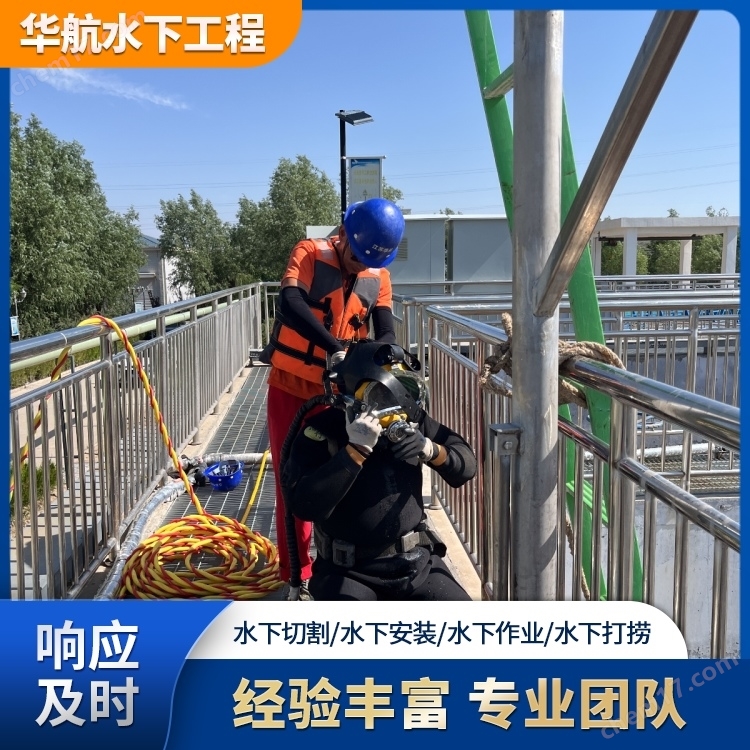
Before starting to dress, the surface gas supply system should be turned on and in good working condition, and emergency gas supply systems such as masks should also be in good working condition. Everything should be ready to assist personnel in helping divers dress.
Before diving, it is necessary to assess the suspected or known contaminated work site.
If there is toxic smoke at the work site, the diving station, compressor, and surface personnel must be located upwind of the air pollution source;
If there is water flow in the diving area, divers should approach the polluted water from upstream to keep the water flow away from the diver with pollution;
3. The diving station should establish a monitoring system for environmental parameters around the diving site as much as possible, so as to prevent possible pollution by surface personnel;
4. The contaminated area should be limited, and personnel and equipment on the water surface should be restricted outside the contaminated area;
When there is pollution in the diving environment, it is impossible to detect it solely by sight or smell. If there is suspicion of pollution, the water quality should be tested before the operation begins.
4.7 Hazard assessment and identification
If there may be chemical hazards in the work area, an assessment of the chemical pollution history of the area should be conducted, including pollutant emission history, known existing chemical substances, composition and content of chemical substances, current discharge methods, air quality of the environment, past work conditions, and the presence of highly hazardous chemical substances;

If there is suspicion of harmful pollutants in the water, sampling and analysis must be conducted on the water or sediment;
3. Certain chemicals may penetrate or infiltrate diving equipment, or cause harm to personnel through respiratory inhalation, digestive ingestion, or skin contact, or a combination of these three pathways; If it is suspected that divers or surface personnel have been in contact with pollutants, blood, urine and other specimens should be collected for medical monitoring.
The program is as follows:
A. Divers wear diving suits;
B. Wear seat belts;
C. Carrying emergency gas cylinders;
D. Wear an appropriate amount of lead pressure strap (the lead pressure strap must be worn outside the back support or other equipment to facilitate quick release in emergency situations);
E. Connect a pressure regulator, open the emergency gas cylinder valve, and reverse it by 1/4 or 1/2 turn to prevent accidental operation
F. Wearing a face mask: The method is to open the zipper of the head mask, separate the head mask to both sides, expose the facial sealing pads on both sides inside the head mask, put the face mask on the head, pull the zipper, fix the headband, so that the face is tightly attached to the facial sealing pad, and place the mouth and nose inside the mouth; The way to wear a headband is: first place the headband on top of the head, then fasten the two on the bottom right and bottom left; Finally, fasten the middle two.
G. Hang the umbilical cord (signal rope) spring hook in the eye ring on the left front of the seat belt;
H. Walk towards the water and put on your fins;
I. Divers adjust the gas supply of the second pressure reducer on their own to experience breathing and pressure regulation; Check the communication system to ensure that the volume is moderate and the sound quality is clear. If you feel everything is normal, please ask for permission to enter the water.

Precautions for Diving Operations
3.3.1 The diving umbilical cord has clear length markings. The diver dives to a certain distance and the umbilical cord relaxes to a certain distance, with precise control by the tugger.
3.3.2 Divers should promptly report their movement direction, and the tugger should change their reasonable position in a timely manner, tightening or relaxing the diving umbilical cord.
3.3.3 When divers move their positions, they should promptly notify the surface telephone operator and actively check the direction of the diving umbilical cord.
3.3.4 Remind the telephone operator to tighten the excess umbilical cord and regularly check the tightness of the umbilical cord.
During the diving process, the following points must be noted:
3.3.5.1 The diving speed is usually based on the diver's ability to smoothly balance ear and sinus pressure, but should not exceed 15 meters per minute. The surface gas supply pressure reducing valve should adjust the gas supply pressure according to the diving depth to ensure that the remaining pressure is not less than 0.8 Mpa.
3.3.5.2 When divers find it difficult to balance ear and sinus pressure, they should slightly rise to a position where they can balance. If they still cannot balance after several rises, they should stop diving. During the diving process, one should always pay attention to reporting their feelings.
During diving or diving operations, the following situations may be encountered and can be handled calmly:
When fog appears inside the mask, the free flow gas supply shut-off valve can be opened to blow off the fog on the mask.
3.3.6.2 When feeling ear pain or sinus pain, divers should stop diving and use a nose drum device to adjust pressure using the nose drum method or swallowing method to eliminate discomfort; If it has not been turned on yet, it should be raised a bit and the pressure should continue to be adjusted; Divers are strictly prohibited from entering the water when the pressure cannot be adjusted (except in emergency situations).
When water enters the mask, the diver can press the manual button of the second pressure reducing gas to drain or open the free flow gas supply shut-off valve to drain.
When divers feel suffocated or have difficulty breathing, it may be due to a malfunction of the secondary pressure regulator or a decrease in exhaust. The troubleshooting method can be to open the free flow shut-off valve or adjust the fine adjustment handle on the pressure regulator to increase the air supply.
When the surface gas supply system malfunctions, the emergency gas supply shut-off valve can be opened to supply gas from the emergency system, and the diver should quickly come out of the water.

3.3.7 When conducting diving operations, one should be prepared to leave the water at all times. Upon receiving notification of leaving the water, one should maintain a positive attitude, immediately stop the operation, quickly organize the work site, clean up the hoses, and place special tools in appropriate positions as required. It is strictly prohibited to hold one's breath during the ascent process; When leaving the bottom, it is necessary to report to the water surface; The speed of ascent generally does not exceed 7-8m/min, and acceleration is strictly prohibited. Be prepared to stop ascent and reduce pressure at any time.
3.3.8 Rising water outlet:
3.3.8.1 After completing the task, the diver should clean the hose and prepare to leave the water. When leaving the bottom, it is necessary to report to prevent obstacles such as boats on the water surface. During the ascent process, the diver should report their feelings at any time and the ascent speed should not be too fast.
3.3.8.2 After receiving the report of the diver leaving the bottom, the telephone operator should record the time and tighten the hose appropriately. When the diver's ascent speed does not comply with the diving rules, the telephone operator should notify the correction in emergency situations to prevent the occurrence of decompression sickness during diving; When reaching the surface of the water, one hand should be raised above the head to avoid collision with the bottom of the boat or other objects;
recording requirements
1. Safety operation manual: Diving units should establish and maintain a set of safety operation manuals, and prepare them at the diving operation site for use by each diving team member and facility owner's auditor. The manual should include:
(1) Safety procedures and diving operation checklist;
(2) The task responsibilities of diving team members;
(3) Emergency procedures and checklists;
(4) Emergency procedures for fires, equipment malfunctions, harsh environments, diseases, and injuries;
2. Diver Operation Record Book: Diving team members should hold and keep the "Diver Operation Record Book" that accurately records diving performance.
3. Equipment inspection and maintenance records: All diving equipment that has been tested and repaired according to regulations must be recorded and kept for future reference at all times.
4. Physical examination: Diving supervisors should ensure that all divers hold valid physical examination certificates and necessary training certificates, such as on-site first aid and cardiopulmonary resuscitation training certificates.
The company currently has an Engineering Technology Department, a Safety Production Department, an Engineering Bidding Office, an Outward Construction Department, a Financial Audit Department, and a Legal Affairs Department; Under its jurisdiction are the Underwater Operations Department and the Leak Prevention Engineering Department. Since its establishment, the company has adhered to the path of technological innovation, boldly adopted the new technology of "scaffolding free high-altitude suspension operation", and paid attention to reputation and quality. With the business philosophy of "honesty as the foundation, quality as the key to victory", the company serves the north and south of the country and inside and outside the Great Wall. Due to being a special type of work, the company has set up offices in many cities across the country, such as Beijing, Tianjin, Shanghai, Chongqing, Shenyang, Tangshan, Zhengzhou, Changsha, Wuhan, Liuzhou, Guangzhou, Hefei, Ningbo, Nanning, etc. All construction personnel of the company have undergone strict training from the safety and labor departments, and all frontline staff hold the "Special Industry Operation Certificate" and have long-term life insurance and pension insurance from insurance companies, solving the worries of employees.
Similar Product Recommend