-
E-mail
max@dhsi.com.cn
-
Phone
13504090879
-
Address
Room 2510, Building B, Shangshang Port View, No. 4K Wuwu Road, Zhongshan District, Dalian City, Liaoning Province
Product Categories
Huayang Scientific Instrument

Fully automatic microplate detection circular dichroism spectrometer
NegotiableUpdate on 12/22
- Model
- Nature of the Manufacturer
- Producers
- Product Category
- Place of Origin
Overview
The fully automatic microplate detection circular dichroism spectrometer is used for high-throughput screening of asymmetric synthesis. The instrument directly reads the circular dichroism spectrum signal (CD) of microplate samples, and the operation is the same as most microplate detectors/enzyme-linked immunosorbent assay (ELISA) instruments on the market that use absorption or fluorescence as test signals, which is very convenient. The instrument does not need to transfer samples to the colorimetric cell during testing, nor does it need to clean the colorimetric cell at the end of testing, which reduces ineffective time loss for R&D personnel in high-throughput screening studies with a large number of samples.
Product Details

Fully automatic microplate detection circular dichroism spectrometerHigh throughput screening for asymmetric synthesis. The instrument directly reads the circular dichroism spectrum signal (CD) of microplate samples, and the operation is the same as most microplate detectors/enzyme-linked immunosorbent assay (ELISA) instruments on the market that use absorption or fluorescence as test signals, which is very convenient. The instrument does not need to transfer samples to the colorimetric cell during testing, nor does it need to clean the colorimetric cell at the end of testing, which reduces ineffective time loss for R&D personnel in high-throughput screening studies with a large number of samples.
High throughput screening (HTS) is used for asymmetric synthesis and requires rapid testing of enantiomer excess values (ee values). Traditional high-performance liquid chromatography (HPLC) has slow speed, high solvent consumption, and long instrument operation time. The traditional circular dichroism CD spectrometer can only measure one sample at a time. Of course, transferring samples from the microplate to the colorimetric cell through an automatic sampler can increase the testing flux, but the workload is still quite heavy and time-consuming. The CD Microplate ReaderTM circular dichroism microplate detector/enzyme-linked immunosorbent assay (ELISA) provides users with breakthrough assistance in improving the speed and efficiency of asymmetric synthesis and catalysis of HTS.
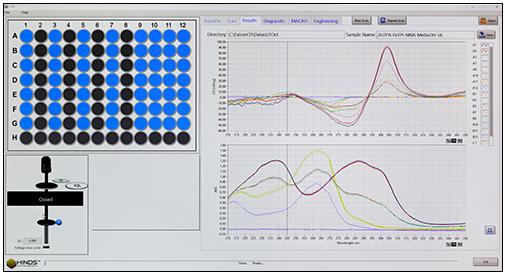
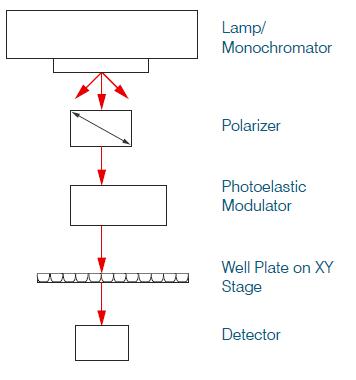
The breakthrough of this circular dichroism CD technology is achieved by converting the optical path configuration of a typical circular dichroism CD spectrometer. In traditional CD (horizontal), the configuration of the optical path allows the beam to pass horizontally through a colorimetric cell filled with solution. By vertically configuring the optical path,Fully automatic microplate detection circular dichroism spectrometerYou can directly test the sample solution in the orifice plate. By using the XY motion table, it is possible to move the orifice plate to test samples of all holes.
High throughput screening of asymmetric synthesis and catalysis
Fast testing speed
Compared to HPLC method, it has faster testing speed and is more economical
Compared to traditional CDs, testing one sample at a time is faster
Compared to traditional CD attached automatic samplers, it is easier to operate
Find asymmetric compounds
Directly read the ee value of the orifice plate
Thousands of ee values can be obtained per hour
Includes computer, instrument control software, and monitor
Compared to traditional circular dichroism CD spectrometers, the additional automatic sampler has a smaller size of 21 "x 23" x 29 "(54cm x 59cm x 74cm)
Technical Specifications:
Noise background: as low as 0.05 mdeg
Wavelength range: 185nm-850nm
Bandwidth: 1nm across the entire wavelength range
Orifice plate specification: 96 hole plate, optional with other sizes
Modulation frequency: 50kHz
Test speed:
Single wavelength testing speed: 96 hole testing takes about 2 minutes.
Multi wavelength testing speed:
Partial spectra (such as 210nm-350nm), 5nm data interval: about 30 seconds/well, 96 wells measured in about 50 minutes.
Full spectrum (185nm-850nm), 1nm data interval: about 11 minutes/well, 96 wells measured in about 18 hours
Similar Product Recommend


