-
E-mail
sales@yixist.com
-
Phone
18067966086
-
Address
2nd Floor, Building C, China Zhigu Fuchun Park, Yinhu Street, Fuyang District, Hangzhou City, Zhejiang Province
Product Categories
Yixi Intelligent Technology (Hangzhou) Co., Ltd


Faraday's Law of Electromagnetic Induction Experiment
NegotiableUpdate on 02/04
- Model
- Nature of the Manufacturer
- Producers
- Product Category
- Place of Origin
Overview
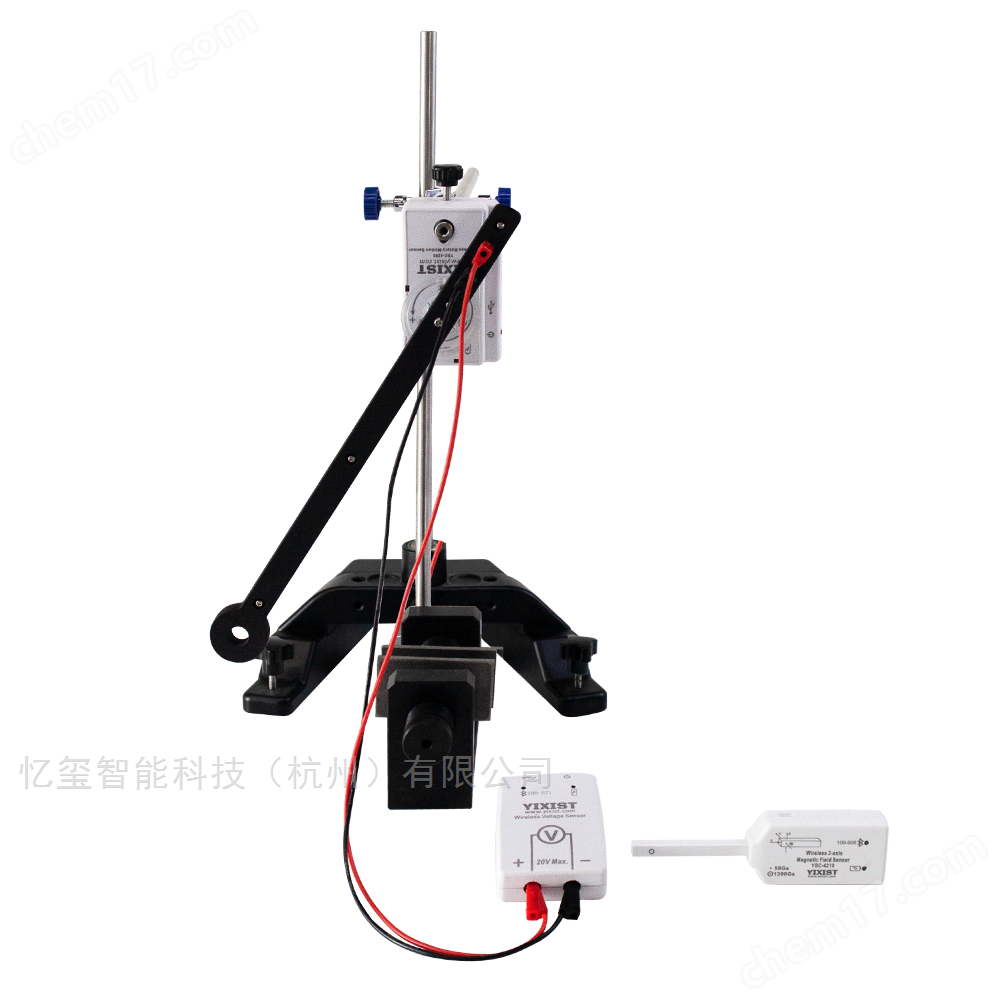
A coil swinging in a magnetic field will generate induced electromotive force by cutting magnetic induction lines, which provides a classic electromagnetic experimental phenomenon for verifying Faraday's law of electromagnetic induction and Lenz's law. When the coil oscillates periodically in a uniform magnetic field, the relationship between induced electromotive force and magnetic flux change rate can be quantitatively analyzed by measuring the alternating voltage signal generated at both ends of the coil, thus verifying the mathematical expression of Faraday's law, ε=- d /dt。
Product Details
Experimental Overview
A coil swinging in a magnetic field will generate induced electromotive force by cutting magnetic induction lines, which provides a classic electromagnetic experimental phenomenon for verifying Faraday's law of electromagnetic induction and Lenz's law. When the coil oscillates periodically in a uniform magnetic field, the relationship between induced electromotive force and magnetic flux change rate can be quantitatively analyzed by measuring the alternating voltage signal generated at both ends of the coil, thus verifying the mathematical expression of Faraday's law, ε=- d Φ/dt. Meanwhile, by observing the attenuation process of coil swing amplitude and the hindering effect generated by induced current, the physical essence described by Lenz's law that 'the direction of induced current always hinders the change of magnetic flux' can be intuitively demonstrated. In addition, the experimental system also provides an ideal model for studying energy conversion and conservation: by accurately measuring the Joule heat loss power on the external resistor and the attenuation rate of the coil swing mechanical energy, the electromagnetic damping effect can be quantitatively analyzed, and the relationship between electrical energy dissipation and mechanical energy loss can be compared, thereby verifying the applicability of the law of energy conservation in electromagnetic mechanical coupling systems.
Experimental Content
Verify Faraday's law of electromagnetic induction and measure induced electromotive force
Verify Lenz's Law
Verify the law of conservation of energy
Determination of magnetic field direction
The relationship between magnetic field strength and distance
Product Features
-
By using high-precision rotation sensors, magnetic field sensors, and voltage sensors, experimental data can be accurately measured.
The sensor supports dual-mode transmission of Bluetooth and USB, which can eliminate wire harness entanglement and reduce measurement errors
Different sizes of uniform magnetic fields can be obtained by changing the spacing between magnetic cores
Combined with SmartLAB data analysis software, real-time collection and analysis of experimental data can be achieved
Typical experimental data
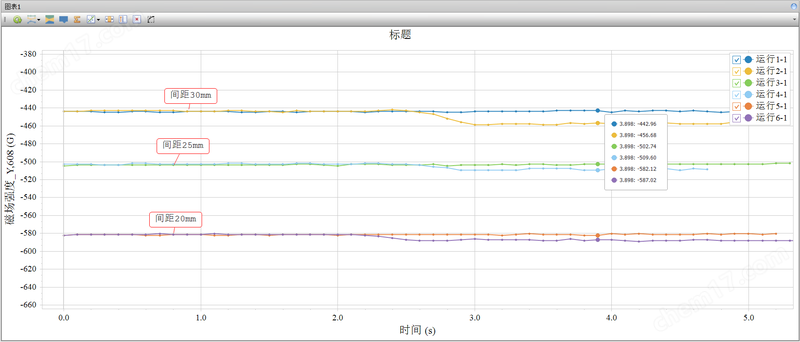
Uniform magnetic field obtained at different magnetic core spacings

The curve of angle and voltage over time when cutting a magnetic field with a coil
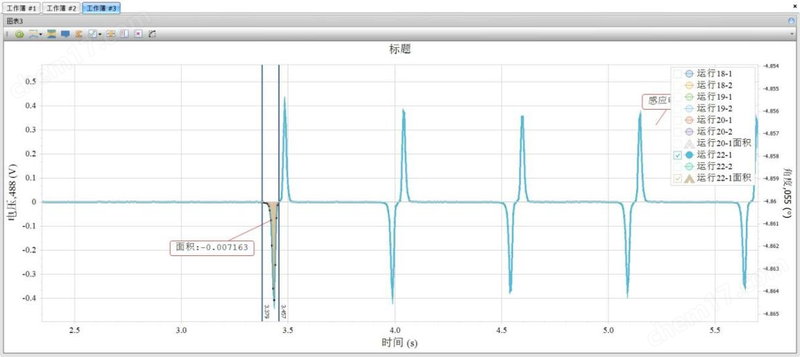
Measure and analyze the induced electromotive force generated
Essential accessories for digital experiments
| No | model | description | quantity |
| 1 | YSW-5004 | SmartLAB data analysis software | 1 |
| 2 | XSC-4406 | smart terminal | 1 |