- Phone
-
Address
302, Comprehensive Building, Xianning (Wuhan) Offshore Science and Technology Innovation Park, Liufang Road, Donghu High tech Zone, Wuhan City
Product Categories
Wuhan Dianchi Materials Co., Ltd

DC TP-100 membrane electrode precision press
NegotiableUpdate on 05/06
- Model
- Nature of the Manufacturer
- Producers
- Product Category
- Place of Origin
Overview
DC TP-100 Membrane Electrode Precision Press $r $n $r $n Product Name: Membrane Electrode Precision Press $r $n $r $n Model: DC TP-100 $r $n $r $n Manufacturer: Wuhan Dianchi New Energy Co., Ltd. $r $n $r $n Origin: China $r $n $r $n $r $n Temperature Control Range: 50~350 ℃ $r $n $r $n Hydraulic Pressure: 10 ton $r $n $r $n Timer: 100 min Countdown $r $n $r $n Plate Size: 180 * 180 mm
Product Details

DC TP-100 membrane electrode precision press
Product Name: Membrane Electrode Precision Press
Model: DC TP-100
Manufacturer: Wuhan Dianchi New Energy Co., Ltd
Place of Origin: China
Temperature control range: 50~350 ℃
Hydraulic pressure: 10 tons
Timer: 100 minute countdown
Tablet size: 180 * 180 mm
The membrane electrode consists of a proton exchange membrane (PEM), catalyst layers (CL) on both sides, and a gas diffusion layer (GDL). During the preparation of the membrane electrode, there is an important process step of hot pressing.
The necessity of hot pressing treatment is mainly reflected in five aspects:
1. Improve the interface contact characteristics between the catalytic layer and the proton exchange membrane
The hot pressing process can reduce the gaps between CL, PEM, and GDL, forming a tight physical contact.
For example, applying a pressure of 5-15 MPa can force the catalyst to embed on the PEM surface, reducing the interface impedance by about 20-40%, thereby improving proton conduction efficiency, reducing voltage loss, and increasing the current density of the membrane electrode, which is helpful for the development and application of high-performance fuel cell technology. At the same time, by hot pressing at 120-160 ℃, the PEM can be partially softened and form a certain network structure with CL, which increases the anti stripping strength of the catalyst by 3-5 times and avoids interlayer separation caused by humidity changes during operation.
2. Regulating pore structure to improve mass transfer efficiency
The hot pressing process can compress the porosity of CL, reduce the pore size distribution, and make the transmission path of gas and protons shorter and more uniform. By adjusting the hot pressing time (usually 30-180 seconds), a gradient pore structure can be formed: the CL surface retains larger pores (conducive to gas diffusion), while the bottom layer forms dense micropores (promoting proton conduction), which can avoid water flooding or membrane drying problems.
3. Activate proton exchange membrane performance
During the hot pressing process of PEM, its sulfonic acid groups can be rearranged at high temperatures to form continuous proton channels, thereby significantly improving conductivity.
4. Eliminate micro defects
By inducing plastic deformation of CL through hot pressing, nanoscale bubbles or cracks present in CL can be forced to be filled, eliminating defects. Therefore, the utilization rate of the catalyst can also be improved by 20% to 30%.
5. Collaborative control of process parameters
During the hot pressing process, the catalytic layer is inevitably affected. How to better optimize the hot pressing process? At present, there have been many explorations in the academic community, focusing on key parameters such as "hot pressing temperature T, hot pressing pressure P, and hot pressing time t. The key to membrane electrode hot pressing lies in precise control of temperature, pressure, and time.
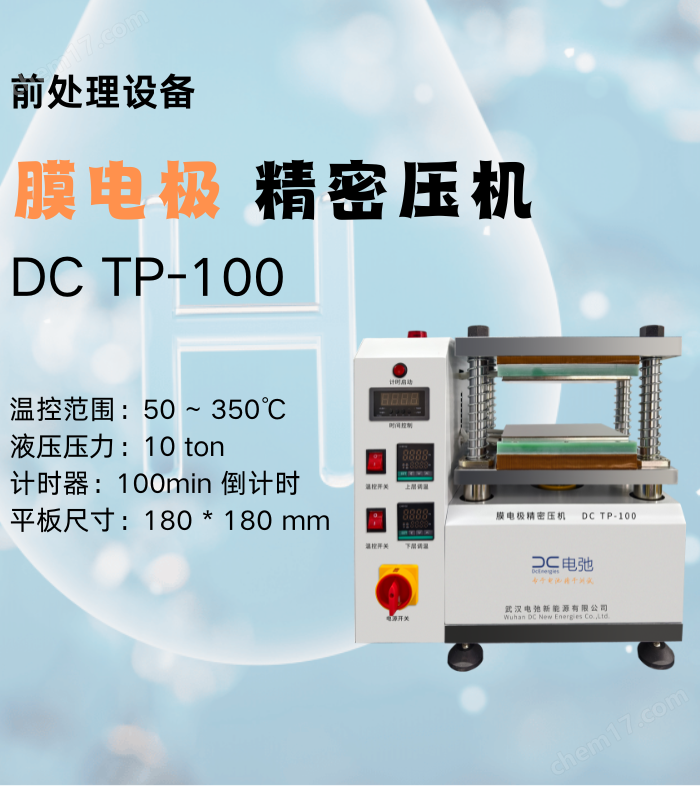
DC TP-100 membrane electrode precision press
In terms of pressure control, the DC TP-100 membrane electrode precision press adopts a four column flat plate hot pressing design to ensure uniform and consistent pressure, and can apply a maximum hydraulic pressure of 10t. What concept is this? We take 5 × 5cm ² membrane electrode hot pressing treatment as an example.
10 t=10,000 kg
According to Newton's second law, F=ma
10,000 kg × 9.8 m/s² =98,000 N
5×5 cm²=25 cm²=0.0025 m²
98,000 N ÷ 0.0025 m² = 39,200,000 N/m²
According to the formula for pressure in international units
1Pa=1 N/m²,1MPa=1,000,000 Pa
39,200,000 N/m² = 39.2 MPa
Namely, a maximum pressure of 39.2MPa can be applied to the membrane electrode
It can be seen that the DC TP-100 membrane electrode precision press is sufficient to meet the pressure control requirements. Of course, the daily hot pressing treatment of membrane electrodes usually requires a pressure of 5MPa, which means applying a hydraulic pressure of 1.275t.
In terms of temperature control, the industry generally believes that a hot pressing temperature of 100-130 ℃ is more suitable, and exceeding 160 ℃ will cause damage. The DC TP-100 membrane electrode precision press has two layers of temperature control, with a temperature control range of 50-350 ℃, which is sufficient to meet the temperature control requirements of hot pressing treatment.
In terms of time control, the hot pressing time should not be too long, usually ranging from tens of seconds to a few minutes. The DC TP-100 membrane electrode precision press has a 100 minute automatic timing function, which is sufficient to meet the time control requirements.
Similar Product Recommend


