-
E-mail
zhenhe17@foxmail.com
-
Phone
15658102012
-
Address
No. 86 Yuzhang Road, Jianqiao Town
Product Categories
Hangzhou Zhenhe Scientific Instrument Co., Ltd


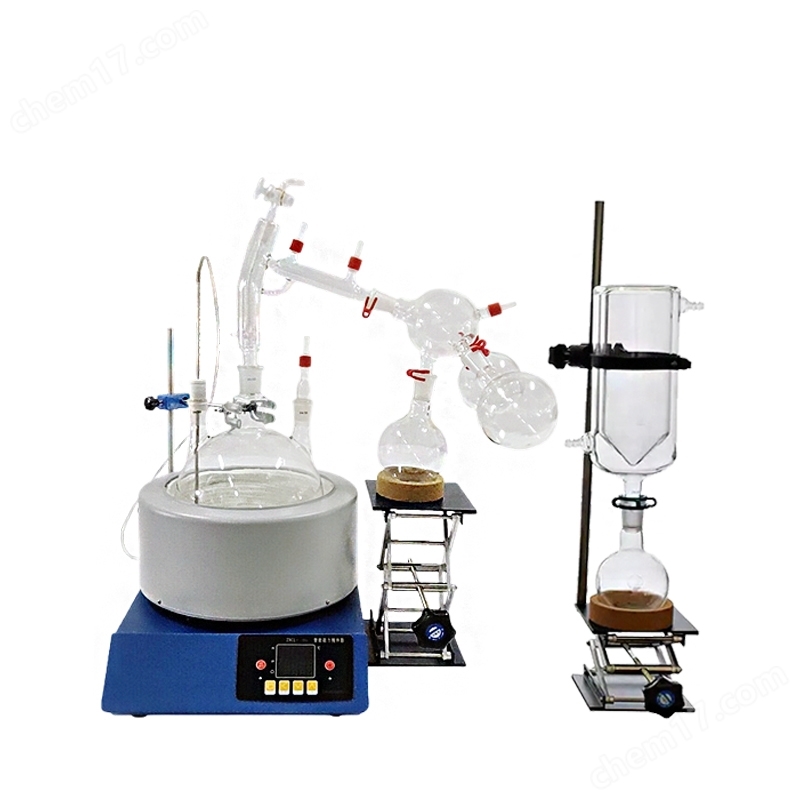
10L-20L short-range molecular distillation
NegotiableUpdate on 01/09
- Model
- Nature of the Manufacturer
- Producers
- Product Category
- Place of Origin
Overview
The 10L-20L short-range molecular distillation apparatus is a special liquid-liquid separation technology that, under high vacuum conditions, allows the average free path of vapor molecules to be greater than the distance between the evaporation surface and the condensation surface, thereby utilizing the difference in evaporation rate of each component in the feed liquid to separate liquid mixtures.
Product Details


10L-20L short-range molecular distillationExperimental operation:
(1) Addition:
Distilled liquids should generally not exceed 2/3 or less than 1/3 of the volume of the distillation flask. Carefully pour the liquid into a distillation flask (or use a funnel or vacuum negative pressure to feed). When stirring is needed, place a stirring magnet. When stirring is not needed, place 1-2 zeolite particles to prevent boiling. Then install the device.
(2) Condensation:
Before starting the distillation process, turn on the refrigeration unit and adjust the temperature for pre cooling. The connection of the condenser tube follows the principle of low inlet and high outlet.
For those who do not use a chiller, they can be connected to cold water. Connect the low water inlet to a faucet, and place the high water outlet into the pool. Turn on the faucet.
(3) Heating:
Set the target temperature based on the boiling point of the distilled liquid.
During the entire distillation process, there should be condensation droplets on the mercury bulb of the thermometer. The temperature at this point is the temperature at which the liquid and vapor are in equilibrium. The reading of the thermometer is the boiling point of the liquid (distillate).
(4) Connecting vacuum:
In order to achieve faster distillation and better separation efficiency, a vacuum pump needs to be connected for use. The vacuum pump is connected after the cold trap. High vacuum requirements can be matched with precision vacuum instruments for use.
(5) Collect fractions:
Before distillation, at least two receiving bottles should be prepared. Because liquids with lower boiling points evaporate before reaching the expected boiling point of the substance. This part of the distillate is called the "pre distillate" or "distillate head". After the pre distillate is evaporated and the temperature stabilizes, a relatively pure substance is evaporated. At this time, a clean and dry receiving bottle should be replaced to collect it. Record the readings of the thermometer at the beginning and last drop of this liquid, which is the boiling range of the distillate (boiling point range: generally, the liquid contains some high boiling impurities to a greater or lesser extent. After the required distillate is evaporated, if the heating temperature is further increased, the reading of the thermometer will significantly increase. If the original heating intensity is maintained, there will be no distillate evaporated and the temperature will decrease. At this time, distillation should be stopped)
(6) Shutdown:
After distillation, the heating and vacuum should be stopped first, then the refrigeration cycle should be stopped, the vacuum should be discharged, and the glass components should be removed and cleaned after cooling with temperature, in preparation for the next experiment. The order of dismantling the instrument is opposite to the order of assembly. First, remove the receiving bottle, and then remove the liquid receiving tube, condenser tube, distillation head, and distillation bottle.
10L-20L short-range molecular distillationNotes:
The power connection must have a reliable grounding wire to ensure the safe grounding of the casing.
Glass instruments should be avoided from impact, scratches from hard objects, sudden changes in temperature during assembly, disassembly, cleaning, and use. It is strictly prohibited to use electric furnaces or open flames for direct heating. When evaporating flammable, explosive, toxic, corrosive or valuable solutions, users must take corresponding safety precautions and comply with relevant safety operation regulations.
For valuable solutions, simulation process experiments should be conducted first. When it is confirmed that the equipment can meet the process and safety requirements, it can be put into normal use. The manufacturer does not assume any responsibility beyond the equipment.
To prevent electrical components from being submerged in water.
In distillation operations, the following points should be noted:
(1) Control the heating temperature well.
If a heating bath is used, the temperature of the heating bath should be several degrees higher than the boiling point of the distilled liquid, otherwise it will be difficult to distill the distillate. The higher the temperature of the heating bath compared to the boiling point of the distilled liquid, the faster the distillation rate. However, the temperature of the heating bath should not be too high, otherwise it may cause the vapor pressure at the top of the distillation flask and condenser to exceed atmospheric pressure, which may lead to accidents, especially when distilling low boiling point substances. Generally, the temperature of the heating bath cannot be higher than the boiling point of the distilled substance by 30 ℃. The entire distillation process requires the addition of bath solution at all times to maintain the liquid level of the bath solution at least one centimeter above the liquid level in the bottle.
If using an electric heating sleeve, pay attention to several points: ① Due to the limited temperature resistance of the motor and magnet of the mixer, the instrument cannot be used solely for heating tests, especially for high-temperature heating tests. Please adjust the motor to rotate or rotate at low speed (idle) to prevent damage to the motor and magnet from high-temperature radiation. ② When the high-temperature heating is completed, please turn off the heating first and wait for a few minutes for the remaining temperature to dissipate before turning off the stirring. ③ The heating part has a high temperature, so be careful when working to avoid burns. ④ When used for the first time, white smoke and odor may appear inside the sleeve, and the color may change from white to brown and then back to white, which is a normal phenomenon. Due to the presence of oil and other compounds in the production process of fiberglass, it should be placed in a well ventilated place and can be used normally after a few minutes of disappearance.
⑤ When using an electric heating sleeve with a capacity of over 3000ml, there may be a creaking sound due to differences in the furnace wire structure and related to the controllable silicon voltage pulse signal. You can use it with confidence. ⑥ If you find that there is no power supply, please first check whether the right rear fuse needs to be replaced.
(2) When evaporating high boiling point substances, due to their tendency to condense, the vapor often condenses back into the distillation flask before reaching the side tube. Therefore, short necked distillation bottles or other insulation measures should be used to ensure smooth distillation.
(3) Before distillation, it is necessary to understand the boiling point and saturated vapor pressure of the substance being distilled and its impurities, in order to determine when and at what temperature to collect the distillate.
(4) Pay attention to whether the liquid nitrogen in the liquid nitrogen cold trap is sufficient and replenish it in a timely manner.
Prohibited from use in explosive gas environments or explosive dust environments.
When not in use for a long time, please keep the instrument clean and store it in a dry and non corrosive gas place.
Principles and precautions for using short-range distillation equipment
Short distance distillation equipment is a special liquid-liquid separation technology that separates liquid mixtures by utilizing the difference in evaporation rate of components in the feed liquid, in a high vacuum state, where the average free path of vapor molecules is greater than the distance between the evaporation surface and the condensation surface. Not only applied in the fields of medicine and petroleum, but also widely used in the food industry.
What are the components of short-range distillation?
Heating part (electric heating sleeve), evaporation bottle, distillation elbow, distributor, receiving bottle, cold well and bracket, fixing clip.
What is the function of a cold well for short-range distillation?
Filter some gases, liquid gases, and impurities into the vacuum pump to contaminate the vacuum oil.
What is the function of short-range distillation?
Evaporative extraction of materials under vacuum conditions.
What is short-range distillation?
The driving force for the flow of steam is the pressure difference between the boiling film and the condensation surface, which can cause the flow of steam for small pressure drops. A distiller made based on this principle, which operates at 1mbar and requires a short distance between the boiling and condensing surfaces, is called a short-range distiller.
What is the distillation process of short-range distillation?
Molecules diffuse from the liquid phase to the evaporation surface, freely evaporate on the liquid layer surface, and fly from the evaporation surface to the condensation surface, where they condense.
What is the maximum vacuum degree that can be achieved by short-range distillation?
The maximum vacuum degree is 0.098Mpa.
What are the preparations before starting short-range distillation?
Connect the cooling water circulation pump first, then turn on and adjust the temperature before pre condensing.
What should I do if the short-range molecular distillation separation effect is not good?
Choose the appropriate evaporation temperature and vacuum degree.
What materials are mainly used in short-range distillation equipment?
The main raw materials for the production of short-range distillation kits are borosilicate glass, polytetrafluoroethylene, 304 stainless steel, and other materials. They all have good chemical resistance and are excellent laboratory distillation equipment.
What is the heating form of the short-range distillation device?
The short-range distillation device uses an electric heating hood to provide a heat source for the entire short-range distillation system. In the case where the entire device is under negative vacuum, this electric heating hood can be heated to 250 ° C. This electric heating hood has magnetic stirring function, which helps the substance in the reaction bottle to be distilled out faster.
What models of short-range distillation do you have?
2L,5L,10L,20L。 Customization is acceptable.
What are the applications of short-range distillation?
As a hot product of our company, short-range distillation is committed to high efficiency and low cost. At the same time, this short-range distillation device is widely used in industries such as pharmaceuticals, laboratory fractionation and purification, food and beverage, essential oils, etc.
17. What is laboratory short-range distillation?
Short distance distillation is a distillation technique that involves the short distance flow of the distillate, typically only a few centimeters, and is typically carried out under reduced pressure.
What are the characteristics of magnetic stirring heating sleeves?
Provide a large heating area, uniform heating, and rapid heating. PAPST series brushless DC motors have stable performance, low noise, long lifespan, and no sparks.
How does short-range distillation work?
In a short-range distillation unit, a liquid solution or lotion is suspended in an evaporative flask, which is connected to a condenser or a cooling unit through a short feed. Place the evaporation flask in a heating jacket, which gradually raises the temperature of the solution to the predetermined boiling point, thereby promoting the evaporation of different compartments of the solution.
What are the application scope of short-range distillation?
Can replace conventional falling film evaporators for distillation, purification, concentration, and decolorization of petrochemical and chemical products;
Especially suitable for distillation and refining of heat sensitive and easily oxidizable chemical industrial products;
It can also be used for distillation separation of high boiling point products.
What are the precautions for using short-range distillation?
Distillation equipment and installation
The atmospheric distillation device mainly consists of a distillation flask, a distillation head, a thermometer sleeve, a thermometer, a condenser tube, a receiver tube, and a receiving bottle. When the boiling point of distilled liquid is below 140C, use a straight condenser tube; When the boiling point of the evaporated liquid is above 1400C, due to the large temperature difference of the water condenser tube, the condenser tube is prone to bursting. Therefore, an air condenser tube should be used instead - for high boiling point compounds, an air condenser tube can achieve the cooling purpose. When distilling liquids that are prone to moisture absorption, a drying pipe should be connected to the branch pipe of the liquid receiving pipe; When distilling flammable liquids, connect a hose at the branch of the liquid receiving pipe to the water tank and cool the receiving bottle in an ice water bath.
The order of installing instruments is generally from bottom to top, from left to right, and the axis of the entire instrument device should be in the same plane, stable and upright.
Installation steps: Starting from the heat source, place the gas lamp on the iron frame, then install the iron ring and asbestos net (or water bath, oil bath, etc.) according to the height of the gas lamp, and then install the steam bottle (i.e. steam head and thermometer). Note that the bottom of the bottle should be 1-2mm away from the asbestos net and should not touch it; When using a water bath or oil bath, the bottom of the bottle should be 1-2cm away from the bottom of the water bath (or oil bath) pot. The distillation bottle should be vertically clamped with an iron clamp. When installing the condenser tube, connect it with a suitable rubber tube, adjust its position to match the height of the already installed distillation flask and be coaxial with the side tube of the distillation head, and then loosen the iron clamp that fixes the condenser tube to move it along this axis and connect it to the distillation flask. The iron clamp should not be clamped too tightly or too loosely, and should be able to rotate with slight force after clamping (intact iron clamps are usually padded with soft materials such as rubber to prevent instrument breakage). The receiving bottle (using a conical flask or round bottom flask) should be connected to the tail of the condenser tube through a liquid receiving tube. The receiving bottle that officially receives liquid should be weighed and recorded in advance. (Note that the screw mouth of the crosshead of the iron clamp should be upward, and the handle on the clamp should also be upward for ease of operation.)
During installation, the flask clamp and condenser clamp should be respectively clamped at the neck of the flask and the middle of the condenser tube. Mercury thermometer
The upper limit of the ball should be on the same horizontal line as the lower limit of the side tube of the distillation head. The distillation head is connected horizontally to the condenser tube, and the lower end of the condenser tube is connected to the liquid receiving tube. Condensed water should flow in from the bottom of the condenser tube and out from the top to ensure that the condenser tube is always filled with water
Similar Product Recommend