- Phone
-
Address
No. 55 Hanlin Road, Xishan District, Wuxi City, Jiangsu Province
Product Categories
Wuxi Guanya Constant Temperature Refrigeration Technology Co., Ltd


-10 ℃ cooling water circulation machine - water-cooled industrial chiller
NegotiableUpdate on 05/06
- Model
- Nature of the Manufacturer
- Producers
- Product Category
- Place of Origin
Overview
【 Wuxi Guanya 】 LT series freezer (refrigeration cycle chiller) temperature range -80 ℃~30 ℃, temperature control accuracy of 0.5 ℃, secondary supercooling technology, rapid refrigeration; We use branded semi closed piston compressors, semi closed piston two-stage compressors, and semi closed screw compressors. -10 ℃ cooling water circulation machine - water-cooled industrial chiller
Product Details


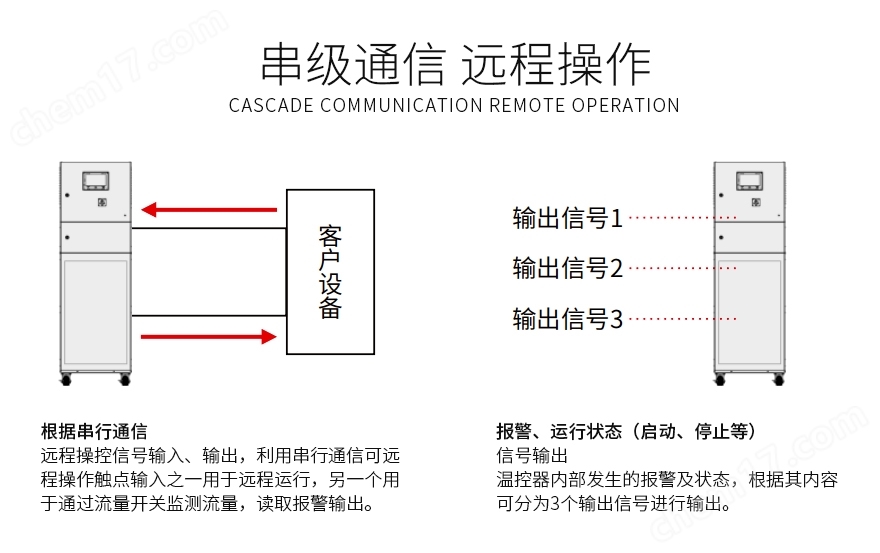


-10 ℃ cooling water circulation machine - water-cooled industrial chiller
-10 ℃ cooling water circulation machine - water-cooled industrial chiller
The laboratory refrigeration unit is a key equipment for maintaining a low-temperature environment in scientific research experiments. It provides a stable cold source for sample storage, reaction control, instrument cooling, etc. through a systematic refrigeration cycle. The process flow is designed around refrigerant phase change and heat transfer, and has the advantage of adapting to laboratory scenarios, becoming an experimental auxiliary equipment in fields such as biology, chemistry, and materials.
1、 Process flow of laboratory refrigeration machine
The core of a laboratory refrigeration machine isThe refrigeration cycle process of "compression condensation throttling evaporation" is divided into four key steps. Firstly, there is the refrigerant compression stage, where the compressor compresses low-temperature and low-pressure gaseous refrigerant into high-temperature and high-pressure gaseous refrigerant, providing power for heat transfer; Next is the condensation and heat dissipation process, where high-temperature and high-pressure refrigerants enter the condenser and release heat through air or water cooling, gradually condensing into medium temperature and high-pressure liquid refrigerants; Next is the throttling and pressure reduction process, where the liquid refrigerant undergoes a sudden drop in pressure when passing through capillary tubes or expansion valves, transforming into a low-temperature and low-pressure gas-liquid mixture; Finally, there is the evaporation and heat absorption process. The gas-liquid mixture enters the evaporator and exchanges heat with the object that needs to be cooled in the laboratory. The refrigerant absorbs heat and vaporizes, returning to the compressor to start the next cycle, while the cooled object remains in the set low temperature range.
At the same time, the laboratory refrigeration unit is equipped with an independent circulating medium system. When the cooling object needs to be indirectly cooled, the circulating pump drives the refrigerant to flow between the evaporator and the cooling object, and transfers the cooling capacity through the refrigerant, avoiding direct contact between the refrigerant and the experimental sample or equipment, and improving the safety and flexibility of use.
Similar Product Recommend