Polyacrylamide Manufacturer in China | Shouxin Advanced Polymer Sciences Co., Ltd.
Shouxin Advanced Polymer Sciences Co., Ltd. is a leading polyacrylamide (PAM) brand and global supplier based in China.09,18,2026 7 views


10,20,20250From:
In 2025, the Technical Exchange Conference on Secondary Water Supply Quality Monitoring Equipment will be held in Weifang, bringing together experts, enterprise representatives, and technical backbones from the national water supply industry to explore cutting-edge technologies and innovative practices for ensuring secondary water supply quality. The meeting focuses on core issues such as the implementation of hygiene standards for secondary water supply facilities, the application of intelligent monitoring technology, and full process water quality control, providing technical support for improving urban water supply safety.
At the meeting, Manager Yu from Tianwei Environmental Technology Co., Ltd. introduced that the secondary water quality monitoring equipment is an intelligent water quality monitoring device designed specifically for building secondary water supply systems. It uses high-precision sensor arrays to monitor core water quality parameters such as turbidity, residual chlorine, and pH value in the water supply network in real time. The equipment adopts food grade contact materials and anti-corrosion structures, which comply with drinking water hygiene standards. The built-in self-cleaning device can effectively prevent sensor contamination. Support 4G/NB IoT multi-mode communication, achieve remote transmission of monitoring data and real-time control of device status, and establish a water quality change warning model in conjunction with cloud algorithms. ”
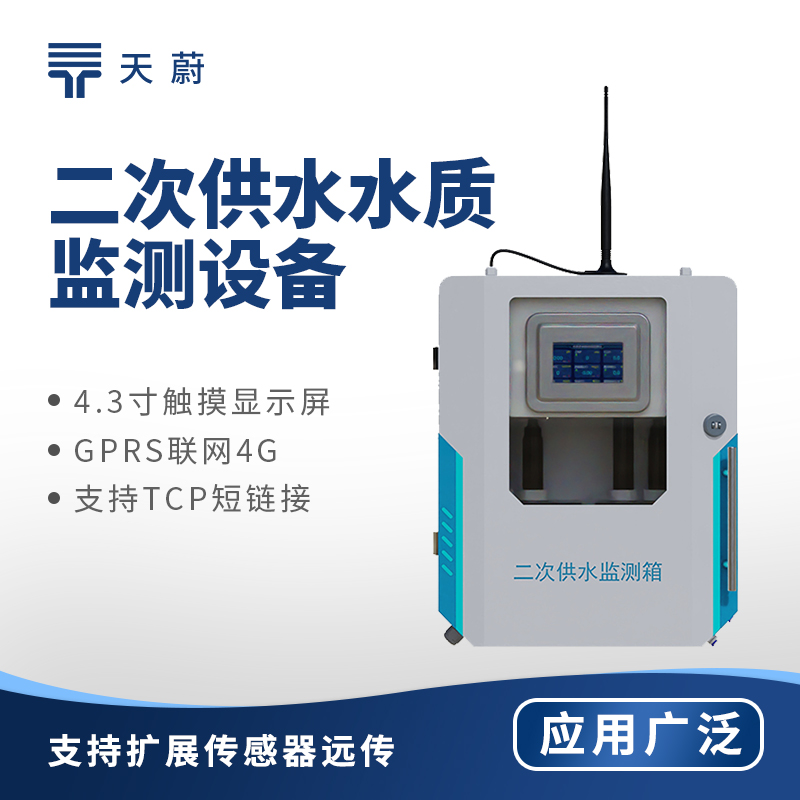
The 2025 Weifang Technical Exchange Conference focuses on the intelligent upgrade of secondary water quality monitoring equipment, with the core breakthrough being "multi parameter collaborative collection+AI risk prediction". The equipment integrates basic parameters such as water temperature, pH value, conductivity, turbidity, etc., and expands monitoring modules for residual chlorine, dissolved oxygen, heavy metals (such as lead and mercury), and organic matter (COD, ammonia nitrogen) to achieve full chain water quality coverage. For example, pH monitoring adopts the principle of electrochemical salt bridge with an accuracy of ± 0.1, combined with automatic temperature compensation (0-50 ℃) to avoid interference from water temperature fluctuations; Turbidity monitoring adopts scattered light method, with a range of 0-40NTU and an accuracy of ± 1%, which can accurately capture water quality changes caused by pipeline corrosion, biofilm growth, etc.
Technical adaptation: Low power consumption and high reliability design
In response to the humid and limited space environment of the secondary water supply system, the equipment adopts modular design, and the core sensor selection is suitable for low turbidity and low pollutant concentration scenarios. The residual chlorine sensor adopts "fluorescence method" or "polarography method" to avoid the problem of frequent replacement of reagents in traditional colorimetric methods; The pH sensor uses anti pollution electrodes to reduce the impact of scale adhesion on data.
The introduction meeting was a complete success, and we welcome customers with such needs to come.
Previous111

Polyacrylamide Manufacturer in China | Shouxin Advanced Polymer Sciences Co., Ltd.
Shouxin Advanced Polymer Sciences Co., Ltd. is a leading polyacrylamide (PAM) brand and global supplier based in China.