Polyacrylamide Manufacturer in China | Shouxin Advanced Polymer Sciences Co., Ltd.
Shouxin Advanced Polymer Sciences Co., Ltd. is a leading polyacrylamide (PAM) brand and global supplier based in China.09,18,2026 6 views


06,17,20250From:
First author:Cheng Miao and Pan Shaoqing
Corresponding author:Liu Bo
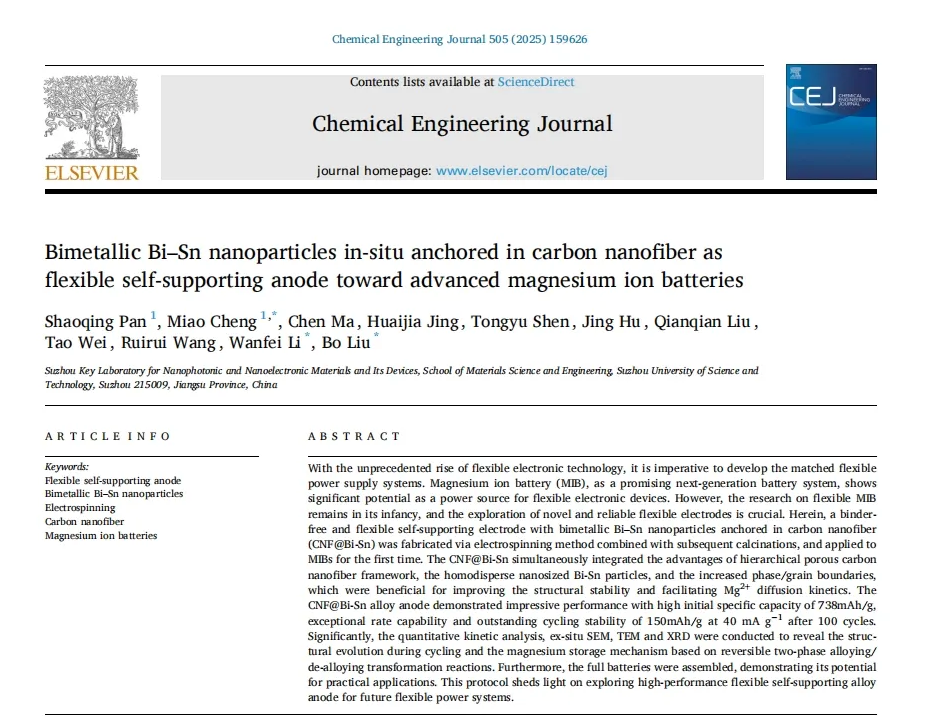
Article Title:《Bimetallic Bi–Sn nanoparticles in-situ anchored in carbon nanofiber as flexible self-supporting anode toward advanced magnesium ion batteries》
Influencing factors:13.4
01Teacher Profile
Professor Liu Bo is a researcher of School of Materials Science and Engineering, Suzhou University of Science and Technology, a part-time researcher of Shanghai Institute of Microsystems and Information Technology, Chinese Academy of Sciences, and a visiting professor of Qilu University of Technology. Mainly engaged in research on nano optoelectronic materials and devices. Responsible for and participated in over 60 scientific research projects, including the National Nanotechnology Major Scientific Research Program (973); Published 317 journal articles (230 SCI papers), authorized 119 inventions in China and 5 inventions in the United States.
Research Background of Paper 02
With the booming development of flexible electronic devices, exploring and developing high-performance flexible energy storage systems has become increasingly crucial. Among them, significant progress has been made in the practical application of flexible lithium-ion batteries in flexible electronics and wearable devices. However, the high cost caused by limited lithium resources and the safety risks caused by uncontrollable lithium dendrite formation pose challenges to their further development and application. Therefore, there is an urgent need to develop alternative battery systems with high natural abundance, low cost, and high safety. Rechargeable magnesium ion batteries are expected to become a reliable alternative to lithium based battery systems due to their abundant magnesium resources, low cost, high theoretical specific capacity, suitable reduction potential, and the absence of dendritic crystals during electrochemical deposition/dissolution processes, providing high operational safety. However, there is very little research on flexible electrode materials for magnesium ion batteries. In recent years, electrospinning has been consideredIt is used to manufacture 3D porous membranesconvenient、possessOne of the cost-effective and feasible technologies in the industry, an increasing number of researchers are focusing on using electrospun nanofiber based composite materials as flexible electrodes.
03 Paper Highlights/Abstract
With the development of flexible electronic technology, it is imperative to develop a flexible power supply system that matches it. Magnesium ion batteries (MIBs), as a promising next-generation battery system, demonstrate enormous potential as power sources for flexible electronic devices. However, research on flexible magnesium ion batteries is still in its infancy, and exploring new and reliable flexible electrodes is crucial. This article describes the preparation of a flexible self-supporting electrode without binder using electrospinning combined with in-situ thermal reduction process. The electrode is anchored by bimetallic Bi Sn nanoparticles on carbon nanofibers( CNF@Bi-Sn )Formulated and applied to magnesium ion batteries. CNF@Bi-Sn At the same time, it integrates the advantages of multi-level porous carbon nanofiber framework, uniformly dispersed nanoscale Bi Sn particles, and increased phase/grain boundaries, which help to improve the structural stability of flexible electrode materials and promote Mg2+The diffusion dynamics. CNF@Bi-Sn The alloy negative electrode exhibits excellent electrochemical performance, with a high initial specific capacity of 738mAhg−1Excellent magnification performance and cycling stability, at 40mAg−1After cycling 100 times at a current density, it still maintains 150mAhg−1The reversible capacity. This work reveals the structural evolution of flexible electrode materials during cycling and the magnesium storage mechanism based on reversible two-phase alloying/dealloying conversion reactions through quantitative kinetic analysis, non in situ SEM, TEM, and XRD. In addition, a full battery was assembled, demonstrating its potential in practical applications. This study provides new ideas for exploring and developing high-performance flexible self-supporting alloy negative electrodes.
04Text and image analysis
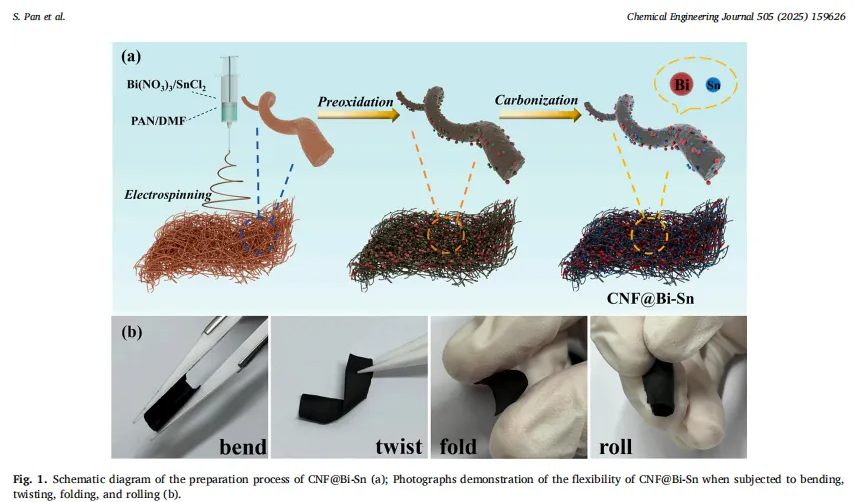
Figure 1: CNF@Bi-Sn The preparation schematic diagram and its flexible display.
1: Bi Sn nanoparticles uniformly anchored in carbon nanofibers as flexible self-supporting negative electrodes for magnesium ion batteries
A flexible thin film loaded with bimetallic Bi Sn nanoparticles was prepared by electrospinning and in-situ thermal reduction methods( CNF@Bi-Sn )It exhibits good flexibility and can withstand various deformations (bending, twisting, folding, etc.). During the battery assembly process, no current collector, conductive agent, or binder was used. It can be observed through SEM and TEM that Bi Sn nanoparticles are uniformly distributed in carbon nanofibers.
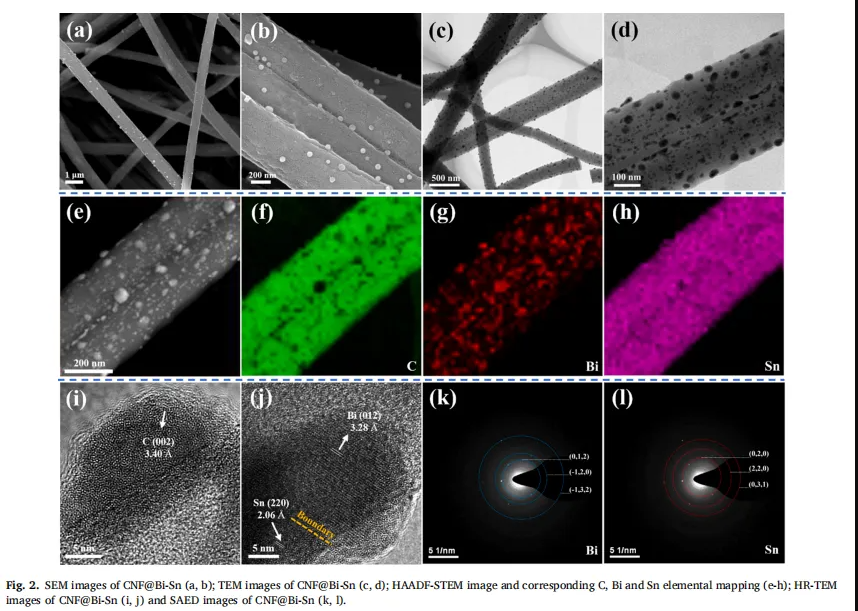
Figure 2: Displayed CNF@Bi-Sn SEM images (a, b); CNF@Bi-Sn TEM images (c, d); HAADF-STEM images and corresponding distribution maps of C, Bi, and Sn elements (e-h); CNF@Bi-Sn HR-TEM images (i, j) and CNF@Bi-Sn Selected Area Electron Diffraction (SAED) image (k, l).
Secondly: CNF@Bi-Sn Exhibiting high reversible capacity, excellent rate performance, and good cycling stability
CNF@Bi-Sn Having a capacity of 738mAhg-1After cycling at different rates, its discharge specific capacity can be restored to 214 mAHg with a high initial specific capacity-1It proves CNF@Bi-Sn The electrode has good rate performance. And in 40mAg-1Can still maintain 150mAhg after 100 cycles at a current density of-1Higher reversible capacity.
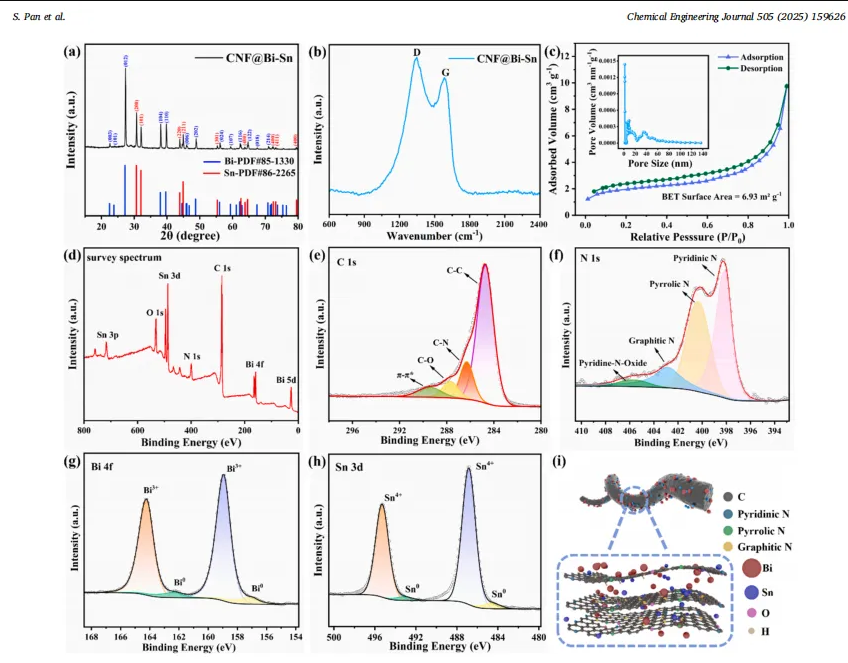
image3:The electrochemical magnesium storage performance of the sample was demonstrated. (a) CNF@Bi-Sn At 0.1mV−1Cyclic voltammetry curve at scanning rate(CV curve); (b) CNF@Bi The CNF@Sn and CNF@Bi-Sn The magnification performance; (c) CNF@Bi-Sn Charge discharge curves at different current densities; CNF@Bi-Sn At 40mAg-1Cycle under current density100 cycles of performance (d) and at 100 mAg-1Cycle under current density200 cycles of performance (e); (f) CNF@Bi The CNF@Sn and CNF@Bi-Sn The Nyquist plot (illustrated with its corresponding equivalent circuit model); (g) CNF@Bi-Sn CV curves of electrodes at different scanning rates; (h) The contribution ratio of capacitance control capacity and diffusion control capacity at different scanning rates.
3: Revealed the structural evolution and magnesium storage mechanism during magnesemization/de magnesemization process through non in situ characterization
Characterization methods such as non in situ SEM, TEM, and XRD were used to investigate CNF@Bi-Sn The morphology and structural evolution during magnesemization/de magnesemization processes were studied. TEM confirmed CNF@Bi-Sn After sufficient discharge (magnesium embedding) and charge (magnesium removal), Bi Sn nanoparticles are still well encapsulated and uniformly dispersed in carbon nanofibers, effectively alleviating their volume changes during alloying and preventing loss of active materials. The EDS results indicate that Bi, Sn, and Mg elements are uniformly distributed in the carbon matrix in the discharge state, and non in situ XRD also confirms this CNF@Bi-Sn The magnesium storage mechanism of electrodes is based on reversible two-phase alloying/dealloying transformation reactions.

image4:displayedCNF@Bi-Sn SEM images (a), TEM images (b, c), HAADF-STEM images and corresponding Bi, Sn, and Mg element distribution maps (d), HR-TEM images (e), XRD patterns (f) after 20 cycles in a fully discharged state, and CNF@Bi-Sn Schematic diagram (g) of the structural evolution of electrodes in charge and discharge states.
05 Equipment used in this article
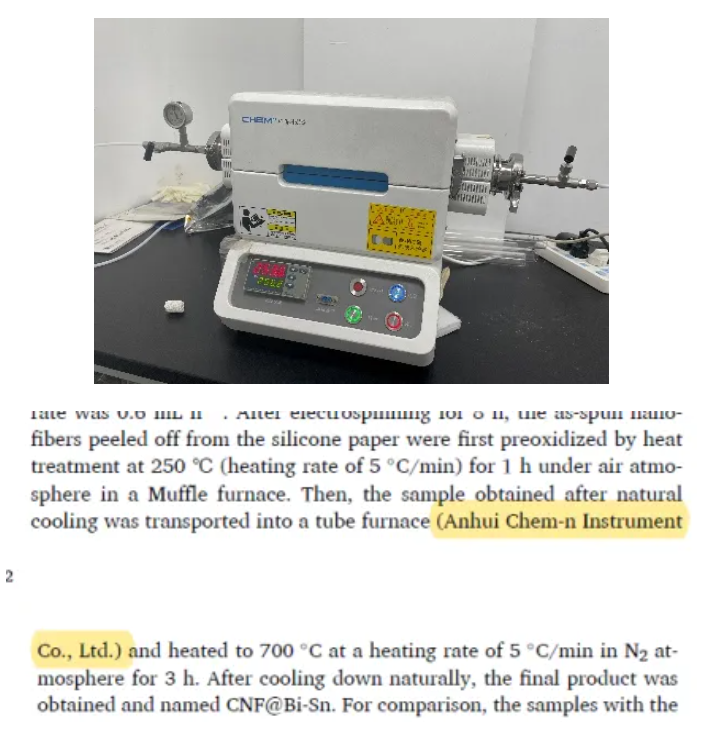
Teacher Liu Bo's research group used it in the experimentMicro assisted tube furnaceProvided by Kemi Instrument, the paper specifically mentions Anhui Kemi Instrument Co., Ltd. We would like to express our sincere gratitude to the teacher for choosing and recognizing Kemi Instrument.
Previous111

Polyacrylamide Manufacturer in China | Shouxin Advanced Polymer Sciences Co., Ltd.
Shouxin Advanced Polymer Sciences Co., Ltd. is a leading polyacrylamide (PAM) brand and global supplier based in China.