- Phone
-
Address
Building 16, Electronic Smart Park, South Industrial Park, Binhai Economic Development Zone, Binhai County, Yancheng City
Yancheng Nayang Micro Chemical Engineering Technology Co., Ltd
Company Profile

- Company Name:
- Yancheng Nayang Micro Chemical Engineering Technology Co., Ltd
- Year Established:
- 2026/5/15 23:34:58
- Registered Capital:
- Main Products:
- Address:
- Building 16, Electronic Smart Park, South Industrial Park, Binhai Economic Development Zone, Binhai County, Yancheng City
About Nayang Microelectronics

Yancheng Nayang Micro Chemical Engineering Technology Co., Ltd. (Nayang Micro Chemical) was established in 2017. We focus on the design and manufacturing of microchannel reactors under different operating conditions, innovate micro chemical engineering for process matching, and develop and promote micro chemical engineering for various high-risk reaction types such as nitrification, sulfonation, chlorination, oxidation, ammonification, hydrogenation, and polymerization.
Yancheng Nayang Microelectronics has been proposed twice domesticallyMicro chemical three-stage process logicThe three functional units, namely pre mixed micro dispersion, enhanced micro reaction, and delayed maturation, jointly complete the "three transmission and one reaction" chemical process. We adopt the classic cross finger mixing structure to achieve dispersion and premixing of different materials, using the Na Yang methodpatentMicro chaotic tube wall turbulence structureEnhance mass and heat transfer in the reaction process; For chemical processes with slow intrinsic kinetics, a tubular reactor is used to extend the reaction time and complete the maturation process.
From the beginning of product design, Central Microelectronics has considered the issue of amplification. We adopt a combination of size and quantity amplification to reduce the amplification effect; The same method is used from small-scale testing, pilot testing to mass productionMaintain consistency in the three-stage process logic of microchemistrySpatiotemporal View of Microchemical Reaction ProcessesAnd the heat transfer capacity makes the amplification effect controllable, and even seamless amplification can be achieved.
selfSince its establishment in 2017, we have adhered to innovation and developed over 40 microchannel reactors using various materials such as glass, quartz, stainless steel, Hastelloy, titanium, tantalum, and silicon carbide, based on actual process conditions; The company has established a complete system from independent research and development to production and manufacturing, as well as a quality management system. It has passed the GB/T19001-2016/ISO9001:2015 standard certification and has authorized more than 30 domestic projectspatent.
Na Yang Microelectronics adopts a flexible and flexible service and cooperation model, providing micro reactor equipment services such as sales, leasing, and on-site testing; We have established a partnership with Yancheng Engineering Vocational and Technical CollegeJoint Laboratory of Microchemical Engineering and TechnologyWe have a complete set of microchannel reactor equipment, gas phase, liquid phase, mass spectrometry and other analytical and detection instruments to provide customers with small-scale validation and process development services.
Equipment innovation drives technological innovation, and technological innovation promotes industrial revolution. Based on our innovative capabilities in microchemical equipment, we strive to contribute to the elimination of obstacles on the path of microchemical technology innovation, and help to open up a safe, green, efficient, and energy-saving new chemical path.
That central equipment model

The central service process

That central qualification certificate
Since its establishment in 2017, we have adhered to innovation and developed over 40 microchannel reactors using various materials such as glass, quartz, stainless steel, Hastelloy, titanium, tantalum, and silicon carbide, based on actual process conditions; The company has established a complete system from independent research and development to production and manufacturing, as well as a quality management system, and has passed the GB/T19001-2016/ISO9001:2015 standard certification,Authorized for over 30 domestic projectspatent.

Future direction of chemical engineering

Continuous flow and microchemistry represent the direction of future chemical engineering. The chemical industry provides raw materials, materials, and energy production for the national economy and people's livelihood, and is an important pillar industry related to the national economy and people's livelihood. Although China is a major producer of chemical industry, it is not a strong country, and recently there has been a high incidence of chemical accidents, high energy consumption, heavy pollution, resource waste, and low efficiency, which still plague many chemical enterprises.To address the above issues, innovation in chemical production facilities is the fundamental solutionThe innovation of equipment drives technological innovation, and technological innovation can promote the revolution of the chemical industry. The current extensive chemical production mode is based on batch reactor and high flux pipeline reactor, while the microchannel reactor that has emerged in recent years has high specific surface area, efficient heat transfer and mass transfer capabilities, which can shorten the chemical reaction time from tens of hours to minutes or even seconds, and is expected to open up high efficiencyA new model of lean production: continuous flow microfabrication.
Micro Chemical Innovation Factory
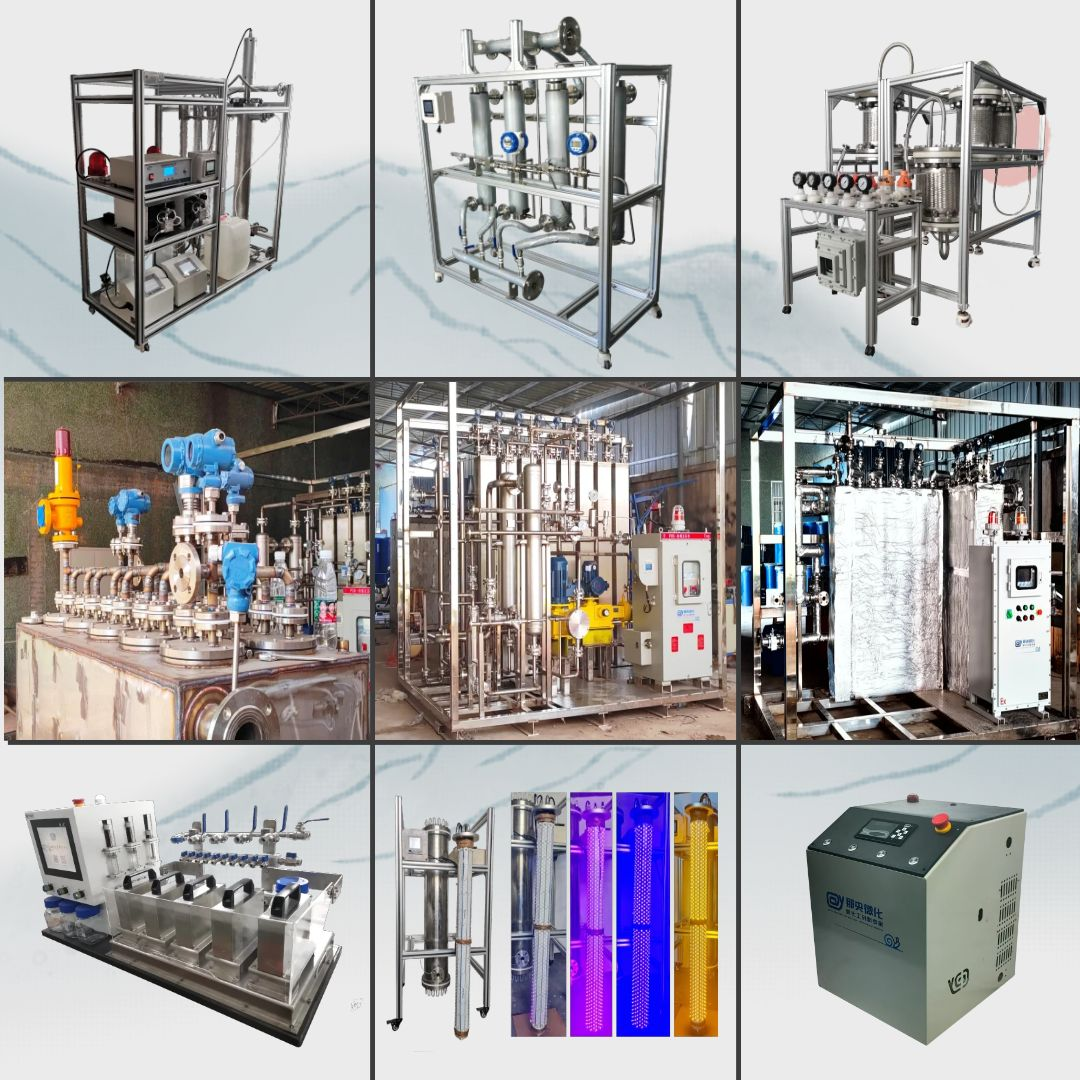
The kitchen has pots, pans, and utensils, carpenters need to chisel axes and saws, chemical engineering cannot do without pumps, kettles, pipes, and valves, and microchemistry also requires a series of related equipment.Compared with traditional kettle type chemical engineering, microchemical engineering has higher requirements for its equipment: corrosion resistance, high temperature resistance, high pressure resistance, fluid driven stability, stronger mass transfer and heat transfer capabilities, and higher compatibility between microchemical processes and equipmentEspecially in terms of the compatibility between process and assembly, the requirements for microchannel reactors vary depending on the working conditions. For example, liquid-liquid continuous flow reactions and gas-liquid continuous flow reactions require different premixing equipment, process intensification equipment, and delayed maturation equipment; Liquid liquid reactions are easier to achieve laminar flow in microchannels, while gas-liquid reactions have more anti mixing phenomena in microchannels due to the different viscous forces of gas-liquid materials.
Na Yang Microelectronics focuses on the development of microchannel reactors for different process conditions and innovative micro chemical engineering with high compatibility. As of nowWe have completed the micro chemical engineering development and promotion of various high-risk reaction types such as nitrification, sulfonation, chlorination, oxidation, ammonification, hydrogenation, polymerization, etcIn order to match different working conditions, we have developed various types of microchannel reactors and auxiliary equipment, including microchannel reactors made of different materials such as stainless steel, silicon carbide, glass, and tantalum titanium, microchannel reactors with pre mixing, microreaction process enhancement, delayed maturation, photocatalytic reactors, ultrasound assisted microchannel reactors, high-frequency vibration microchannel reactors, dynamic tube microchannel reactors, etc.
The founder team of Nayang Microelectronics focuses on microfluidics/15 years of experience in microreactor technology, with profound theoretical and practical knowledge in mesoscopic fluid dynamics and microfluidics. Based on green environmental protection, intrinsic safety, high efficiency and energy saving, flexible and continuous flow production, we closely cooperate with the process team to develop a series of microchemical process enhancement equipment, innovatively solving various difficulties encountered by users in the development of microchemical processes. We hope to use processes such as microreactors to enhance technology and contribute to solving the current severe environmental pressure, outdated production methods, and higher requirements for safety production!Our goal is to collaborate and jointly build a micro chemical innovation factory, drive the innovation of micro chemical technology through the innovation of micro chemical equipment, and bring about a revolution in the chemical industryTo contribute to the new era of efficient and refined synthesis in the chemical industry, and to contribute to rewriting the current situation of high incidence of chemical production accidents!
Three-stage process logic
The essence of chemical engineering lies in the principles of mass transfer, transmission, heat transfer, and reaction kinetics. Both kettle reaction processes and micro chemical reaction processes follow this logic, but they have different forms of expression. The chemical reaction process completed in a kettle reactor starts from mixing and continues over time until completion. If any point of the chemical reaction process from 0% to 100% inside the kettle can be displayed as a "slice" to understand, the display of all reaction processes "slices" inside the kettle reactor requires the continuation of time to complete. The microchannel reactor completes the chemical reaction process by continuously flowing it within the microchannel, which is commonly referred to as "material in, product out". Any "slice" of the chemical reaction process from 0% to 100% can be simultaneously displayed in the continuous flow microchannel. Based on the above analysis, the chemical reaction processes that occur in kettle reactors and microchannel reactors need to be understood from different "spatiotemporal perspectives". For the latter, the process of central miniaturization is referred to asSpatiotemporal View of Microchemical Reaction ProcessesTherefore,We propose a microchannel reactor based on continuous flowThe three-stage process logic of microchemical engineering includes three stages: pre mixed micro dispersion process, enhanced micro reaction process, and delayed maturationThis theory helps us understand the process of microchemistry and guides us in the development and manufacturing of microchemical devices.
According to the three-stage process logic of microchemistry, microreactor equipment can be divided into material pre mixing and dispersion microreactors, process intensification microreactors, and delayed maturation microreactors.
1) The function of a material pre mixing and micro dispersing microreactor is to pre mix and micro disperse different component reactants according to volume ratios (or molar ratios). This process achieves preliminary mixing of different component reactants at the micro scale of hundreds of micrometers (size range approximately 0.1-0.5mm), with strong controllability, good dispersibility, uniform mixing, and fast and efficient efficiency.
2) The function of a process enhanced microreactor is to advance pre mixed reactants of different components from a micro mixing state at the level of hundreds of micrometers to a micro molecular mixing state under set pressure, temperature, and other conditions, and the mixing process begins with a chemical reaction. The microstructure inside the microchannels of microreactors has the characteristics of high specific surface area and efficient vortex initiation ability, which enables the reaction system to have efficient mass transfer capability, eliminates the mass transfer barriers of traditional kettle reaction devices, and thus improves reaction efficiency, product purity, and product yield. The larger heat transfer coefficient ensures the rapid transfer and supply of heat in the reaction system, enabling the microreactor to efficiently react while ensuring safe production.
3) The delayed maturation microreactor is designed to replace the maturation process in a kettle reactor, allowing the reaction system to complete product synthesis during the flow process. For different reaction systems, it is necessary to analyze the specific issues and determine the optimal choice between using delayed maturation microreactors or kettle reactors for production.
Pipe wall microchannel

Unlike plate microchannel reactors, Yancheng Nayang *Tube wall microchannel microreactors combine the advantages of tube reactors and microchannel reactorsCarving and processing microchannels on the outer surface of tubular reactors not only retains the advantages of high-pressure resistance, high flux, large capacity, pressure reduction, and easy amplification of tubular reactors, but also combines the advantages of strong mixing and strengthening ability, good heat transfer effect, and small amplification effect of microchannel reactors. It has the characteristics of easy replacement, easy maintenance, low cost, and strong mass industrialization ability.
Yancheng Nayang CompanyIn 2018, a tube wall microchannel reactor was developed and continuously innovated and practiced. Multiple mature industrial tube wall microchannel reaction devices have been developed, including metal (316L stainless steel, Hastelloy alloy, titanium, tantalum, Monel alloy, etc.), glass, and silicon carbide materials, which have been successfully applied in micro chemical processes and large-scale production of various high-risk reaction types such as nitration, sulfonation, chlorination, oxidation, ammonification, and polymerization.
Enterprise News
Technical Article