-
E-mail
13991923748@139.com
-
Phone
13991923748
-
Address
Building 16, Puhui Zhongjin Science and Technology Innovation Park, Guangde Road, Airport New City, Xixian New Area, Xi'an City
Xi'an Taikang Biotechnology Co., Ltd
Technical characteristics and structural design analysis of glass reaction kettle
Date: 2025-11-08Read: 57
Glass reaction kettle is a laboratory equipment commonly used in industries such as chemistry, medicine, biology, and food. It is mainly used for various chemical reactions and is particularly suitable for experiments that require high reaction process requirements and sealed environments. Due to its excellent chemical stability, transparency, high temperature resistance, and corrosion resistance, glass has become an important equipment widely used in laboratories and small-scale production.
1、 Technical features
1. Excellent chemical corrosion resistance:glass reactorOne of its advantages is its excellent corrosion resistance. Common reaction vessels use high borosilicate glass materials, which have good corrosion resistance to most acids, bases, solvents, and other chemicals. Therefore, it can handle reaction media such as strong acids, strong bases, solvents, etc., and is particularly suitable for some highly corrosive chemical reactions.
2. Transparency and visualization of reaction process: Transparency enables operators to observe real-time changes in reactants, the generation of bubbles, and the mixing of solutions during the reaction process. For problems encountered during the experimental process, transparent design can help adjust experimental parameters in a timely manner and avoid unnecessary experimental errors.
3. High temperature stability and thermal conductivity: The high borosilicate glass material used has good high-temperature resistance and can withstand certain high-temperature environments. At the same time, high borosilicate glass has good thermal conductivity, which can uniformly transfer heat to the reaction medium, ensuring the stable progress of the reaction.
4. Good sealing and safety: usually equipped with precision sealing devices, which can effectively prevent gas leakage or liquid evaporation during the reaction process. Especially during high-temperature and high-pressure reactions, sealing is particularly important. Its sealing performance can be achieved through sealing gaskets, mechanical seals, and other methods to ensure safety during the experimental process.
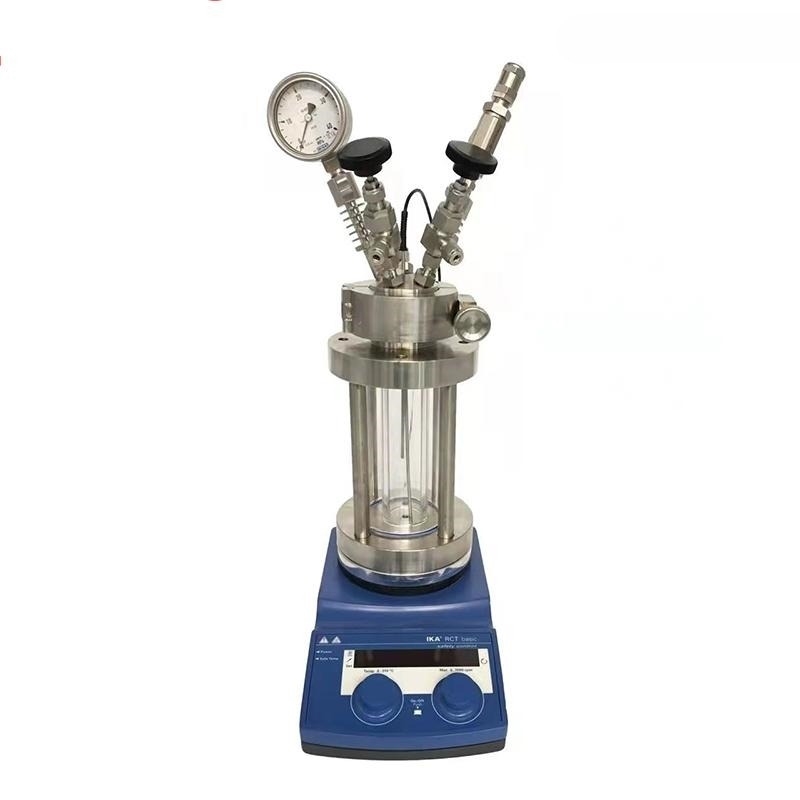
2、 Structural Design
The structural design of glass reaction vessels usually follows the following key elements:
1. Reactor body: The body of the reactor is generally made of high borosilicate glass, which has the characteristics of high temperature resistance, acid and alkali resistance, and corrosion resistance. The volume can be selected according to experimental requirements, and common volumes include 1L, 2L, 5L, 10L, etc. The design of the reactor body is usually circular or cylindrical to ensure the fluidity and mixing of reactants.
2. Mixing system: The mixing system is an important component that ensures uniform mixing of reactants. Common stirring methods include magnetic stirring and mechanical stirring. Magnetic stirring is suitable for small-scale reactions and is easy to operate; Mechanical stirring is suitable for large-scale reactions and can provide stronger stirring force. During design, the speed of the mixer and the shape of the stirring blade will be adjusted according to experimental needs.
3. Temperature control system: The temperature control system consists of a heating system and a cooling system. Heating systems typically use heating belts or electric heating tubes, which can provide constant temperature conditions for the reaction. The cooling system adopts cooling water circulation, which reduces the reaction temperature through cooling jackets or external cooling equipment to ensure temperature stability during the reaction process.
4. Pressure and vacuum control systems: Many designs have pressure and vacuum control systems used to control the internal pressure and vacuum environment during the reaction process. In the high-pressure reaction process, the design of the pressure vessel is crucial, and the pressure inside the reaction vessel is usually regulated through valves and pressure sensors. For reactions that require vacuum conditions, the design of the reaction vessel should be able to withstand negative pressure and equipped with components such as vacuum pumps and vacuum gauges.
5. Sealing and safety design: Sealing design usually uses rubber sealing rings or mechanical seals to ensure that reactants or gases do not leak during the reaction process. In addition, safety measures such as safety valves and temperature protection devices need to be equipped to prevent sudden situations such as overpressure and overheating, ensuring the safety of experimental personnel.
Glass reaction vessels have become key equipment for chemical reactions, synthesis, and processing in laboratories due to their excellent chemical stability, transparency, precise temperature control, and stirring system. Its reasonable structural design not only ensures efficient reaction conditions, but also guarantees the smooth progress of experiments through high standards of sealing and safety design.
Last Article: What are the safety devices for homogeneous reactors?
Next Article: Working principle and application analysis of rotary evaporator