-
E-mail
1019062891@qq.com
-
Phone
18021603489
-
Address
Room 108, Building 3, Hexin Zhihui Technology Park, 118 Anyang Road, Huqiu District, Suzhou City
Weisite Technology (Suzhou) Co., Ltd
Preparation of phase change material microcapsules using microjet technology
Date: 2025-11-07Read: 3
Microfluidic technology is a highly efficient and controllable method for microencapsulation, particularly suitable for preparing microcapsules with uniform particle size and stable performance.
1 What is phase change material microcapsule?
phase change material: Refers to changes in physical phase (such as solidification)-Substances that can absorb or release a large amount of latent heat during liquid and liquid gas processes. Solid liquid phase transition materials such as paraffin, fatty acids, and hydrated salts are commonly used in microcapsules.
microcapsuleA technique of wrapping tiny liquid droplets or solid particles (called core material) with a continuous thin film (called wall material) to form a miniature container.
Microcapsules of phase change materialsIt is to wrap the phase change material as the core material. This is how it was donebenefitYes:
1. prevent leakageDuring the melting of phase change materials, the wall material can confine them internally, preventing their flow and environmental pollution.
2. Increase heat transfer areaThe tiny capsules provide a huge specific surface area and improve heat exchange efficiency.
3. Improve stabilityProtect the core material from external environmental factors such as oxygen and moisture.
4. Easy to processSolid state microcapsules can be conveniently incorporated into matrices such as fibers, coatings, plastics, etc.
II Introduction to Microfluidic Jet Technology
Microfluidic technology is a particle processing technique based on high-pressure fluid dynamics. Its core equipment isMicro jet homogenizer.
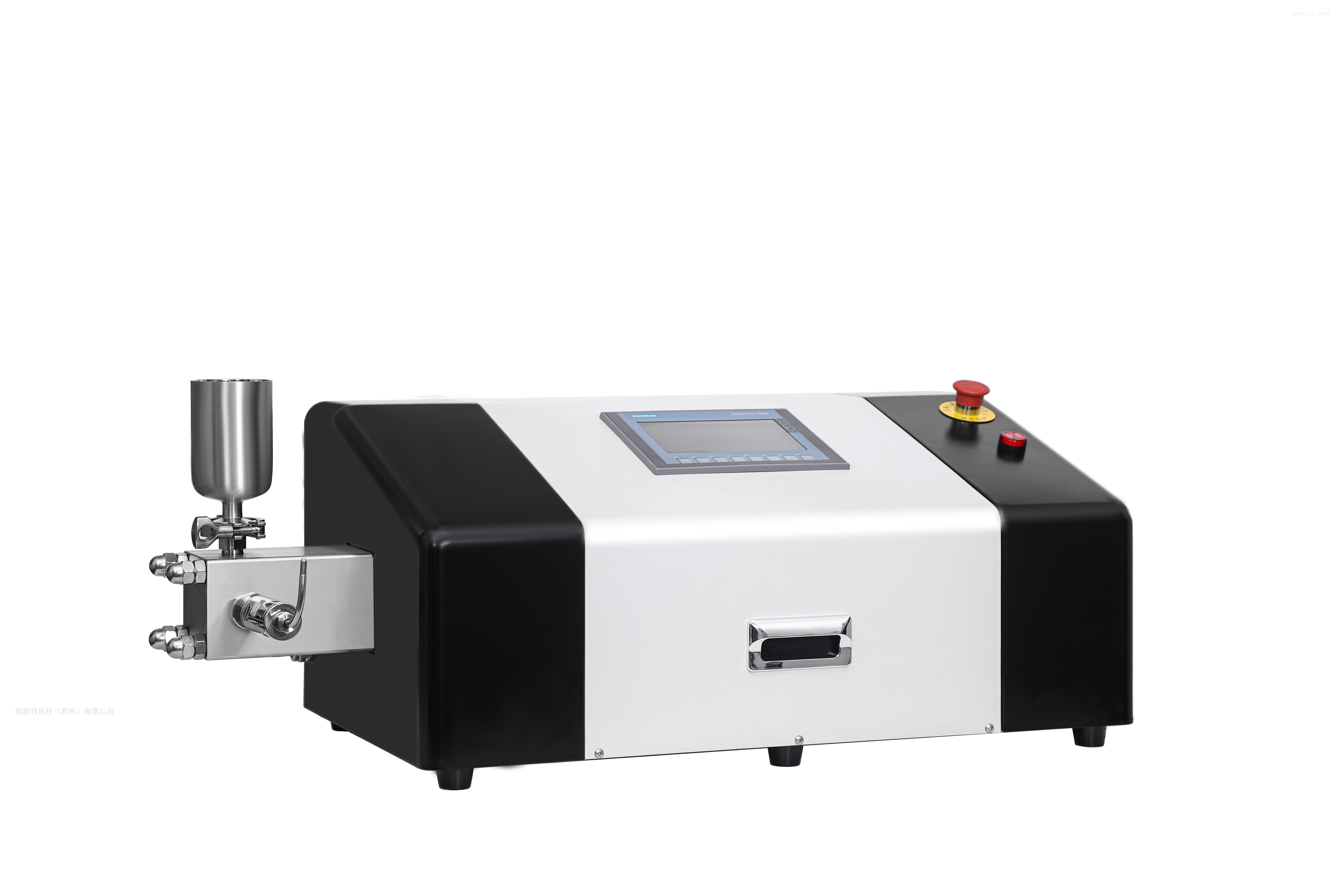
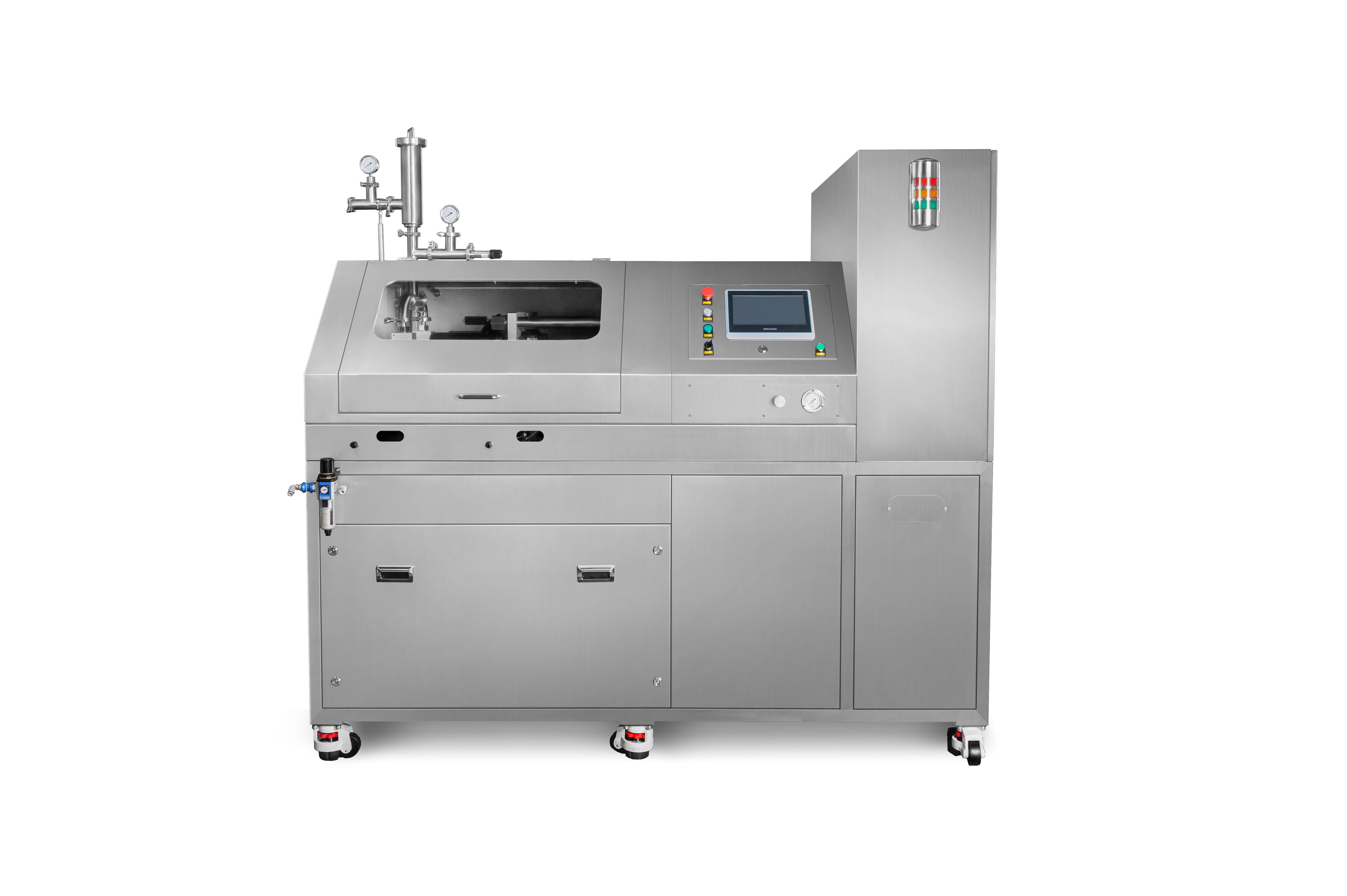
working principleThe fluid to be processed is under high pressure (usually up to)40000 psi or~2750 bar) is pumped into a specially designed "interaction chamber (diamond interaction chamber)". Inside the cavity, fluid flows through extremely small channels (such as Z-shaped or Y-shaped) to form high-speed jets. This high-speed jet will produce three main effects:
1. High shear forceThe internal velocity gradient of the fluid is extremely large, generating strong shear forces.
2. Hole effectRapid changes in pressure lead to the instantaneous formation and collapse of microbubbles in the fluid, producing strong shock waves.
3. Collision effect: InIn the Y-shaped cavity, two high-speed jets collide with each other, generating enormous energy.
The combination of these effects can break down droplets into micrometer or even nanometer scale, and make mixing and reaction extremely efficient and uniform.
III Process flow of preparing phase change material microcapsules by microjet method
Microfluidic technology typically does not complete the entire microencapsulation process alone, but rather serves as a tool foremulsificationandpolycondensationThe key equipment in the steps is combined with the chemical polymerization process. A typical process flow is as follows:
step1: Formula design
core materialSelect the required phase change materials, such as n-octadecane, n-eicosane, paraffin, etc.
Wall materialChoose polymer materials that can form stable thin films. Commonly used ones include:
1. melamine-Formaldehyde resinHigh hardness and good density, it is one of the commonly used wall materials.
2. urea-formaldehyde resinLow cost.
3. Arabic gum/GelatinNatural wall material, used for complex coagulation method.
4. polyurethane、polystyreneWaiting for synthetic polymers.
5. emulsifierUsed to stabilize initially emulsified droplets and prevent them Coalescence.
step2: Pre emulsification
The core material (phase change material), wall material monomer (or prepolymer), emulsifier and water are mixed and preliminarily emulsified by high-speed shear or ordinary homogenizer to form a rough lotion with wide particle size distribution(O/W lotion). The purpose of this step is to provide a uniform feed for the next step of microjet processing.
step3: Micro jet emulsification (core step)
Pass the pre emulsified lotion throughMicro jet homogenizerUnder the set pressure (e.g 10000-30000 psi) for cyclic processing.
effect:
1. Efficient crushingThe shear force and cavitation effect of microjets break large phase change material droplets into uniformly sized and small micro droplets.
2. homogenizationObtaining well monodisperse and stable nanoparticles/Submicron lotion.
3. Interface reaction promotionIntense mixing and micro mixing effects cause the wall material monomers in the aqueous phase to mix with the oil-Adequate contact between the water interface lays a solid foundation for subsequent interface aggregation or in-situ aggregation.
This step is the key to obtaining uniformly sized and high-performance microcapsules.
step4: Polymerization reaction
Transfer the fine lotion after micro jet treatment to the reaction kettlePerform polymerization reaction under pH value and stirring speed.
For in-situ polymerization: By heating or adjustingpH, Initiate the polymerization of wall material monomers on the surface of core material droplets, forming a complete wall shell.
For interface aggregationUsually, a second monomer needs to be added to the aqueous phase, and the two monomers undergo polymerization reaction at the interface of the core material droplets.
step5: Post processing
After the reaction is completed, the final phase change material microcapsule powder is obtained by filtration, centrifugation, washing, and drying (usually freeze-drying to maintain the structure).
4 The advantages of microjet technology
Compared with traditional methods such as mechanical stirring and ultrasonic emulsification, microjet technology has significant advantages in preparing microcapsules:
1. Uniform particle size and strong controllabilityCan prepare microcapsules with excellent monodispersity and extremely narrow particle size distribution. By adjusting the operating pressure and processing times, the final size of microcapsules can be precisely controlled.
2. High encapsulation efficiency: The formed lotion droplets are small and stable, providing an ideal template for uniform deposition of wall materials, thus improving the encapsulation efficiency of core materials.
3. The wall material is dense and the performance is stableIntense mixing results in a more uniform distribution of wall monomers at the interface, forming a denser and stronger wall shell, effectively preventing core material leakage, and improving thermal cycling stability.
4. Good reproducibility of the processAs a mechanical process, the parameters of microjet (pressure, flow rate) are easy to precisely control, ensuring high consistency between batches.
5. High efficiency, easy to scale upFast processing speed and minimal amplification effect from laboratory to industrial production.
5 Application field
The high-performance phase change material microcapsules prepared are widely used in:
1. building energy efficiencyMixing into gypsum board, concrete, or paint for temperature regulation.
2. Textile and ClothingDeveloping temperature regulating intelligent textiles(Outlast ® Technology is a famous example.
3. Thermal management of electronic devicesAs a filler for thermal conductive composite materials, it is used to absorb the pulse heat generated by chips.
4. Cold chain transportation of food and medicineAs an insulation material to maintain temperature stability.
5. Solar thermal storage systemStore thermal energy and release it when needed.
summary
Microfluidic technology provides a unique high-pressure fluid dynamics principle for the preparation of high-performance phase change material microcapsulesExtraordinary emulsification techniques. It is not only for achieving uniform particle size of microcapsulesThe "sharp tool" is a key process for improving the encapsulation efficiency, sealing performance, and thermal stability of microcapsules. With the continuous improvement of performance requirements for microcapsules, the application of microjet technology in this field will become increasingly widespread and in-depth.