-
E-mail
service@hrtech.cn
- Phone
-
Address
No. 409 Xinfeng Road, Xukou Town, Wuzhong District, Suzhou City, Jiangsu Province
Suzhou Hongrui Purification Technology Co., Ltd
Design and Technological Innovation of Handheld Dust Particle Counter
Date: 2025-11-25Read: 0
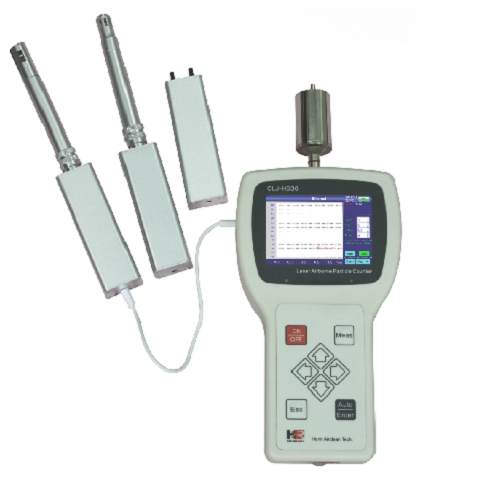
Handheld dust particle counterIt is a portable device used to measure the concentration and size distribution of dust particles in the air, widely used in fields such as air quality monitoring, industrial production, and clean room management. With the development of technology, it is gradually moving towards high precision, convenience, and intelligence, reflecting a series of design innovations and technological breakthroughs.
1、 Design concept
Traditional dust particle counters are generally bulky and complex to operate, requiring the instrument to be fixed in a specific position during use. With the increasing demand for air quality monitoring, especially in terms of mobility and convenience, handheld dust particle counters have emerged. The handheld design not only makes it portable, but also adaptable to more application scenarios, such as use in production workshops, laboratories, or outdoor environments.
1. Miniaturization design: With the continuous advancement of chip technology, microsensors, and battery technology, miniaturization design has gradually been achieved. By using lightweight materials, the volume and weight of the instrument have been reduced, making it more suitable for long-term grip use, especially in places that require frequent movement and operation.
2. Data display and user interface innovation: The display screen usually adopts high-resolution LCD or OLED screens, which have clear data display functions and can display important parameters such as particle count, particle size distribution, and air quality index in real time. In addition, it also supports touch screen operation, providing a more intuitive user interface, making the operation easier and faster.
3. Efficient battery management system: Handheld devices have very high requirements for batteries and must have long-term endurance. Usually equipped with efficient lithium batteries, the device's usage time is extended by optimizing the battery management system. It is also equipped with fast charging technology, which can complete charging in a short time and reduce inconvenience during use.
2、 Technological innovation
1. Progress in Optical Counting Technology
The core technology of handheld dust particle counters is particle detection and counting, and currently most of them use the principle of laser light scattering. With the advancement of laser technology, more precise laser beams can be used to irradiate samples, and the concentration and size of particles can be determined by detecting changes in the intensity of scattered light. This technology has significant advantages in high-precision measurement, fast response, and low error.
2. Multi channel particle counting technology
In order to improve the accuracy and range of measurement, many have adopted multi-channel particle counting technology. By setting up multiple optical detection channels inside the device, it is possible to simultaneously measure dust particles with different particle size ranges and classify the data for processing. This technology not only improves the accuracy of particle counting, but also enables more precise determination of the distribution of dust particles in the air, which helps to evaluate air quality more comprehensively.
3. Intelligence and Data Connectivity
Intelligence has become a major development trend. Many devices are equipped with wireless communication functions such as Wi Fi and Bluetooth, allowing them to connect with terminals such as smartphones and tablets, enabling remote data transmission and real-time monitoring. In addition, it also supports integration with cloud platforms, allowing users to upload monitoring data to the cloud for storage, analysis, and sharing. Through big data analysis, it is possible to more accurately assess environmental quality and even predict trends in air quality changes.
4. Application of high-precision sensors
With the advancement of sensor technology, measurement accuracy has been significantly improved. For example, some models of equipment use ultra high sensitivity sensors that can detect dust particles at the nanometer level. At the same time, the new sensors have better anti-interference ability and can provide stable and accurate measurement results in complex environments.
Overall, handheld dust particle counters have achieved significant innovation in design and technology, particularly in areas such as miniaturization, accuracy, intelligence, and data connectivity. With the further development of technology, it will become more precise, convenient, and play an important role in a wider range of application scenarios.