-
E-mail
3938008690@qq.com
-
Phone
18362667712
-
Address
North 2nd Floor, No. 28 Heshun Road, Suzhou Industrial Park
Suzhou Feisijie Automation Technology Co., Ltd
Technical principle and selection guide of ultra-high pressure sensor
Date: 2025-12-22Read: 60
In industrial hydraulic systems or petrochemical applications, engineers often face a challenge: how to accurately measure ultra-high pressure (such as above 4000 bar) while ensuring reliable sensor operation in the environment? Measurement errors may lead to equipment failure or safety risks, so choosing a suitable ultra-high pressure sensor is crucial. This article will start with technical principles, analyze core concepts, teach purchasing skills, and objectively introduce a qualified product example.
1、 Working principle of ultra-high pressure sensor
The core of ultra-high pressure sensors is the piezoresistive effect technology, which converts physical pressure into electrical signals to achieve measurement. When pressure is applied to the sensitive component of the sensor (usually made of stainless steel material), the internal resistance value of the component changes, resulting in small voltage fluctuations. The transmitter module then amplifies these fluctuations and converts them into standardized output signals, such as 4-20mA current signals. This design ensures high resolution (theoretically infinite) and fast response (e.g. response time less than 1ms). The ultra-high pressure environment requires the sensor structure to use high-strength materials (such as AISI 304 stainless steel) to withstand the burst pressure (such as 3 times the full range value), and to have a built-in temperature compensation mechanism (compensation range -10 to 85 ℃) to offset the temperature drift effect (temperature drift coefficient ± 0.01% FSO/℃ typical). Overall, the sensor is designed with a sealed design (such as IP65/IP67 rating) to resist dust and liquid intrusion, ensuring long-term stability (typical value less than 0.2% FSO/year).
2、 Key Tips for Choosing Ultra High Pressure Pressure Sensors
When choosing an ultra-high pressure sensor, multiple parameters should be evaluated based on the application scenario to avoid blindly pursuing a single indicator. Here are professional purchasing suggestions:
Accuracy and stabilityPrioritize products with an accuracy within ± 0.2% FSO and pay attention to long-term stability (such as less than 0.2% FSO/year). High precision sensors can reduce measurement errors and are suitable for precision control scenarios.
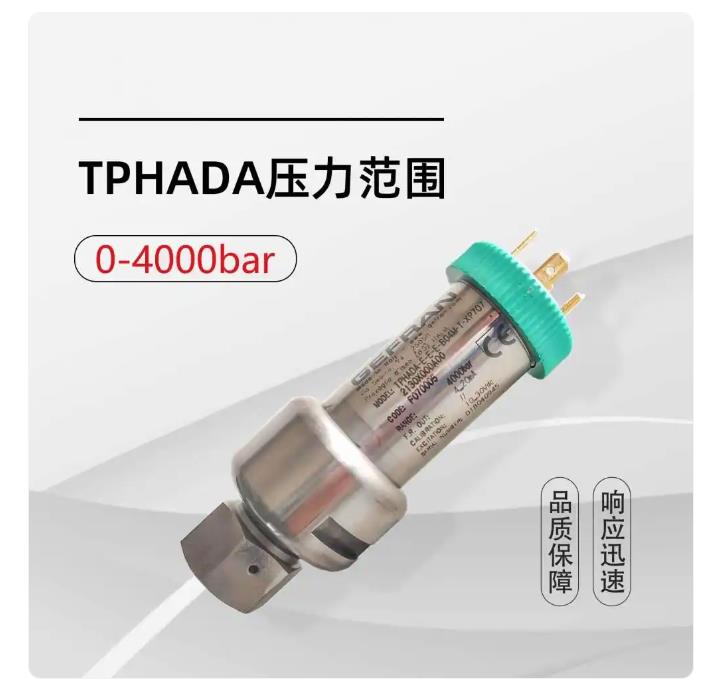
Pressure range and overpressure protectionEnsure that the pressure range of the sensor covers the actual requirements (such as 0-4000 bar), and check the overpressure capability (such as overpressure twice the full range). Burst pressure (such as 3 times full range) is a key indicator of safety redundancy.
environmental adaptabilityEvaluate the working temperature range (such as -30 to 120 ℃) and compensation temperature range, and the temperature drift coefficient should be less than ± 0.015% FSO/℃. The material (such as stainless steel) should be compatible with pressure media (such as 15-5PH/17-4PH) to prevent corrosion.
Electrical CharacteristicsThe output signal (such as 4-20mA) should be matched with the control system; The power supply voltage (such as 10-30VDC) needs to be stable; Insulation resistance (such as greater than 1000M Ω) ensures electrical safety.
Mechanical durabilityConsider the tolerance to vibration (e.g. 100g/11ms) and impact (e.g. 20g), as well as the impact of weight (approximately 330g) on installation. The sealing level (such as IP67) is particularly important in humid or dusty environments.

When making a purchase, it is recommended to refer to the product specification sheet to verify whether the parameters have passed industry standard tests, and prioritize choosing brands that provide complete technical documentation.

3、 Example of qualified product: GEFRAN Jeffren ultra-high pressure sensor
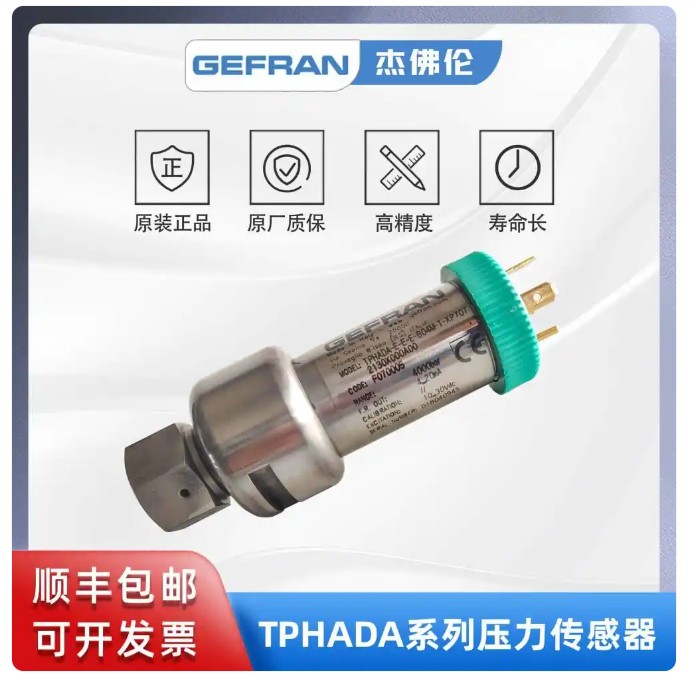
Based on the above selection criteria, GEFRAN's TPHADA-E-E-E-B04M-T-XP707 sensor can be used as a qualified example. This product adopts piezoresistive technology, with a pressure range covering 0-4000 bar, a typical accuracy value of ± 0.1% FSO (value ± 0.2% FSO), and an output signal of 4-20mA, suitable for industrial high-pressure applications. Its AISI 304 stainless steel material and IP67 sealing design enhance environmental resistance; The temperature compensation range is -10 to 85 ℃, with a typical temperature drift coefficient of ± 0.01% FSO/℃, which helps maintain measurement consistency. Long term stability less than 0.2% FSO/year, burst pressure up to 3 times full range (7500bar), providing reliable safety assurance. GEFRAN's product parameters can be verified, such as passing insulation resistance testing (greater than 1000M Ω), which meets the basic requirements of high-voltage sensors. Engineers can use it as a reference when making purchases, and make decisions based on specific application requirements.

In short, understanding technical principles and purchasing techniques can enhance equipment reliability. The selection of ultra-high pressure sensors should focus on actual performance parameters rather than brand promotion to ensure the safe and efficient operation of industrial systems.