-
E-mail
wei.zhu@shuyunsh.com
-
Phone
17621138977
-
Address
Room 602, Building 3, G60 Science and Technology Innovation Cloud Corridor, Lane 288, Qianfan Road, Songjiang District, Shanghai
Shuyun Instrument (Shanghai) Co., Ltd
Guidelines for avoiding pitfalls in scintillator development: Lexsyg RL testing reveals fatal defects in BiPO ₄: Ce
Date: 2025-11-19Read: 0
Recently, a research team from Clemson University published important results in the Journal of Luminescence, using advanced equipment such as Freiberg Instruments Lexsyg Research luminescence spectrometer to systematically elucidate the hexagonal phase BiPO₄The complex luminescent mechanism of this material has solved the long-standing academic controversy. In the study, Lexsyg Research's photoluminescence spectrometer played an irreplaceable role in revealing key luminescent phenomena.
Important discovery: The mystery of the five fold luminescence has finally been solved
The research team precisely controlled the excitation wavelength (250-460 nm) and combined it with the high-sensitivity RL (radiation luminescence) test of the Lexsyg fluorescence spectrometer to analyze the hexagonal phase BiPO₄Up to 5 types of luminescent centers have been discovered:
1. 350 nm blue light (defect emission)
2. 405 nm Purple Light (Intermetallic Charge Transfer MMCT)
3. 570 nm yellow light (Bi ³)⁺The ³ P₁→¹S₀Transition)
4. 445 nm/490 nm bimodal blue-green light (Ce ³)⁺The transition from 5d to 4f
5. Disturbing dynamic Bi ³⁺(Oxygen vacancies cause energy level redshift)
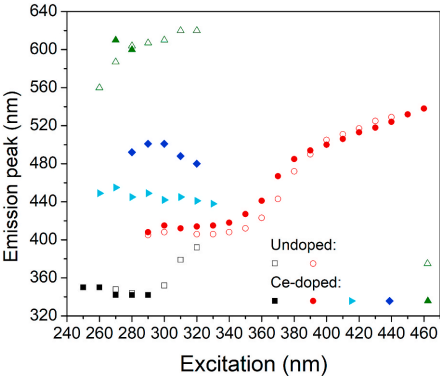
Figure 1 Relationship between luminescence peak position and excitation wavelength
Lexsyg's key contribution: RL testing breaks traditional cognition
Through the RL testing module (40 kV X-ray excitation) of Lexsyg spectrometer, the research team found that:
1、Ce³⁺Under X-ray excitation, it does not emit light (Figure 2), while Bi ³⁺Disturbance dynamics dominate 630 nm emission;
2. The luminescence intensity is only 0.015% of that of BGO scintillator, indicating that it is not suitable for use as Ce ³⁺Scintillation material.
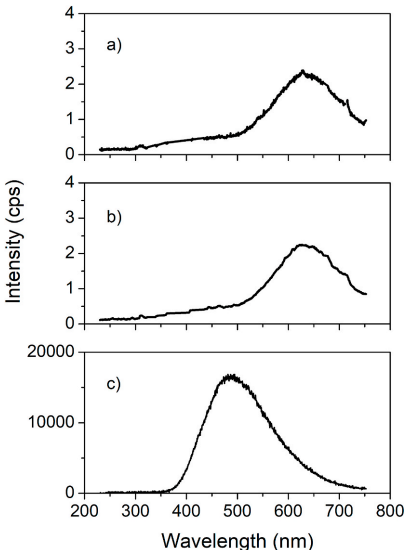
Figure 2 RL spectrum reveals Ce ³⁺quenching phenomenon
Dispute resolution: Correction of erroneous conclusions in the literature
The research team compared nearly 20 controversial literature and first pointed out that:
1. Previous reports on 'Ce ³'⁺The luminescence at 352-459 nm is actually MMCT or defect luminescence;
2. Real Ce ³⁺The luminescence is located in the 445/490 nm double peak (Δ E=0.26 eV, consistent with spin orbit splitting).
Research Tool: How Lexsyg Reveals the Truth
1. Multi mode combination:Combining PL (photoluminescence), PLE (excitation spectroscopy), and RL (radiative luminescence) for comprehensive analysisAnalysis;
2. High precision RL testingSimulate the real working conditions of a scintillator through continuous X-ray excitation (tungsten target, 40 kV/1 mA);
3. Super low temperature detection:-Cooling CCD at 80 ° C significantly reduces noise and captures weak luminescent signals.
Conclusions and Implications
This study not only solved the problem of BiPO₄The controversy over luminescence further demonstrates the significant value of advanced luminescence spectroscopy technology in material research by Freiberg Instruments Lexsyg Research: "Lexsyg's RL testing proves that, BiPO₄The cavity is filled with Bi ³⁺Localized capture leads to Ce ³⁺Unable to participate in flashing light. ”
In the rapidly developing field of materials science, precise characterization tools are the cornerstone of scientific breakthroughs and industrial upgrading. Freiberg Instruments Lexsyg Research, with its important advantages of "high stability, high sensitivity, and high precision," has become the preferred choice for many advanced research institutions (such as Clemson University) and enterprises worldwide for radioluminescent testing equipment.
Whether you are engaged in scintillator research and development, rare earth material characterization, or photocatalytic research, Lexsyg Research can provide you with reliable support from data to conclusions, helping your research produce results faster and your products reach the market faster.
Contact Freiberg Instruments now for exclusive demo demonstrations and application solutions, making Lexsyg Research your accelerator for material innovation!
Paper address:researchgate.net/publication/344145593_Luminescence_of_undoped_and_Ce-doped_hexagonal_BiPO4