-
E-mail
yibao@szyibao.com.cn
-
Phone
18675539088
-
Address
312, Shangshuijing Comprehensive Building, 333 Jihua Road, Jihua Street, Longgang District, Shenzhen City, Guangdong Province
Shenzhen Yibao Technology Co., Ltd
Space ground point spectral monitoring opens up a new mode of precise agricultural policy implementation
Date: 2025-11-13Read: 2
Modern agriculture no longer relies solely on manual observation, and intelligent monitoring is becoming a new trend in crop management.
In agricultural production, problems such as pests and diseases, nutritional imbalances, or water stress have already missed the optimal intervention time when they are visible to the naked eye. Traditional inspection methods are limited by time, climate, and human experience, and cannot reflect crop growth status in a timely and accurate manner. Spectral technology provides a new perspective for crop monitoring.
The advantages of spectral technology in agricultural monitoring:
Spectral technology can identify plant physiological states under non-destructive conditions by collecting crop reflectance and absorption spectra. Under different wavelengths, the spectral characteristics of plants will show differences with changes in chlorophyll, moisture, anthocyanins, carotenoids, etc., providing accurate growth information.
Hyperspectral imaging: covering hundreds to thousands of wavelengths, capturing small physiological differences, and generating fine crop health index maps
Multispectral imaging: covering key spectral indicators such as NDVI and NDRE, quickly assessing growth, yellowing, and chlorophyll distribution
Ground Spectral Analysis: Used for measuring crop spectral characteristics in the field, obtaining reflectance data of leaves or crop populations, and providing reference for spectral analysis, crop health assessment, and aerial remote sensing data
Aopu Tiancheng Agricultural Monitoring Plan:
based onhyperspectralBy utilizing multispectral and ground spectral technologies, Aopu Tiancheng has developed a monitoring plan that covers the entire growth cycle of crops

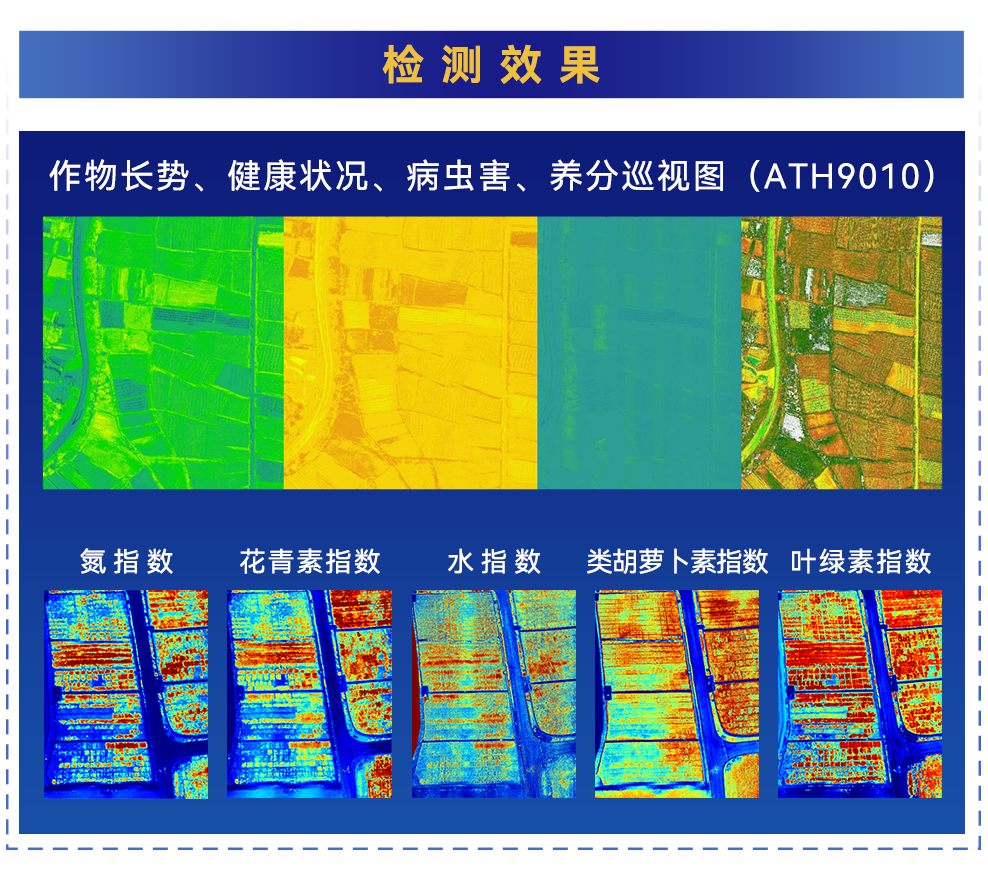
The plan forms an integrated observation network of "air ground point", relying on spectral analysis technology, based on normalized vegetation index, normalized difference red edge index, anthocyanin reflectance index, etcHuangdu IndexVegetation indices such as carotenoid reflectance index were used to analyze crop growth, plant moisture content, anthocyanin content distribution, etc. A real-time monitoring system for crop growth cycle and multi-dimensional monitoring was constructed.
By analyzing spectral data and historical trends, agricultural managers can real-time grasp crop growth, water content, and pigment distribution, achieving data-driven management; Being able to quickly obtain professional indicators, visually present crop health status, and achieve precise management and variable pesticide application. Suitable for monitoring high standard farmland, tea gardens, greenhouses, scientific research fields, and other scenarios.
Detection effect:
Core product applications:


Three types of products work together to achieve full cycle monitoring from macro inspection to micro analysis, visualizing and quantifying crop health status, and assisting in smart agriculture management decisions.
Spectral technology has moved from scientific research to production practice, providing more accurate and efficient means for agricultural testing. Through scientific data support, farmers and managers can identify risks earlier, optimize farmland management strategies, and achieve the goals of smart agriculture and sustainable development.