-
E-mail
suas@suastest.com
-
Phone
13302210258
-
Address
1st Floor, Factory Building, No. 47 Yangtaishan Road, Guantian Community, Shiyan Street, Bao'an District, Shenzhen
Shenzhen Shengsi Yiwei Technology Co., Ltd. (formerly Shenzhen Sansi Testing Machine Co., Ltd.)
How does the electronic universal tensile testing machine provide mechanical "proof" for product quality?
Date: 2025-11-07Read: 3
At every stage of product development and quality control, a fundamental question always lingers in the minds of engineers: "How strong is this product?" For a safety rope, is its ultimate tensile strength truly as reliable as it claims? Will the key components of a medical device fatigue and break after repeated use? The answers to these questions cannot be judged solely based on experience and intuition, they require a quantitative and objective mechanical performance 'proof'. ButElectronic universal tensile testing machineIt is the issuer of this crucial 'proof'.
When a material or component is fixed in the fixture of the testing machine, it initiates a standardized "mechanical interview". The testing machine applies precise control of tension, compression, bending, shear and other forces through precision servo motors and sensors, and records the force values and deformation (i.e. stress-strain curve) in real time. Each feature point on this curve is a key testimony to the mechanical properties of the product:
1. Elastic modulus: It proves the "rigidity" of a material, that is, its ability to resist elastic deformation.
2. Yield strength: It proves the maximum stress that a material can withstand before undergoing deformation.
3. Tensile strength: It proves the ultimate bearing capacity of the material, that is, the "maximum tensile strength".
4. Fracture elongation: It proves the "toughness" or "brittleness" of a material, that is, how much it can elongate before fracture.
5. Peel strength: For adhesive products, it proves the adhesion strength of the bonding layer.
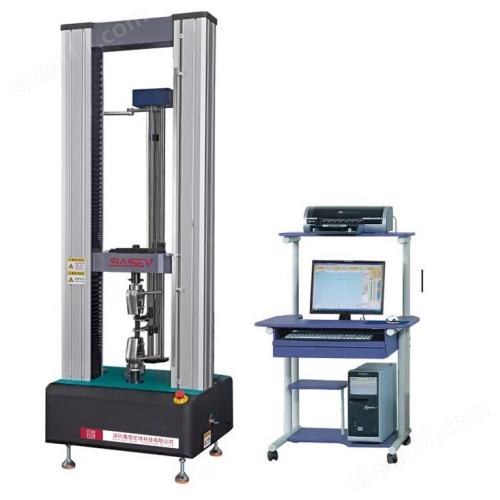
The process of issuing certificates for electronic universal tensile testing machines reflects the pursuit of precision and reliability in modern industry.
1. Accurate force application: The testing machine does not have uneven force and variable speed like manual testing. It can control displacement with precision in millimeters per minute or force with precision in Newton per second, ensuring that the conditions for each test are consistent and the results are highly reproducible and comparable.
2. Real time recording: The high-frequency data acquisition system captures in real-time every set of force and deformation data during the entire process of material from initial stress to final fracture, generating a complete stress-strain curve without leaving any information blind spots.
3. Objective judgment: The entire testing process is controlled by a computer program, eliminating subjective errors and emotional interference caused by human operation. The test results are entirely based on the raw data feedback from sensors, ensuring the absolute objectivity and impartiality of this' proof '.
In an increasingly competitive market environment, product quality and reliability are the cornerstone of winning trust. The electronic universal tensile testing machine has issued a legally binding and scientifically valuable mechanical certificate for the product with its accurate and objective data. It makes the strength of a product no longer a vague concept, but clear, reliable, and verifiable data indicators.