-
E-mail
bd@xtalpi.com
-
Phone
18918670587
-
Address
1st Floor, Phase II, International Biomedical Industry Park, No. 2 Hongliu Road, Fubao Community, Fubao Street, Futian District, Shenzhen
Shenzhen Jingtai Technology Co., Ltd
XmartChem ® Intelligent synthesis workstation: AI+robot creates a new paradigm for synthesis research
Date: 2025-10-13Read: 4
AI+Robot Drive
Chemical synthesis intelligent independent innovation
●Jingtai Technology's chemical research is one meter wide and one hundred meters deep
Dr. Ma Jian, co-founder and CEO of Jingtai TechnologyThe scientific research concept of "one meter wide, one hundred meters deep" is proposed. One meter wide refers to finding the right problem, while one hundred meters deep requires us to approach the problem we are studying with industry reverence and seriousness.
As a pioneer in AI driven drug development, Jingtai Technology has been focusing on key pain points in the industry for the past decade. In the complex drug development process, the chemical synthesis stage occupies more than 50% of the DMTA (Design Synthesis Test Analysis) cycle, becoming a key bottleneck that restricts the efficiency of drug development. The core significance of chemical synthesis as a bridge connecting micro molecular design and macro drug activity lies in:Through efficient synthesis and testing, the massive molecules designed by AI are transformed into verifiable entities, driving drug development from "accidental discovery" to "systematic innovation", ultimately shortening the new drug development cycle and reducing trial and error costs.This is a model of Jingtai Technology's practice of the "one meter wide" concept - precise targeting in the vast field of chemical researchThe key breakthrough point of "chemical synthesis" is achieved through continuous deep cultivation to achieve technological breakthroughs.

When computing power and algorithms no longer constitute bottlenecks among the three elements of artificial intelligence,High quality data becomes the key to breakthrough innovation.Jingtai Technology's intelligent independent experimental platform focuses ondata assetWe have established a complete data asset management system for the entire lifecycle management, from collection, governance to application,The core value of the intelligent autonomous experimental platform lies in creating high-quality data generation capabilities, which is the key to driving rapid molecular synthesis and screening of new compounds in drug discovery.Jingtai Technology's intelligent independent experimental platform integrates over 200 vertical AI models to create a chemical super brain, guiding material structure and experimental design; Efficiently completing high-throughput precision chemical execution and data governance with laboratory automation robots; The structured data collected by robots from real scenes is fed back to train AI models, making predictions more accurate and designs more optimal. The intelligent autonomous experimental platform has achieved a dual breakthrough in data collection in terms of quality and scale, significantly surpassing traditional methods. Data is the winning weapon in Jingtai Technology's "hundred meter deep" technological battle.

AI+Robot: Finding blueprints for chemical research
The deep integration of AI and robots is reshaping the paradigm of chemical research,Build an innovative system of "data infrastructure+intelligent decision-making". Jingtai Technology's intelligent autonomous experimental platform is a complete closed-loop system consisting of "algorithm design → robot experiments → data feedback → model iteration"It can significantly reduce trial and error losses and achieve precise upgrades in chemical synthesis research,Gradually assist chemists in drawing the "blueprint" for chemical synthesisFrom precise control of single step reaction parameters to intelligent planning of multi-step synthesis routes, ultimately achieving full process prediction of complex molecular synthesis. This dynamically optimized intelligent synthesis mode, like the auto drive system, continues to explore the optimal path, and promotes the leap forward transformation of chemical research from the traditional "experience driven" to the "data driven".
In the process of AI+robot industrialization landing, Jingtai Technology has always adhered toProblem oriented technological iteration path.Although the chemical synthesis problem solved by AI+robots is a chemical research problem, the research paradigm and methodology behind it are universal. In recent years, Jingtai Technology has focused on the interdisciplinary collaboration challenges of integrating AI with disciplines such as chemistry, physics, and materials. By establishing an interdisciplinary collaboration mechanism, it effectively resolves the barriers between experts in different fields such as chemists and computer scientists in terms of professional language and cognitive styles, making data capabilities the core engine for promoting scientific research and innovation. It solidly promotes the industrial empowerment of AI+robotics technology in multiple fields such as drug research and development, chemical engineering, new energy, and new materials, achieving "one step, one step" connectivity.


Jingtai Technology XmartChem®
Intelligent synthesis workstation
Jingtai Technology, relying on its independently developed intelligent independent experimental platform, innovatively integrates AI and robotics technology and successfully launches XmartChem®Intelligent synthesis workstation. The robot workstation focuses on experimental execution and data collection, and has been implemented in internal application scenarios, achieving a complete closed-loop process of "intelligent synthesis prediction → robot experiments → real-time data feedback → algorithm autonomous iteration" in chemical synthesis research, significantly improving the success rate of synthesis and research and development efficiency.
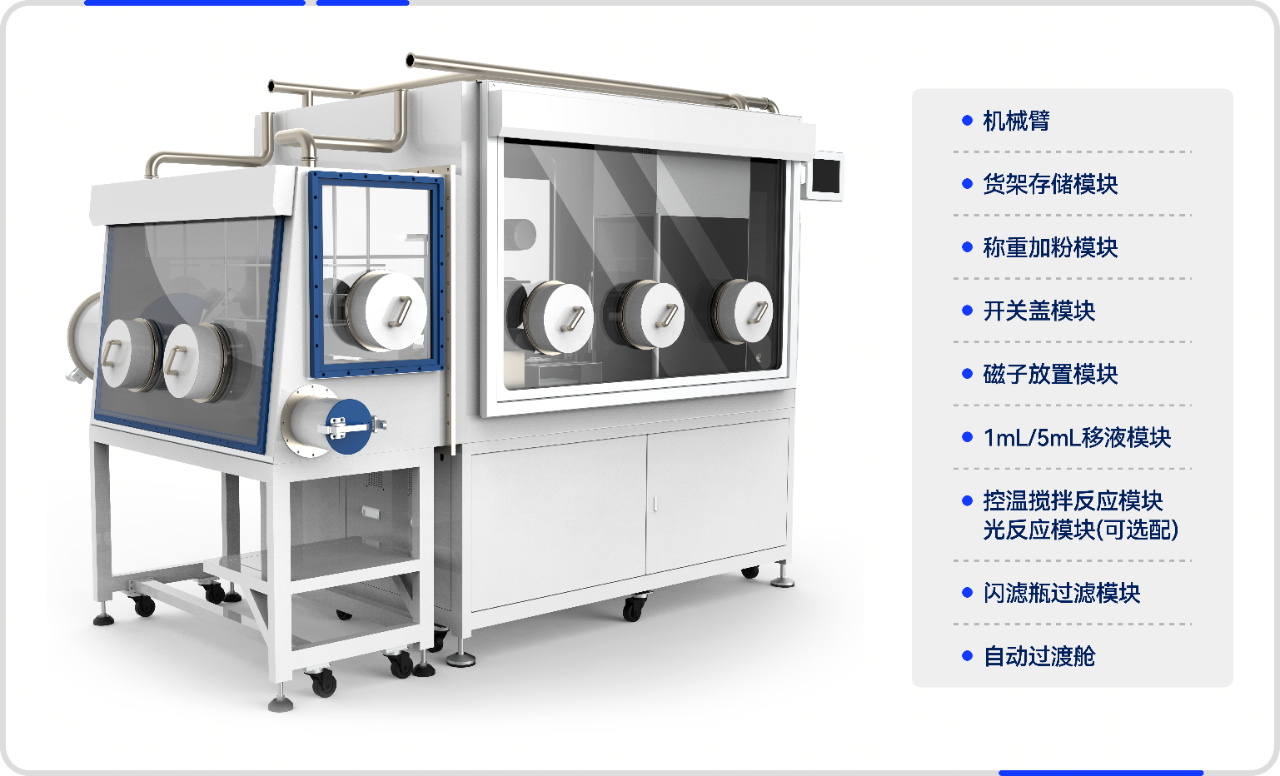
XmartChem®Intelligent synthesis workstation, capable of automating the entire process of feeding, reaction, product dilution, transfer, filtration, and liquid quality analysis in synthesis experimentsAccording to research and development requirements, different reaction volumes, temperature conditions, inert atmosphere conditions, and experimental operation methods can be configured to complete automatic LCMS spectrum analysis and product peak area calculation. Al can determine whether the product meets the quality requirements of subsequent reaction steps. Breaking through the bottleneck of low efficiency in traditional synthetic screening reaction conditions, optimizing high-throughput experimental parameters, freeing up laboratory manpower, and greatly improving efficiency.

●workflow

1. Solid/liquid reagent addition:
Solid reagent sampling
• Covering most commonly used chemical solid reagents, with a weighing range of 1 mg~20 g and a weighing resolution of 0.1 mg;
• Intelligent parameter optimization learning;
• Unique windproof and anti-static design, improving the accuracy of micro weighing;
Liquid reagent sampling
•Configure 1 mL and 5 mL pipettes to support multiple liquid reagents;
•High precision liquid level detection technology, precise control of pipette transfer;
2. Reaction:
Supports high-throughput reactions, with the option to use full plate pressing for fast and efficient operation, or screw cap mode for intermediate sampling or flexible control of reaction time. Supports the selection of multiple volume and flux reactors (such as photoreaction, heating oscillation reaction);
3. Analysis and testing:
• Dilution filtration: Using a flash filter bottle for filtration, it can complete the dilution filtration sample preparation operation for 12 reactions at once;
• Support the integration of various third-party devices such as LCMS into workstations;
4. 定制化配置:
According to different application scenarios, compatible with different reaction containers, the six axis/four axis robot system supports the integration of multiple automation modules.

A software system specially developed for chemical personnel, intuitive and easy to use
What you see is what you get, intuitive operation:
Worry free data security and integrity:
Intelligent spectrum analysis:
Seamless integration into the digital ecosystem:
● Product functional structure