-
E-mail
design@sealtex.cn
-
Phone
18019714807
-
Address
502, Building 23, Baoshi Garden, No. 487 Tianlin Road, Xuhui District, Shanghai (200233)
Shanghai Yikesuotuo Sealing Materials Co., Ltd
6-step method for selecting suitable sealing gasket materials for continuous digesters in paper mills
Date: 2025-10-24Read: 43
Continuous digesters are crucial for maintaining high productivity in paper mills. Any interruption in operation can result in significant losses, so ensuring effective sealing of these systems is crucial.
The selection of gaskets presents unique challenges due to certain working conditions, fluids with abrasive and chemically corrosive properties, high temperature and pressure, thermal cycling, and vibration. When choosing a sealing solution for pulp and paper digesters, it is crucial to identify the options that need to be considered to ensure optimal gasket performance.
第1Step: Understand the sealing problem
The steamer operates under certain conditions, so it is crucial to choose the appropriate gasket material. Metal gaskets are often difficult to apply due to insufficient available bolt load. The flexible graphite gasket often recommended by designers is also not feasible because graphite, as a highly brittle material, makes it difficult to handle large gaskets.
第2Step: Evaluate material options
Gaskets can be made of various materials, such as metal, composite materials, and polymers, and must be carefully selected to meet application requirements. Non metallic gaskets are often considered a more feasible choice for industrial sealing applications due to their stronger chemical resistance, higher sealing performance, and operational advantages over flexible graphite. Among these options, polytetrafluoroethylene(PTFE)It has become a multifunctional solution, especially suitable for processes involving corrosive media.PTFEDue to its excellent physical properties, it has been widely used in the field of industrial sealing
Excellent chemical resistance
Non sticky
high load capacity
Low sealing pressure requirement
Due to polytetrafluoroethylene being a flexible polymer, it can be easily made into durable gaskets without any risks during installation.
It should be noted that there are various types of polytetrafluoroethylene available in the market(PTFE). Due to the use of resins of different qualities and unique manufacturing processes, a variety of materials with specific mechanical properties have been formedPTFEGasket type. Among them, the compressibility and creep exhibited under high temperature environments or thermal cycling conditions are particularly prominent.
Therefore, it is necessary to pay attention to the mechanical properties of PTFE gaskets.
第3Step: Review the manufacturing method of polytetrafluoroethylene
Specific processes require different types of polytetrafluoroethylene resins, and their selection depends on the characteristics of these resins, such as molecular weight, average particle size, and degree of filamentation. The type of resin and the manufacturing process of the sheet will affect the minimum and maximum stress values allowed for the gasket, and significantly affect the creep performance of the product - according toWernerResearch has shown that its impact accounts for a significant proportion70%.
Therefore, the manufacturing process has a significant impact on the performance of polytetrafluoroethylene gaskets. The main methods include:
Molded polytetrafluoroethylene
Craftsmanship: Made from native or recycled resin. The material is compacted and fired into a cylindrical shape, and then a thin layer is cut from the cylindrical blank to form a sheet
Advantages: High cost-effectiveness. Glass fillers can be added for manufacturing.
Limitations: prone to high creep, especially under high temperature or thermal cycling conditions. There may be limitations to the tensile strength.
Expanded polytetrafluoroethylene(ePTFE)
Process flow: Polytetrafluoroethylene resin is extruded to form a fibrous structure. This material can be stretched unidirectionally (unidirectional strip) or multidirectionally (multidirectional sheet) according to the required properties. The stretching process has created this lightweight yet tough material.
Advantages: High compressibility and good creep resistance.
Applicable scenarios: Suitable for fragile flanges and applications with uneven surfaces, as it can effectively adhere to surface defects.

Modified polytetrafluoroethylene(rPTFE)
Process: Forming a highly fibrotic structure through rolling and sintering. Directly adding fillers to the microstructure to enhance the mechanical properties of the material. Adding pigments facilitates identification of different fillers/Combination of polytetrafluoroethylene.
Advantages: Compared to molded and cut polytetrafluoroethylene, it has good creep resistance, high torque retention, and enhanced mechanical properties, and can be produced in any size as a whole.
Applicable scenarios: harsh working environments, including strong acid and strong alkali media.

第4Step: Prioritize mechanical performance to achieve effective sealing
It is crucial to choose materials with the following mechanical properties to ensure good sealing performance in continuous digesters:
High torque retention: Maintain bolt load to ensure stable sealing performance.
Heat cycling resistance: adapts to temperature fluctuations without degradation.
Low creep resistance: prevents the bolt load from decaying over time.
Excellent sealing performance: maintains effective sealing under various pressure and temperature conditions.
第5Step: SelectrPTFEUsed for high-performance applications
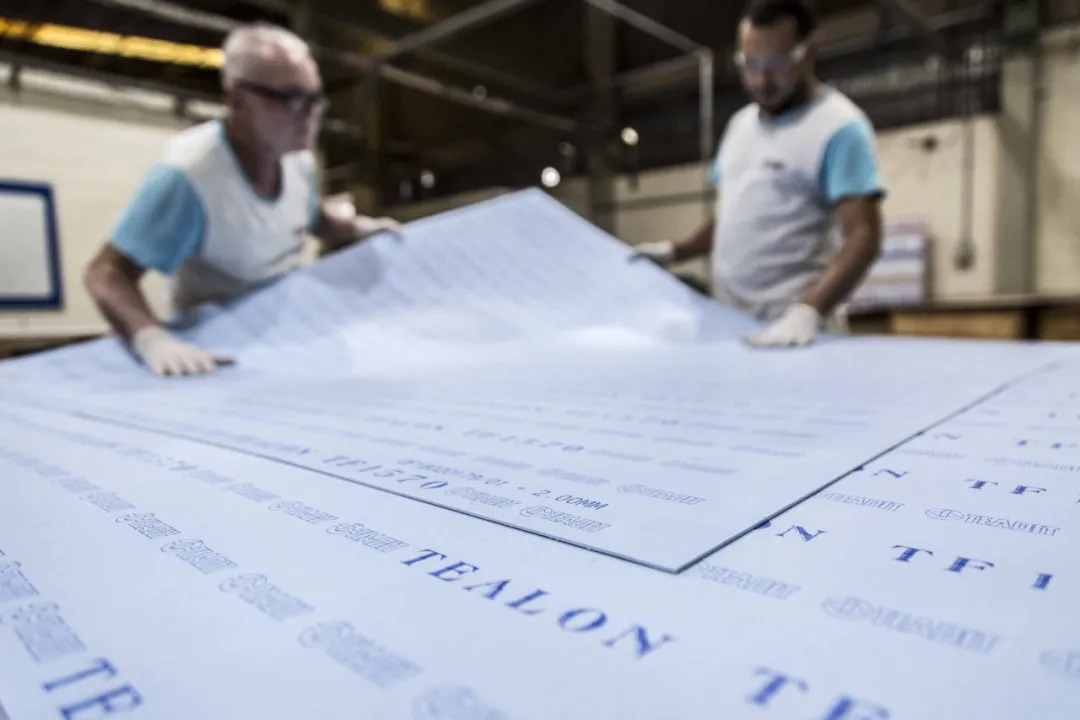
Multiple performance test results indicate that the use of modified polytetrafluoroethylene in continuous digesters(rPTFE)The gasket has a good effect. For example,TEADIT®ofTealon TF1570waitrPTFEGaskets are particularly suitable for steamer applications as they have the following advantages:
High stability at high temperatures: maintaining mechanical integrity under certain conditions.
High torque holding force:rPTFEThe fiber structure provides high torque retention, which is crucial for maintaining sealing under certain operating conditions.
Easy to operate: flexible and elastic, suitable for large-sized installation without material breakage.
In addition,rPTFEThe material can achieve hot melt bonding of multiple pad segments, enabling the manufacture of large pads even if their size exceeds the specifications of the original cut sheet.
第6Step: Optimize gasket selection based on process requirements
To ensure reliable sealing performance and extend the service life of the digester, specific process requirements need to be comprehensively considered, including fluid corrosiveness, operating temperature and pressure, and flange surface condition. By combining these factors withrPTFEThe characteristics of the gasket match, allowing operators to optimize the performance and durability of the paper industry steamer.