-
E-mail
shtaifan@163.com
-
Phone
15921940737
-
Address
No. 36, Lane 379, Hongmei South Road, Minhang District
Shanghai Taifan Instrument Technology Co., Ltd
Application of automatic zeroing burette in acid-base neutralization reaction
Date: 2025-12-02Read: 2
A burette is a commonly used precision measuring instrument in chemical experiments, mainly used for quantitative analysis of liquids, especially in acid-base titration, redox titration, and preparation of standard solutions. Traditional burettes are usually made of glass and have scale markings, which can be used for precise titration. In chemical experiments, controlling the flow rate and volume of the titrant helps chemical analysts accurately determine the reaction endpoint.
However, traditional burettes also have certain shortcomings, one of which is that they need to be manually adjusted to zero before each use. If there is a deviation in the zero point of the burette during the titration process, it will affect the accuracy of the experimental results. Therefore, automatic zeroing burettes have emerged, which eliminate human errors and improve the reliability and convenience of experiments through automation technology.
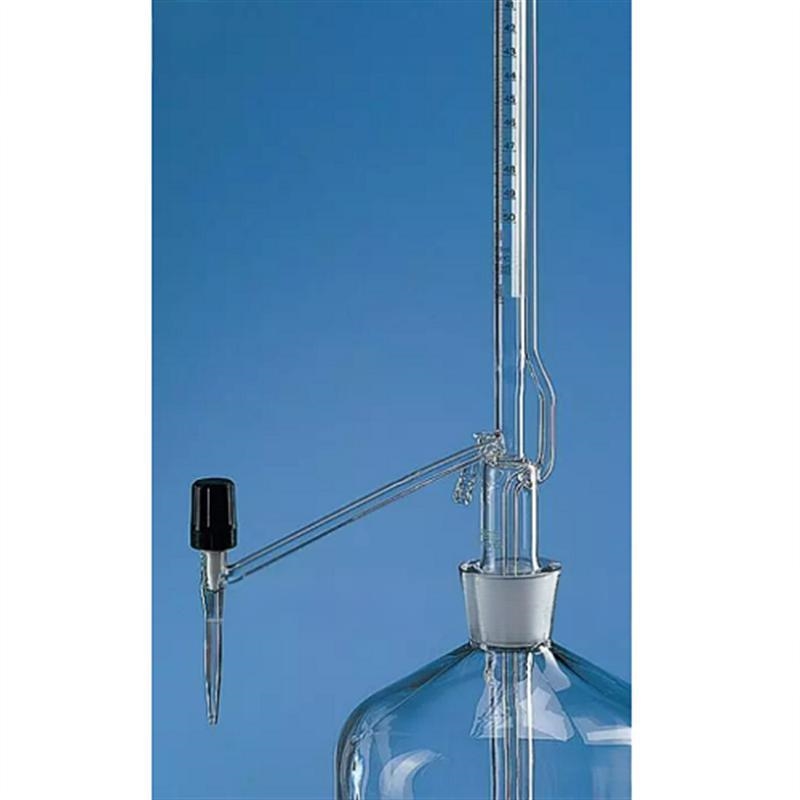
Automatic BuretWorking principle:
1. Electronic sensors: Sensors are usually equipped inside, which can monitor the height changes of the liquid in the burette in real time. When the titrant flows out or in, the sensor will sense this change and automatically update the data. Sensors can not only monitor liquid volume, but also provide real-time feedback on the current liquid flow rate and titration accuracy.
2. Automatic zeroing system: This system is a critical function. When the liquid in the burette flows out to a certain position, the automatic zeroing function will restore the reading of the burette to zero through the electronic control system. Users do not need to manually operate, which can ensure the accuracy of the zero point at the beginning of titration and greatly improve the accuracy of the experiment.
3. Digital display and data processing: Traditional burettes rely on glass scales to read liquid volume and are often affected by deformation or contamination of the glass tube. Equipped with a digital display screen, it can directly display the volume of the liquid, and digital data processing can reduce errors. This digital system typically collaborates with sensors and a central processing unit (CPU) to update the readings of the burette in real-time, avoiding visual reading errors in traditional methods.
4. Control and Calibration Function: Equipped with automatic calibration function, the system can automatically adjust before and during use to ensure accurate readings and avoid zero deviation caused by environmental changes or equipment wear and tear. Through the built-in calibration program, the burette can perform self zeroing calibration.
Advantages:
1. Improve accuracy: Eliminating the zero point deviation problem that may occur during the use of traditional burettes, reducing errors caused by human operation, and ensuring the accuracy of data during the titration process. Especially in high-precision experiments, automatic zeroing can ensure that each titration starts from the accurate zero point.
2. Reduce human operation errors: Traditional burettes require users to manually calibrate the zero point before each use, and improper operation may lead to result errors. Through automation technology, the impact of human factors has been reduced, making the operation simpler and particularly suitable for beginners or busy experimental environments.
3. Improve work efficiency: The automation function allows experimenters to focus more on other analysis steps without the need to repeatedly adjust the zero point of the burette. In addition, digital display makes readings more intuitive and clear, and also saves time for manual comparison and calculation.
4. Increase reliability: The automatic zeroing function makes the titration process more stable and reliable. No matter how many times the burette is used and cleaned, it can maintain a precise zero point, making each experimental result more reproducible and reliable.
5. Strong adaptability: The design usually considers multiple experimental requirements. In addition to the automatic zeroing function, it may also integrate functions such as liquid flow rate regulation, temperature monitoring, pressure monitoring, etc. to meet the needs of different experimental conditions.
Application areas of automatic zeroing burette:
1. Acid base titration: In acid-base neutralization reactions, it can provide accurate volume of acid or base solution, ensuring the accuracy of titration and avoiding errors caused by volume deviation of titrant.
2. Water quality analysis: In water quality monitoring, it is used to determine the chemical components such as dissolved oxygen, hardness, and ammonia nitrogen in water. Due to the fact that water quality analysis typically requires high-precision titration operations, it can improve the reliability of experimental results.
3. Food testing: In food safety testing, quantitative analysis of acid, sugar, salt and other components in food is often required. Accuracy can effectively ensure the accuracy of test results, helping food manufacturers and regulatory agencies maintain strict quality control standards.
4. Drug development: Titration is used to determine the concentration and purity of drugs during the drug development process. Being able to provide stable measurement data provides strong support for drug quality assurance.
5. Chemical production: Titration analysis is a common process control method in chemical production. The use of burettes can effectively ensure the accuracy of each titration process and avoid the impact of changes in raw material composition on the production process.